
Amazon SEO Service Mistakes: FAQs and Red Flags Before You Hire

Amazon SEO services are more than just stuffing a product listing with keywords. Good services also concentrate on indexing, listing quality, conversion rates, catalog health, and performance metrics.At the end of the day, sales rely on more than just visibility.
Before you hire a consultant or agency, look at how they choose keywords, check searchability, use Amazon data, improve CTR and CVR, and report progress beyond just showing ranking snapshots.
You should not just look for a provider who promises quick rankings. Instead, find someone who can explain what needs fixing, what they will test first, and how SEO fits with the rest of your Amazon account.
Quick Answer: What Should an Amazon SEO Service Actually Fix?
An effective Amazon SEO service should improve relevance, indexing, listing clarity, conversion signals, catalog health, and measurement.
It should help shoppers find your products and understand why they should buy them. It should not simply fill listings with more keywords.
Use this table as a quick red-flag check.
If a provider cannot answer these questions clearly, the service may be too narrow for a productive Amazon growth problem.
Mistake 1: Confusing Amazon SEO With Keyword Stuffing
Keyword stuffing is one of the easiest problems to spot.
It often shows up as repeated phrases, hard-to-read titles, copied keyword lists, or backend terms filled with unrelated words.
Amazon's guide on search terms recommends using relevant terms and warns that prohibited or repeated inputs may be ignored or removed.
Amazon may not use every part of a listing or all backend search terms when retrieving a product. Because of this, repeating the same exact keyword multiple times does not improve searchability and is not a reliable SEO strategy.
A better approach starts with shopper intent.
The provider should decide which terms belong in visible copy, which belong in backend fields, and which should be left out because they do not match the product.
Mistake 2: Choosing Keywords Without Amazon-Native Data
Generic keyword tools can help with research, but they should not be the only source.
Amazon SEO should use data from Amazon whenever that data is available.
Eligible sellers with a Professional selling account and the appropriate Brand Representative role for a brand enrolled in Brand Registry can use Amazon Brand Analytics, including Search Query Performance.
This can help show which queries drive impressions, clicks, cart adds, and purchases instead of relying only on estimated search volume.
PPC data can also provide useful demand signals.
Sponsored Products search-term reports show customer searches associated with ad clicks. They can help identify useful queries, but they do not show every search where an ad appeared. Use them alongside SQP and other available data rather than treating them as a complete picture of organic demand.
Amazon Ads states that Sponsored Products targeting can use shopper search queries and automatic campaign data to identify keywords and products for manual targeting.
This makes Sponsored Products search data useful for SEO research. However, ad data does not guarantee better organic rankings.
The provider should be able to explain how it uses third-party keyword tools, SQP, ad search terms, indexing checks, and competitor gaps together.
If the entire strategy is just a keyword spreadsheet, it is incomplete.
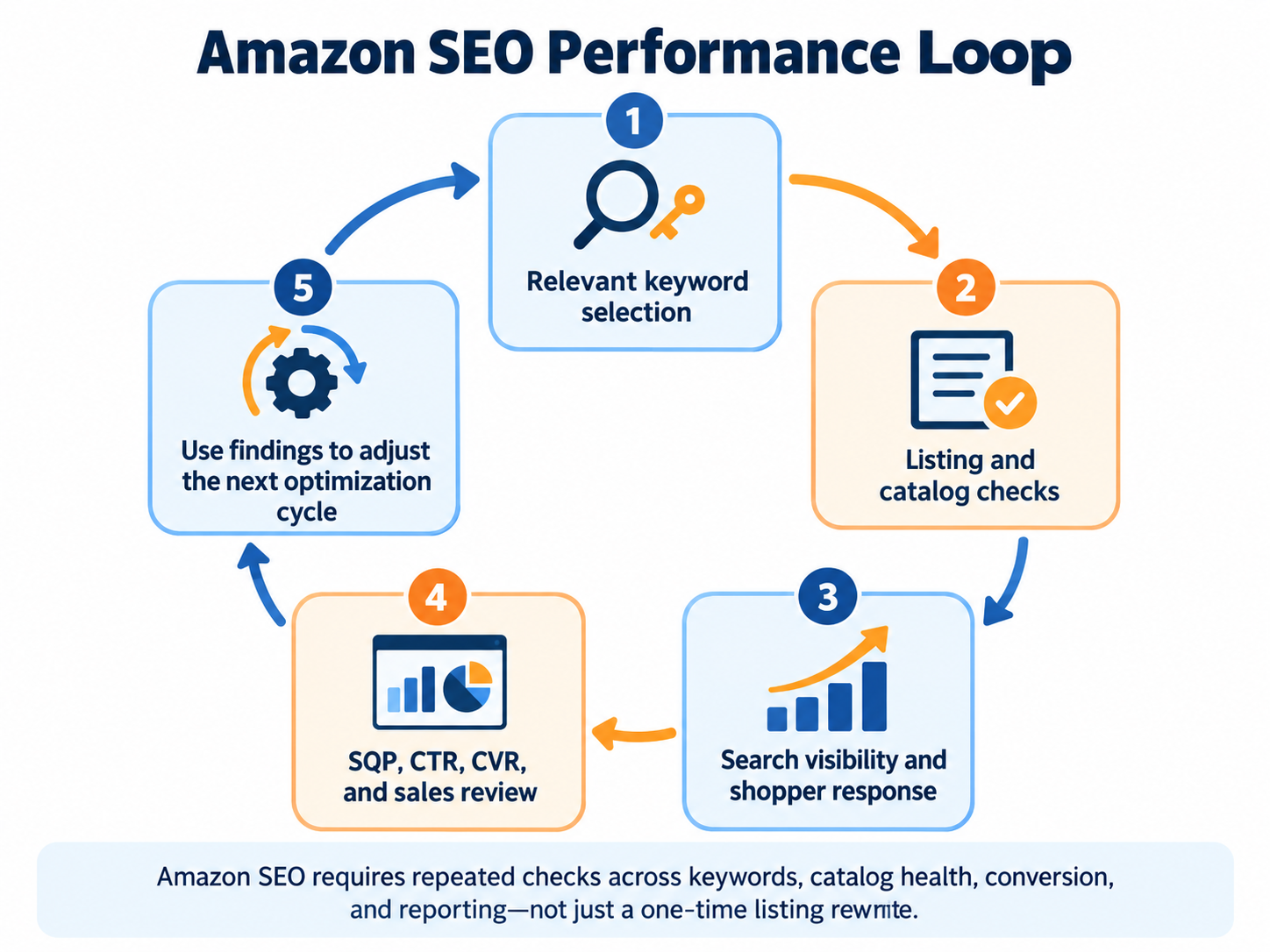
Mistake 3: Confusing Listing Optimization With Ongoing SEO
Listing optimization and Amazon SEO overlap, but they are not the same job.
A one-time optimization effort can fix titles, bullets, images, and backend terms.
However, ongoing SEO builds on the optimization efforts to check if those changes actually made the item more searchable, got more clicks, increased conversion, and took more query ownership, after some time has passed. After a rewrite, a listing may look better, but the real business problem might still remain.
The ASIN may still miss important searches, sit in the wrong browse path, or lose clicks because of weak images.
If your main problem is listing quality, Amazon listing optimization services may be the right fit.
For problems that involve ranking changes, indexing checks, reporting, and continuous testing, you need a more comprehensive SEO process.
Mistake 4: Ignoring Indexing, Browse Classification, and Suppression Issues
Copy changes cannot fix every visibility problem.
If an ASIN is not searchable, is placed in the wrong category, has missing attributes, or is suppressed, better wording may not produce the result you expect. These are catalog health and listing integrity issues, not SEO aspects in the traditional sense.
This may include:
- The backend search terms
- The product attributes
- The browsing classification
- Configuration of parent-child variations
- Issues of compliance
- Listing quality alerts that can restrict visibility
The main question is simple: can shoppers find the product for the right searches after the update?
If a provider only submits revised copy and never verifies whether the ASIN becomes indexed for the priority terms, the underlying visibility problems may still persist.
Mistake 5: Focusing on Rank but Ignoring Conversion
Rank only matters when it brings the right kind of shoppers that click and convert.
A listing can rank for a search and still receive no clicks, add-to-carts, or sales. Ranking and conversion do not depend only on SEO factors such as keywords, indexing, and listing copy; they also depend on conversion-focused elements that influence shopper behavior.
Amazon describes A+ Content as richer product-page content that supports product details and a consistent brand experience.
That is why SEO should not stop at keyword integration.
If shoppers see the listing but do not trust or understand the product, changing keywords alone will not solve the problem.
The provider should connect keyword priorities, images and A+ Content copy with proof points, review gaps, and offer clarity.
For comprehensive creative and conversion support, the SEO plan may need to connect with Amazon creative services.
Mistake 6: Separating SEO From PPC, Inventory, and Account Health
Amazon SEO is seldom effective by itself.
Amazon SEO focuses on organic discoverability, including keyword relevance, listing content, searchability, catalog quality, and performance monitoring. PPC, inventory, and account health have different owners, but their data and operational issues can affect SEO outcomes.
Search data helps identify which terms convert, while inventory levels can affect momentum. In addition, account health may limit what the team can do, and catalog errors can block visibility.
The error is treating SEO as just a content function while other teams handle ads, inventory, catalog, and operations independently.
This creates blind spots. A keyword can appear to be good in research, but PPC might reveal poor conversion rates.
A page may rank well, but low inventory or Buy Box problems may limit sales.
A title may be improved, but catalog controls may stop the change from appearing.
A connected provider should know when to bring in Amazon PPC management, catalog support, inventory planning, or account operations.
This does not mean PPC will always enhance organic rank. It means SEO decisions are better informed by demand, conversion, and inventory signals from the real world.
Mistake 7: Hiring the Wrong Fit: Consultant, Freelancer, Tool, or Agency
The right provider depends on the problem you need to solve.
An Amazon SEO consultant may be enough for a strategy audit or focused keyword plan.
A freelancer may work well for a one-time listing update.
A tool can help with keyword research and monitoring.
An agency may be a better fit when you need to review and monitor all aspects to find out what is working.
Choose the service based on the problem and who owns the work, not just the provider's job title.
If your issue spans SEO, ads, creative, inventory, and catalog operations, a full-service Amazon agency may be a better fit than standalone Amazon SEO consulting.
Mistake 8: Accepting Vague Reports and Rank Screenshots
Rank screenshots can provide useful context, but they do not show business impact on their own.
They do not tell you whether an ASIN is searchable for the right terms, whether CTR improved, whether conversion Increased, or whether organic sales contribution is growing.
A stronger report would tie actions to results. It should indicate what changed, which queries were under focus, how searchability was tested, what became of impressions and clicks, and what the next test will be.
Reporting should also communicate uncertainty.
Certain modifications require more time. Certain information may be missing. There may be some ASINs that need operations work to fix them to allow for better SEO results. Transparent reporting should make clear these boundaries, rather than conceal them behind graphs.
Questions to Ask Before Hiring an Amazon SEO Service
Use these questions before finalizing the decision.
Good answers should be specific, clear, and tied to your catalog rather than generic claims about mastering the algorithm.
- Which Amazon data sources will you use before choosing keywords?
- How will you check whether our ASINs are searchable for priority terms?
- What will you do if the listing copy improves but indexing does not change?
- How do you decide which keywords belong in visible copy and which belong in backend search terms?
- How do PPC search terms, SQP, and conversion data affect your SEO plan?
- What parts of the listing will you review beyond the title and bullets?
- What are the reports we will get?
- How often will you review performance and update the SEO plan?
- Who will handle catalog, creative, or inventory issues that affect SEO results?
- What results can you realistically measure, and what outcomes will you not guarantee?
Watch out for red flags. Be cautious of vendors that guarantee ranking timelines, discuss algorithm hacks, dismiss Amazon guidelines, or don’t tell you how they will track progress.
Get Tailored Help in Amazon SEO
This usually means you need a partner that can connect search terms, indexing, listing quality, creative, PPC data, catalog health, and reporting into one practical growth plan.
If you are seeing weak organic visibility, unclear reporting, or advice that stops at keyword placement, use this article as a checklist before making your next decision.
Book Your 1:1 Growth Call with SalesDuo
Frequemtly Asked Questions about Amazon SEO Service
What Does an Amazon SEO Service Do?
An Amazon SEO service helps improve how products are found, understood, clicked, and purchased on Amazon.
The work can include keyword strategy, listing relevance, searchability checks, conversion review, reporting, and ongoing testing.
What Are the Most Common Amazon SEO Service Mistakes?
Typical errors are keyword stuffing, selecting keywords blindly (without taking Amazon data into account), thinking you can rewrite a listing and that will be your whole strategy, neglecting indexing issues, obsessing about rank and not conversion.
Is an Amazon SEO Consultant Different From an Agency?
Yes.
A consultant tends to focus more on strategy, audits, and guidance. On the other hand, an agency delivers wider, more scalable execution, including copy and creative, PPC, catalog, reporting, and account operations.
The right fit depends on your catalog size and how many teams need to work together.
Does Keyword Stuffing Work on Amazon?
Keyword stuffing is not a sound strategy.
Repeating terms can hurt readability, waste backend space, and still fail to improve searchability.
A better approach uses relevant, non-repetitive terms based on shopper intent.
How Do I Know if My Amazon Listing Is Indexed?
You need to check whether the ASIN appears for the priority searches you are targeting.
Check whether your ASIN appears for relevant shopper searches and review any listing quality, category, or suppression issues in Seller Central. You can use targeted search tests as a diagnostic, but results may vary and should not be treated as definitive proof that a keyword is indexed.
Search Query Performance and advertising reports can show impressions, clicks, and purchases when data is available. However, a query missing from those reports does not necessarily mean the ASIN is not indexed. Ask your provider to explain which checks they use, what each check can confirm, and what remains uncertain.
Should Amazon SEO Use PPC Data?
Yes, when PPC data is available and relevant.
Sponsored Products search terms can show which queries bring clicks and orders. This can help SEO teams choose stronger terms.
PPC data should guide decisions, but it should not be presented as a direct guarantee of better organic rankings.
Is Listing Optimization the Same as Amazon SEO?
No.
Listing optimization improves the visible and backend content on a product detail page.
Amazon SEO also includes searchability, query ownership, conversion signals, performance measurement, and ongoing testing after the listing changes.
How Long Does Amazon SEO Take?
There is no fixed timeline for every ASIN.
Timeline depends on multiple factors, including category, competition, listing history, conversion rate, inventory, account health, ad support, catalog quality, and how quickly changes are approved or indexed.
Avoid providers that promise a guaranteed ranking timeline for every product.
What Should I Ask Before Hiring an Amazon SEO Service?
Ask about data sources, indexing proof, search-term planning, reporting, testing schedule, and issues that fall outside the SEO provider's responsibilities.
Also ask what the provider will not promise.
Clear limits can be a sign of a competent service provider.
About the Author
Meet Aryan Suyal, an SEO Content Writer Intern at SalesDuo who excels at turning patterns into precise, on-point content. He brings sharp insights and analytical thinking, along with a builder's instinct for creating systems that help ideas work smarter. Outside of work, you'll find him getting lost in books, tinkering with and building AI systems, or losing hours to a good documentary.