Amazon Seller Tariffs 2025: How SPAX Navigated Rising Costs with a 58% ASP Price Reset

If you are an Amazon seller dealing with the 2025 tariff increase, this case study shows how SPAX changed its pricing strategy to protect profit margins and continue growing.
Background: The Context and the Challenge
In 2025, U.S. import tariffs were adjusted, leading to greater landed-cost pressure on a wide range of imported goods. Spax’s range of imported fasteners suffered from increased duties, which forced the brand to reconsider its pricing on Amazon.
Brands were mainly left with two difficult choices:
- Absorb the extra costs and accept lower profits.
- Increase prices and risk losing customers and market share.
Many sellers decided to wait and see what their competitors would do before changing prices.
However, the tariff increase forced Amazon brands that depended on imported products to rethink their landed costs and pricing. SPAX was one of those brands.
SPAX is a premium brand known for high-performance fasteners and construction products. Instead of waiting for the market to settle, SPAX decided to act early.
Between Q1 and Q3 of 2025, SPAX increased its average sales price (ASP) from $88.95 to $140.67. This was a 58% increase.
The price increase was necessary to protect margins, but it also created some major risks.
Higher prices can make customers less likely to buy. They can also reduce conversion rates, lower order volume, and increase advertising costs for every sale.
SPAX saw some of these problems soon after the price increase because many competitors had not yet made similar pricing changes.
SPAX partnered with SalesDuo to manage this important transition.
The main goals were to:
- Maintain product buyability.
- Improve advertising efficiency.
- Find higher-value customer groups that would continue buying even at higher prices.
By using data and making quick changes to the Amazon account, SPAX aimed to do more than simply survive the market change. The goal was to come out of it in a stronger position.
Tariff Impact Model: What Amazon Sellers Need to Know
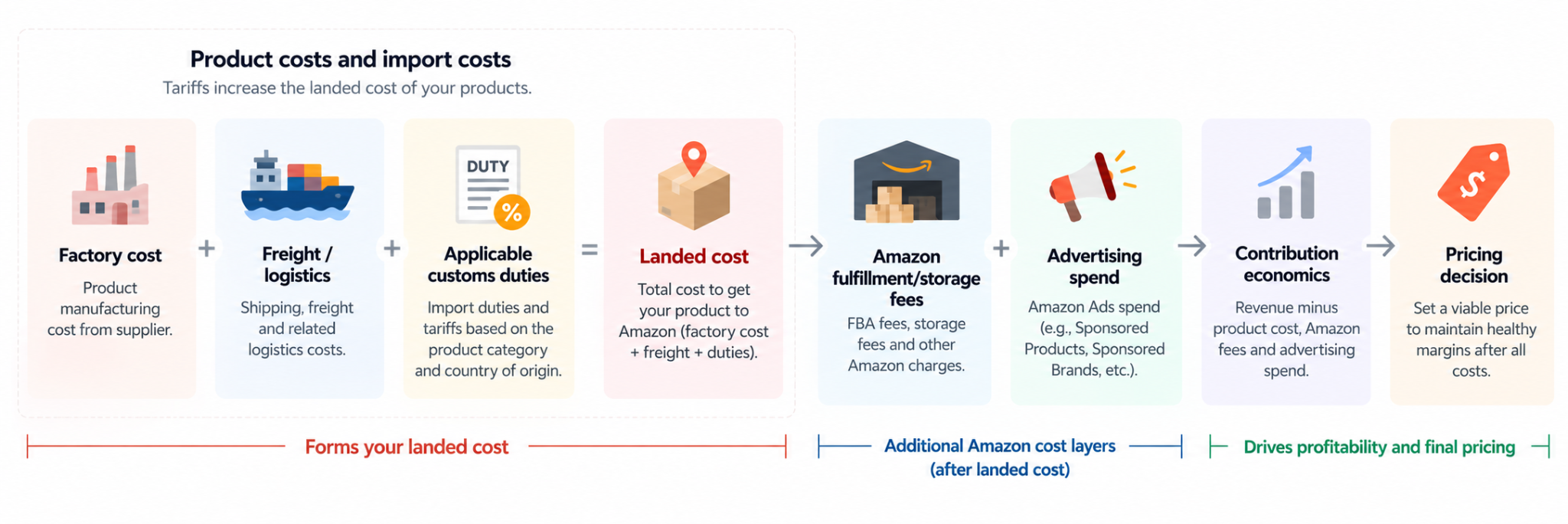
To understand why SPAX needed a mid-year price reset, it is important to understand how tariffs affect Amazon costs.
Even a small tariff increase can raise landed costs, reduce contribution margins, and force sellers to change their pricing.
| Cost Component | Description | Tariff Impact |
|---|---|---|
| Product Cost (Ex-Factory) | Basic manufacturing cost | Unchanged |
| Freight + Import Costs | Freight, port charges, brokerage, customs duties, and related import costs | Applicable customs duties may rise; freight and logistics costs are separate variables |
| Landed Cost | Total product cost before FBA fees | Goes up because of the higher tariff rate |
| Amazon FBA Fees | Fulfillment and applicable storage/service fees | Not directly caused by tariffs; calculate separately from customs duties and landed cost |
| Contribution Margin | ASP – (landed + FBA + ads) | Shrinks unless the ASP is increased |
| Final Pricing Decision | ASP adjustment used to restore margin | Often becomes necessary after a tariff increase |
Why does it matter?
For Amazon sellers importing goods into the US, higher customs duties can increase landed cost before the goods are shipped to Amazon's fulfillment network. These duties and taxes are the responsibility of the importer of record and are independent of Amazon FBA fulfillment fees.
The 2025 tariff increases pushed SPAX’s landed costs higher. Because of this, the brand needed to rethink its pricing strategy before Q3 and Q4 profitability was affected even more.
The Timeline at a Glance
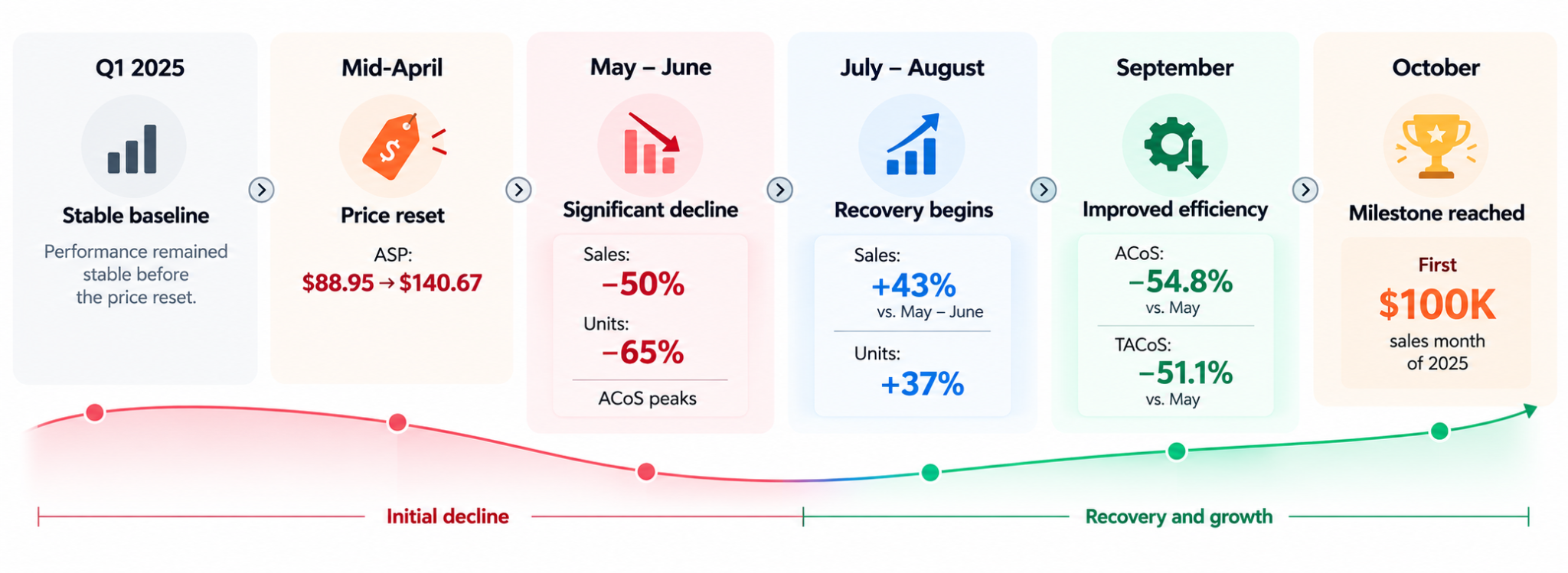
- Q1 (Jan–Mar): Performance was stable before the tariff changes. Sales and advertising metrics were consistent, conversion was predictable, and demand remained steady.
- Mid-Apr: SPAX increased prices. The 2025 U.S. tariff increase on imported fasteners led the team to review landed costs and introduce a mid-year price reset.
- May–Jun: As expected, sales volume dropped. Sales were about 50% lower compared with Q1, while unit sales fell 65%. Advertising also became less efficient, with ACOS reaching its highest point in May.
- Jul–Aug: Recovery started after new campaigns were launched. Sales increased 43%, and unit sales grew 37% compared with May–June. ACOS also dropped sharply, showing that advertising was producing more efficient conversions.
- Sep–Oct: Performance continued to improve. ACOS improved by 55% and TACOS by 51% compared with their May peaks. This showed that SPAX was attracting better-quality traffic and improving advertising efficiency.
- October: SPAX reached its first $100,000 sales month of 2025, making it the strongest month of the year.
- By Q4, SPAX’s total sales had moved above its early-year levels, even though products were selling at a much higher price.
Challenges Faced
SPAX knew that increasing prices would create challenges. However, the immediate impact was larger than expected.
- Price Elasticity: SPAX increased its ASP by almost 50%. This created a risk of losing price-sensitive customers. Early sales data showed a major drop in conversions as customers reacted to the higher prices, especially because competitors had not yet made similar changes.
- Higher applicable import duties increased SPAX’s landed cost per unit.
- Tariff-related cost increases reduced contribution margins and made normal Amazon ACOS targets difficult to maintain.
- Changes in sourcing and higher import duties increased landed costs, forcing SPAX to raise its ASP even though there was a risk of lower conversions.
- Conversion Drop: Advertising performance was affected almost immediately. CPC and ACOS increased sharply in May. This meant SPAX was spending more on advertising while getting a lower return. May became the most expensive advertising period of the year.
- Demand Uncertainty: There was very little past data showing how customers would behave after such a major tariff-driven price increase. SPAX had to understand whether the drop in demand was temporary or likely to continue.
- B2B Blind Spot: A large proportion of SPAX's sales were to businesses and institutional clients. However, its advertising campaigns were primarily geared towards ordinary retail customers. As a result, a key part of its customer base was being underserviced.
- Category Diversification: SPAX’s product portfolio depended heavily on retail-focused SKUs. This made the sales slowdown more painful and delayed the overall recovery.
SalesDuo’s Account Management team quickly started studying SPAX’s order data, customer behavior, and advertising performance to find ways to stabilize sales and begin the recovery.
Solution — How SPAX Responded to Amazon Seller Tariffs in 2025
Part 1: Uncovering the B2B Advantage
The first major opportunity came from studying SPAX’s order data more closely.
SalesDuo found that B2B orders made up almost 23% of SPAX’s total sales.
Even more importantly, the average selling price of these B2B orders was about 42% higher than regular retail orders.
This showed that many of SPAX’s business customers were still willing to buy even after the price increase.
However, SPAX did not have active advertising campaigns designed specifically for B2B customers.
SalesDuo decided to change this.
The team launched B2B-only advertising campaigns focused on the needs of professional buyers.
Instead of using consumer-focused lifestyle messaging, the campaigns highlighted things that mattered more to businesses, such as bulk reliability, technical specifications, efficiency, performance, and compliance standards.
SalesDuo also changed the timing of SPAX’s advertising.
Ads were given more priority during business hours, when contractors and corporate buyers were more likely to be shopping.
Advertising budgets were also moved toward keywords connected with bulk purchases, industrial applications, and professional use.
At the same time, consumer-focused keywords that were performing poorly were gradually reduced.
The results appeared quickly.
- As the B2B campaigns started performing, SPAX’s sales recovered by 43% between the early post-price decline and the recovery period.
- Advertising became much more efficient, with ACOS falling by about 55% from May to September.
- Conversion rates also improved, showing that business customers were much less sensitive to the higher prices than regular retail customers.
This became an important turning point for SPAX.
By focusing on an existing but underused B2B customer base, SPAX was able to make up for some of the decline in consumer demand.
At the same time, the company stabilized sales and improved advertising efficiency.
Part 2: Targeting by Interest — The Farm & Ranch Opportunity
B2B targeting helped SPAX stabilize its high-value sales, but SalesDuo found another important customer group through keyword analysis.
After April, keyword and conversion analysis showed stronger purchase intent around farm and ranch use cases. SalesDuo built campaigns around rural, agricultural, and farm-and-ranch buying intent.
These buyers appeared to care less about price.
Instead, they were more interested in product reliability, consistent supply, durability, and the ability to buy the quantities they needed.
SalesDuo created Sponsored Products, Sponsored Brands, and Sponsored Display campaigns around farm-and-ranch buying intent, supported by relevant search terms and product-use messaging.
Search terms were adjusted to target rural and agricultural buying intent.
The creative strategy was also changed.
Instead of using only standard catalog-style images, SalesDuo focused more on practical product benefits such as weather resistance, strength, and ease of use.
Visuals also started showing products in real working environments, so they connected better with farm and ranch customers.
The results came quickly.
- Sales became more stable during the recovery period, helping SPAX achieve a 43% increase in total sales from May–June to July–August.
- Advertising efficiency continued to improve as ACOS fell and campaigns attracted more qualified customers with stronger buying intent.
This stage showed that growth was not only about changing prices or ad placements.
Relevance also mattered.
By following the data, SalesDuo helped SPAX move away from competing mainly on price and instead focus on why its products were valuable to specific customer groups.
Part 3: Continuous PPC Optimization and Portfolio Lift
Once sales became more stable, SalesDuo moved into the next stage: continuous improvement.
The goal was not simply to recover sales for a short period.
The team wanted to create a strategy that could continue working over time.
SalesDuo introduced a regular optimization process that included weekly performance reviews, bid adjustments, and testing new keyword groups.
Three main areas became the focus:
- Keyword restructuring: SalesDuo regularly added negative keywords and improved match-type control. This helped stop wasted advertising spend and gave more budget to search terms that were actually generating sales.
- Campaign layering: New targeted campaigns were created for SKUs that had previously performed poorly. This gave each product advertising visibility based on its profit potential.
- Budget governance: Advertising budget was shifted toward the ASINs responsible for roughly 80% of the strongest account performance. This helped improve ROI and increase sales velocity across the catalog.
Read more on the above at: Amazon Advertising Benchmarks: Key Metrics, Insights & How You Stack Up.
The data clearly showed the results.
- TACOS improved by 33.5% from Q2 to Q3, showing that advertising spend was becoming healthier compared with total sales.
- ACOS dropped by 55% between May and September, making this one of the most efficient advertising periods of the year.
- Month-over-month sales growth remained positive throughout Q3, creating a strong base going into Q4.
This continuous optimization became an important part of SPAX’s recovery.
The results did not come from one short-term tactic.
Instead, SalesDuo used a structured and ongoing strategy that helped SPAX continue growing even with an average selling price that was approximately 58% higher than the Q1 level.
The Results
By the end of Q3 2025, SPAX’s recovery could clearly be seen across its most important performance metrics.
The results showed how customer segmentation, smart advertising, and disciplined account management helped the brand recover.
SPAX’s average selling price increased from $88.95 in Q1 to $140.67 in Q3, an increase of approximately 58%.
At first, the higher prices created the expected problems.
Between January–March and May–June, sales fell by around 50%, while unit sales dropped by 65%.
Customers needed time to adjust to the higher prices.
However, SalesDuo’s targeted advertising campaigns and audience segmentation helped reverse the decline.
From May–June to July–August, sales increased by 43%.
Unit sales also increased by 37%, showing that customer demand was returning.
By focusing on higher-value B2B customers and farm and ranch audiences, SPAX was able to recover sales while supporting the higher-price strategy.
Advertising performance also improved.
ACOS fell by 54.8% between May and September.
TACOS dropped by 51.1% over the same period.
From Q2 to Q3, overall TACOS improved by another 33.5%.
These improvements showed that the advertising-efficiency gains continued beyond the initial recovery period.
SPAX’s B2B customers continued to play an important role.
On average, B2B sales represented 23% of total sales.
B2B orders also had an ASP that was about 42.6% higher than regular retail orders.
Because this customer group remained stable, it helped reduce the impact of weaker performance in other sales channels and provided SPAX with a more reliable source of revenue.
By October, SPAX achieved its first $100,000 sales month of 2025.
It was the company’s highest monthly revenue of the year.
More importantly, SPAX entered Q4 with higher total sales than it had in Q1, even though its ASP was approximately 58% higher than the Q1 level.
This showed that strong customer segmentation and careful advertising management can help brands overcome price sensitivity.
The continued improvement in ACOS and TACOS also confirmed that the recovery was not temporary.
SPAX had created a more efficient and scalable Amazon advertising strategy.
Key Takeaways
- Account intelligence matters: Finding that B2B customers generated 23% of total sales allowed SalesDuo to quickly move more attention toward a customer group that was less affected by the price increase.
- Targeting drives resilience: The Farm and Ranch campaigns showed that targeting the right audience can help maintain demand even when prices increase significantly.
- Optimization compounds: Regular bid adjustments, negative keyword harvesting, and campaign layering created long-term improvements instead of short-term results.
- Growth at higher ASPs is possible: SPAX proved that brands can continue increasing revenue even after major price increases when they have the right customers, strong data, and controlled advertising.
SPAX’s experience shows why good data and the ability to act quickly matter.
With SalesDuo’s support, a major pricing challenge became an opportunity for growth.
The case study shows how data-driven advertising and customer targeting can help brands turn market disruption into a long-term advantage.
Client Testimonial
"SalesDuo has been an exceptional partner for our Amazon business. Their team brings strong expertise across multiple areas — from operational support to listing optimization, strategy development, and advertising execution. We’ve seen meaningful improvements across several key metrics since partnering with them.
A special callout to our account manager, Devashish Mishra, who continues to exceed expectations. He is organized, proactive, and consistently goes above and beyond to keep our projects moving. Devashish handles multi-level initiatives with ease, provides clear communication, and brings thoughtful recommendations that make a real impact. His advertising support, in particular, has been fantastic — data-driven, detailed, and aligned with our business goals.
“If you’re looking for a reliable, knowledgeable Amazon partner that feels like a seamless extension of your team, I highly recommend SalesDuo. Their support has been excellent, and Devashish is truly top-notch."
— Stephanie Feyen, SPAX eCommerce Manager
Facing a similar market shift?
Let SalesDuo’s data-driven account management team help you turn pricing problems into growth opportunities.
Our team works with brands to find new revenue opportunities, improve advertising efficiency, and maintain profitability when the market changes.
The SPAX tariff case puts price resets in context, while a full-service Amazon agency can coordinate related advertising, content, and operational changes.
Frequently Asked Questions
What was the main challenge SPAX faced during the mid-year tariff shift?
SPAX faced higher costs and changing customer demand. The company needed an effective mid-year price reset to protect its margins while keeping sales stable.
How did SalesDuo support SPAX with their Amazon pricing strategy?
SalesDuo improved customer targeting, made advertising more efficient, and helped SPAX build an Amazon pricing strategy that protected revenue even as costs increased.
What was the biggest outcome of SPAX’s mid-year price reset?
The mid-year price reset helped SPAX recover sales, lower ACOS, and grow revenue even while selling products at a much higher average price.
About the Author
A passionate brand strategist and customer success manager, Devashish Mishra helps brands thrive on Amazon. With a unique blend of hospitality experience and an IIM education, he brings a fresh, customer-first mindset to eCommerce. Outside work, Devashish enjoys jamming on his guitar and discovering new music vibes.