Amazon Launch Stack 2026: The 90-Day Tool-by-Tool Playbook for New Products

In 2026, launching a product on Amazon isn’t a checklist. It's a Tower of interlocking Tools, each enabled at a certain point in a 90-day timeline. It’s important because each layer builds on top of the preceding layer: A listing must be “finished” before you start buying traffic, review programs require lead time, and outside campaigns require tracking in place before the first click.
Strong operators know which tool to use, at what point to trigger it, and what signal to wait for before moving on to the next step. Late Vine enrollment, premature creator outreach, or post-spend-added attribution tags can all waste the launch window.
This guide starts where the complete Amazon product validation framework ends. Once market demand, differentiation, product experience, and ad readiness have passed their gates, use the SalesDuo Amazon Launch Stack to coordinate listing assets, compliant review collection, PPC, creator activity, external traffic, and consolidation across the next 90 days.
The operating principle: Sequencing is the launch strategy. Do not activate a tool because the calendar says so; activate it when the preceding success signal is present.
What Is the Amazon Launch Stack?
The SalesDuo Amazon Launch Stack is the suite of products, campaigns, and programs a brand leverages in a step-wise manner to establish listing readiness, initial demand, review credibility, measurable traffic, and long-term economics in the first 90 days. It consists of 5 stages: pre-launch foundation, soft launch, PPC scale, external traffic, and consolidation.
There is a day range, a main operative goal, tools to use, and an indicator of success for each stage. The date range is a planning window; no license to disobey the sign. Day 15 conversion is poor? Don’t scale Sponsored Brands just because the calendar says so. Fix the offer, the detail page, or the traffic quality – in that order.
The SalesDuo Amazon Launch Stack: five-phase overview
| Phase | Days | Goal | Primary tools | Success signal |
|---|---|---|---|---|
| Phase 0 — Pre-Launch | Day -30 to Day 0 | Complete the listing, inventory, measurement, and review setup before paid traffic. | SalesDuo AI Creative Studio; Amazon Vine; private product testing; keyword research tools. | Listing, images, A+ Content, attributes, inventory, measurement, and review setup are ready. |
| Phase 1 — Soft Launch | Day 0–14 | Establish a conversion baseline without committing the full budget. | Sponsored Products discovery and manual campaigns; Vine; private feedback monitoring. | Sales, review, BSR, search-term, and CVR baselines are usable. |
| Phase 2 — PPC Scale | Day 15–45 | Scale terms and placements that demonstrate conversion. | Sponsored Products exact and phrase; Sponsored Brands; Request a Review. | ACoS, rank, review count, and conversion improve. |
| Phase 3 — External Traffic | Day 30–60 | Add measured off-Amazon demand after conversion is proven. | Creator Connections; Amazon Attribution; Brand Referral Bonus. | Creator activity, tagged sales, and BRB eligibility are measurable. |
| Phase 4 — Consolidation | Day 60–90 | Protect rank, reduce paid dependence, and test with sufficient traffic. | Request a Review automation; Manage Your Experiments; PPC budget reallocation. | TACoS improves; rank and conversion hold after spend changes. |
Phase 0 (Day -30 to Day 0): Build the Launch-Ready Foundation
Pre-launch is the most leveraged phase since every subsequent metric is filtered through the product detail page. Traffic can’t make up for unclear positioning, missing attributes, weak images, or an offer that doesn't explain what makes the product different.
Complete the listing and creative system
Use for SalesDuo AI Creative Studio for Amazon listings to build the first coordinated draft of the title, bullets, product description, detail-page image plan, and A+ Content direction. The output still needs human review for product accuracy, category rules, claim substantiation, and visual consistency.
Finish the intended image sequence before launch. The Amazon detail page image guide explains how to assign a clear job to each image slot, while the Amazon A+ Content complete guide covers the modules and content needed below the fold. The goal is one consistent product story, not separate assets written by separate teams.
Fill in all applicable catalog fields including: material, dimensions, compatibility, included parts, intended use, variation information, and category-specific information. Amazon’s COSMO research and Rufus material demonstrate how full, precise product context is critical for shopping systems and consumers.
A weak launch listing doesn’t mean it’s a forever handicap. That statement is not substantiated by Amazon’s public documentation. Think of completeness before Day 0 as an avoidable-risk principle: you want your initial consumers, advertisers, and review writers to get the most accurate and complete version of the detail page.
Set up compliant review and feedback paths
Enroll in Vine as soon as the ASIN is eligible, the detail page is accurate, and FBA inventory is available – ideally before launch to allow time for product claims, delivery, use, and review. Amazon charges by enrollment tier, including a $200 tier for 11–30 units.
Use the Amazon Vine program guide for sellers for eligibility, fee tiers, inventory requirements, and enrollment mechanics. Do not wait until the ASIN is close to 30 reviews, because Vine eligibility is tied to the product’s review count at enrollment.
Private product testing can begin pre-launch to discover any product, packaging, instruction, or listing issues. Just keep that separate from Amazon review creation. Amazon consistently disallows third-party services that link free or discounted products, refunds, or reimbursement with an Amazon review. Gather private feedback for product market fit decisions; defer to Amazon-approved review channels for public reviews.
Lock the launch measurement plan
Finalize the desired keyword clusters you want for your Day 0 campaigns. Distinguish between broad discovery terms, product targets, and high-confidence primary terms. Determine your break-even ACoS, max CPC, launch loss tolerance, inventory stop point, and daily budget in advance of your first campaign going live.
Make Amazon Attribution tags before doing any off-Amazon activity. Should be good now, even if outside traffic is planned for Phase 3 - tags, naming conventions, and responsibility should be established now. Post-click measurement cannot retrace the original campaign route.
Phase 1 (Day 0–14): Soft Launch — Build Velocity Without Wasting Budget
The first 14 days are for harvesting controlled data, not for optimizing profit. Launch with enough traffic to learn which queries and targets convert, but keep the budget bounded until the listing has a reliable conversion baseline.
Run discovery and relevance campaigns together
Apply an automated or broad-match discovery layer to discover search queries, along with a manual campaign for a handful of high-confidence keywords. Be competitive on bids to get impressions, but don't pay for top-of-search placement on every term. The objective here is to identify where the product is naturally getting clicks and orders, not to purchase a fake rank position regardless of cost.
Check the search terms every two or three days. Exclude obviously irrelevant queries, keep useful discovery traffic, and mark converting queries for exact or phrase campaigns (Phase 2).
Watch the first success signals
Monitor sessions, click-through rate, conversion rate, units ordered, BSR movement, search-term orders, and contribution margin after ad spend. Interpret these metrics in unison. High traffic, poor conversion could be the listing, price, offer, or review gap. Low traffic, high conversion means it's a visibility/bid coverage issue.
If Vine was signed up early and units were claimed, the first Vine reviews may start rolling in during this window. Don't guarantee a number or when it will be published. If things are slow, check enrollment status, FBA inventory, claim activity, and listing eligibility; don’t escalate spend.
Identify repeated private-feedback themes to resolve dimension, setup, included-component, or expectation gaps before scaling. Never filter public review requests by feedback sentiment.
Phase 2 (Day 15–45): PPC Scale — Amplify What Has Proven It Can Convert
Scale only after the soft-launch data identifies viable terms, targets, and placements. Phase 2 moves budget from exploration into controlled expansion while preserving a discovery layer for new search behavior.
Graduate winners into controlled campaigns
Start pushing search terms to exact and phrase campaigns with specific budgets and bids by placement. Add competitor product targeting when the product has a believable comparison advantage. Sponsored Brands should only be launched once you have an active Brand Registry, your creative is prepared, and the Sponsored Products data indicates that the detail page is capable of converting relevant traffic.
Keep this section focused on launch triggers. For campaign types, harvesting rules, placement logic, and bid management, use the Amazon PPC strategy guide and the Amazon PPC launch checklist.
A realistic launch budget can be 15-25% of your target monthly sales, depending on the margin, conversion, CPC, inventory, and rank targets you have set, but the actual figure is controlled by the influence of those goals. Consider the range as more of a planning envelope, not as a rule applicable in every situation.
For SalesDuo, the July 2026 planning benchmark is $0.91 per click for the portfolio sample used for this brief. Do not use that number as a bid target. Compare your account to Amazon Ads category benchmarks, then work out what CPC your own conversion rate and contribution margin can sustain.
Activate compliant review requests
Amazon’s Request a Review feature becomes available five days after delivery and remains available through Day 30 after delivery. It may be used once per eligible order. The brief’s Day 4 instruction has been corrected to match Amazon’s current published window.
Use the Amazon Request a Review complete guide to define the team workflow. Automation should trigger Amazon’s standard request through an authorized integration; it should not rewrite the message, selectively target satisfied buyers, or use browser automation that creates account risk.
On Day 45, go for at least ten reviews at the target, enhancing conversions and rank movement for a few main terms. These are planning gates, not Amazon rules - adjust them for category and product economics.
Phase 3 (Day 30–60): External Traffic — Add BRB-Eligible Channels
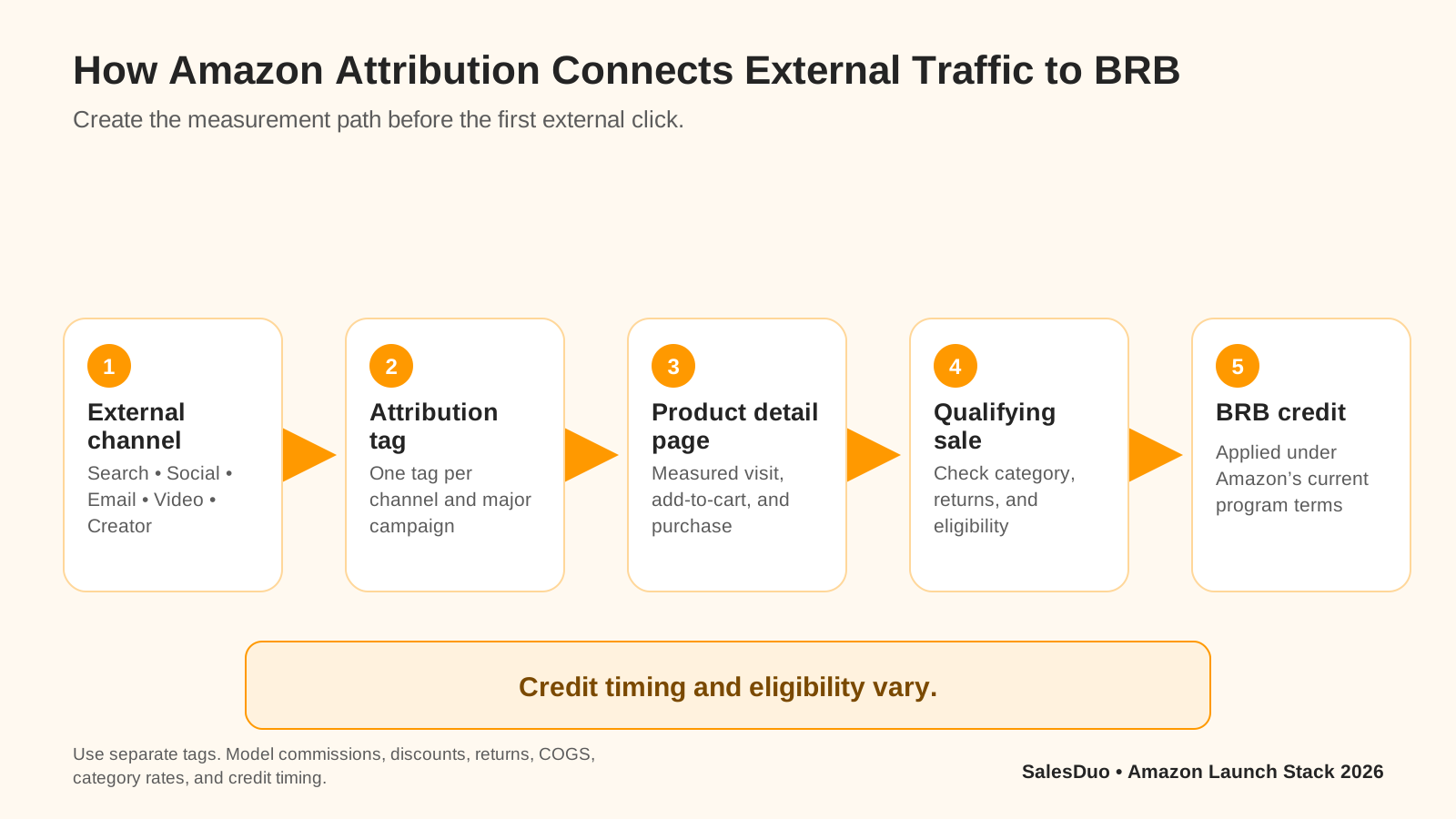
Introduce outside traffic only once your detail page is converting relevant Amazon traffic. Readiness — not some arbitrary review number — is the trigger for activation.
Use Creator Connections as a performance-based channel
Creator Connections lets a brand set a budget, commission, eligible products, and campaign period. Creators may opt in, but Amazon does not guarantee participation, format, or product-page placement. Use the Amazon UGC strategy guide to plan briefs, assets, messaging boundaries, and content reuse.
Start when the detail page and margin can afford the fee. Judge Accepted Creators, Published Content, Attributed Sales, Effective Commission Cost, and Incremental Contribution—Not Invitations Sent.
Tag every external path before launch
Use Amazon Attribution for search, social, display, video, email, and creator traffic. Build a separate tag for each channel and major campaign so you can distinguish clicks, detail-page views, add-to-carts, and purchases.
Eligible US seller brand owners can earn a Brand Referral Bonus averaging about 10% of qualifying sales. Read the Amazon Brand Referral Bonus complete guide for setup.
A 10% creator commission is not "net zero" given that BRB is also taking about 10%. Margins, returns, discounts, samples, COGS, and timing of credit still impact contribution.
Don’t promote unpublished “A10” ranking benefits. Tagged campaigns may generate incremental sales and measurable acquisition data; watch for any organic uplift rather than promising it.
Phase 4 (Day 60–90): Consolidation — Protect Rank and Build the Moat
Consolidation starts once the launch generates sufficient volume and order history to separate the signal of repeatable performance from the noise of the short term. The goal changes from doing everything to maximum velocity to achieving sustainable contribution, consistent organic visibility, and more efficient use of every paid dollar.
Move from launch ACoS to sustainable TACoS
Step down bids and budgets gradually. After every adjustment, observe whether natural sales, keyword rank on the first page, and conversion have stabilized. The key health metric is TACoS—ad spend as a percentage of total sales—because it indicates whether organic sales are growing faster than paid reliance.
Make TACoS below 15%, top ten rank, and at least 25 reviews as planning gates, not Amazon standards. Adjust for margin, stock, category, and strategic intent.
Test only when the traffic can support a decision
Use “Manage Your Experiments” when you have enough traffic. Test a single variable/hypothesis at a time keep your prices and inventory constant if you can, and wait for the results.
Keep “Request a Review” for every eligible order through the approved workflow. It’s not possible to re-enroll in Vine once an enrollment has at least one claimed unit, so we removed language about “re-enroll if needed” in the brief. Build the review moat with eligible orders, a superior customer experience, and Amazon-compliant requests for reviews.
Your launch is complete when: conversion is stable at the planned traffic level; primary keyword rank holds after controlled spend reductions; TACoS is moving toward the margin target; review requests run compliantly; and inventory, pricing, and creator or external campaigns can be managed as an ongoing growth system rather than an emergency launch sprint.
The 2026 Factors That Change Amazon Launch Strategy
There are four 2026 changes that matter for operations: review sharing is more limited across variations, AI-assisted shopping makes full product context more important, CPC planning requires category-level benchmarks, and Creator Connections is now a quantifiable campaign product (rather than a casual outreach method).
1. Review sharing is limited to minor variation differences
From February 12, 2026, Amazon narrowed review sharing across product variations to products with minor differences that do not affect functionality, such as eligible color, pattern, size, or pack-quantity variations. Functionally different child ASINs should be planned as separate review journeys. Do not assume every child needs separate reviews; check the variation family against Amazon’s current eligibility guidance.
For launch planning, audit the parentage before enrollment and use the Amazon variation review sharing policy 2026 section in the Vine guide. If children differ in function, formula, compatibility, or meaningful product experience, forecast review credibility at the child level.
2. Rufus and COSMO reward usable product context
Amazon has yet to release an official Rufus checklist for sellers. The practical answer is to fill in the correct attributes, describe use cases, provide dimensions and compatibility, and, in visible copy and images, answer common questions from buyers.
3. CPC planning must use live category benchmarks
A single marketplace-wide CPC average is not enough for a launch budget. Amazon Ads now provides category benchmark reporting in Campaign Manager and reports. Use those peer benchmarks alongside your own break-even CPC, conversion rate, placement mix, and seasonality.
4. Creator Connections requires campaign economics, not hope
Budgets, rates, duration, products, participation, and ROAS reporting have now been established for Creator Connections. Establish a margin cap on commission and judge quality of content independently from sales attributed.
The 2026 Amazon Launch Tool Stack: Activation Reference
Use this as your working table. Timing is a default schedule; the activation trigger and success signal will override the date if performance is not yet ready.
Tool stack reference table
| Tool | When to activate | Launch job | Cost model | 2026 operating note |
|---|---|---|---|---|
| SalesDuo AI Creative Studio | Day -30 | Create coordinated listing copy, image drafts, and A+ direction. | SalesDuo service pricing. | Human review is required for accuracy, claims, rules, and final quality. |
| Amazon Vine | As soon as eligible; target Day -14 or earlier | Generate honest reviews through Amazon’s official program. | $0, $75, or $200 enrollment tier, plus inventory and fulfillment costs. | Timing is not guaranteed; review sharing depends on eligible variations. |
| Private product testing | Before Day 0 | Find product, packaging, instruction, and listing problems. | Program and sample costs. | Keep compensation separate from Amazon reviews; use private feedback only. |
| Sponsored Products | Day 0; scale after Day 15 | Discover converting terms and build measured visibility. | CPC auction with daily budgets. | Use category benchmarks and your break-even CPC. |
| Sponsored Brands | After conversion data exists | Expand branded visibility and search coverage. | CPC auction; Brand Registry required. | Activate when the PDP converts and creative has a clear role. |
| Request a Review | 5–30 days after delivery | Send Amazon’s standard request once per eligible order. | Free; authorized integrations may charge a subscription. | Do not customize, filter, or send outside the window. |
| Creator Connections | Around Day 30, after conversion is proven | Run a budget-and-commission creator campaign. | Brand-set commission and budget; optional sample costs. | Participation, format, and placement are not guaranteed. |
| Amazon Attribution + BRB | Before any external click | Measure external traffic and earn eligible credits. | Attribution is free; BRB credit averages about 10% of qualifying sales. | Tag before spend; model the lag and category rate. |
| Manage Your Experiments | Day 60+ with sufficient traffic | Test one listing element with eligible traffic. | Free for eligible Brand Registry accounts. | Use after the baseline is stable; avoid overlapping tests. |
The Complete Amazon Launch Stack Checklist: Pre-Launch to Day 90
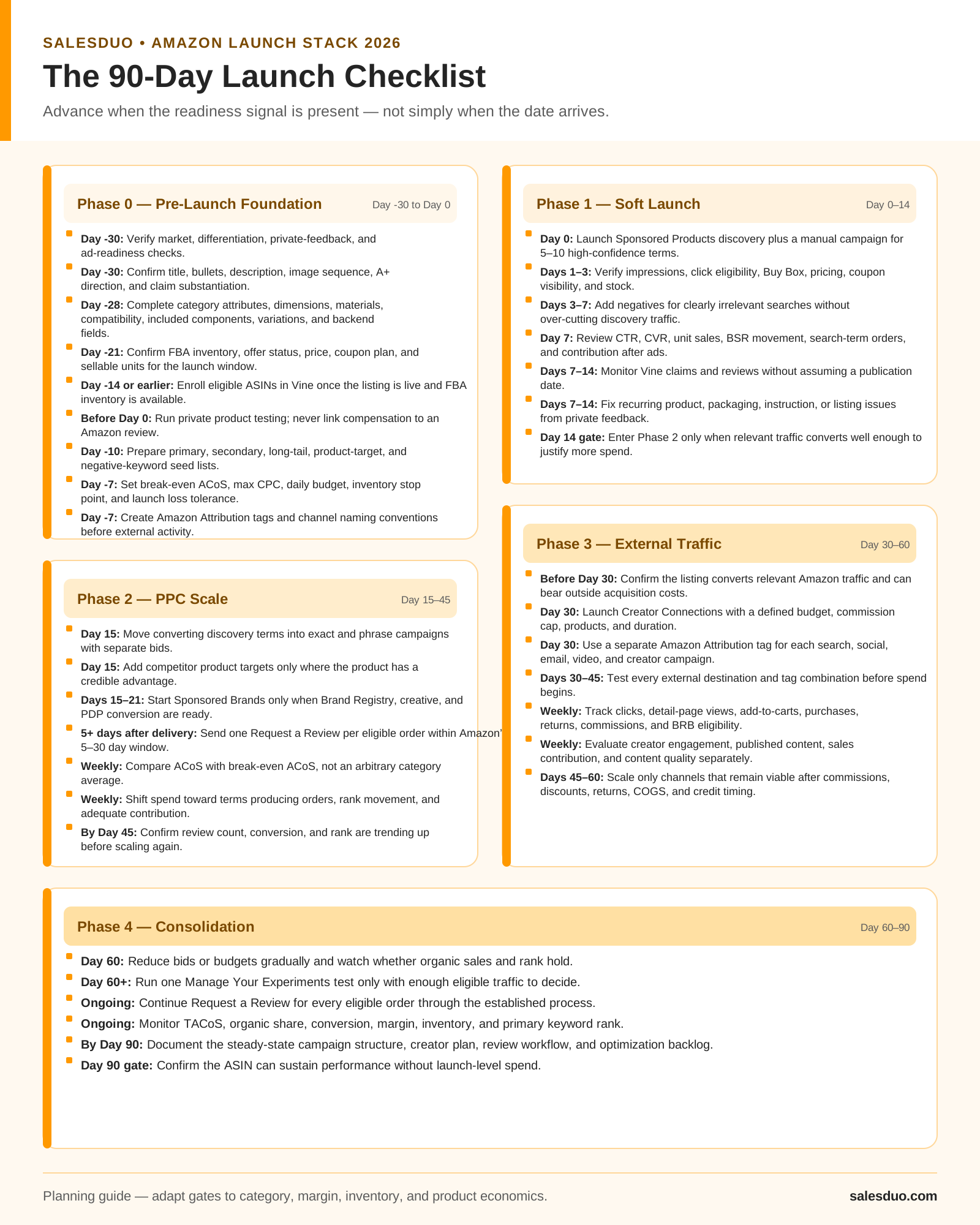
This checklist is designed to stand alone. Do not advance a phase because the date arrived; advance when the listed readiness and success signals are present.
Phase 0 — Pre-Launch Foundation
- [Day -30] Verify the product has passed through the market, differentiation, private-feedback, and ad-readiness checklists.
- [Day -30] Confirm title, bullets, description, intended image sequence, A+ Content direction, and claim substantiation . of description during which you can make changes to title, bullets, description, and intended image sequence.
- [Day -28] Fill in category attributes, dimensions, materials, compatibility, included components, variation data, and backend fields.
- [Day -21] FBA Inventory, Offer Status, Price, Coupon Plan, and enough sellable units for the full launch window - make sure you have availability!
- [Day -14 or earlier] When the listings are live and with FBA inventory, go ahead and enroll eligible ASINs in Vine.
- [Before Day 0] Conduct private product testing for feedback on your product and listing; do not link compensation to an Amazon review.
- [Day -10] Get the primary, secondary, and long-tail product-target and negative-keyword seed lists ready.
- [Day -7] Specify break-even ACoS, max CPC, daily budget, inventory stop point, and launch loss tolerance.
- [Day -7] Before any external activity, create Amazon Attribution tags as well as channel naming conventions.
Phase 1 — Soft Launch
- [Day 0] Turn on Sponsored Products discovery and create a manual campaign for the five to ten terms you are most confident about.
- [Days 1-3] Verify impressions, click eligibility, Buy Box possession, pricing, up to 3 coupons visibility, and stock availability.
- [Day 3 to 7] Add your negatives for totally off-base searches, without cutting off too much of your valuable discovery traffic.
- [Day 7] Analyze the CTR, CVR, unit sales, BSR changes, search-term order, and ad contribution after ads for the day.
- [Day 7-14] Monitor Vine claim/review activity; this is not a guarantee of publication date.
- [Day 7-14] Remediate recurring product, packaging, instructions, or listing issues notified via private feedback.
- [Day 14] Permit Phase 2 only if the right traffic is converting sufficiently to make additional spend worthwhile.
Phase 2 — PPC Scale
- [Day 15] Transfer convert discovery terms to exact/phrase campaigns with different bids.
- [Day 15] Insert competitor product targets for which the product has a valid competitive advantage.
- [Day 15–21] Only start Sponsored Brands when Brand Registry, creative, and PDP conversion are good to go.
- [Day 5+ after each delivery] Hash out one Request a Review per eligible order in Amazon’s 5–30 day window.
- [Weekly] Contrast ACoS against break-even ACoS rather than contrasting it to some arbitrary category average.
- [Weekly] Allocate more spend to terms that generate orders, prop rank movement, and adequate contribution.
- [By Day 45] Make sure your review count, conversion, and rank are trending up before increasing the budget once more.
Phase 3 — External Traffic
- [Before Day 30] Make sure the listing converts relevant Amazon traffic and can bear creator or outside acquisition expenses.
- [Day 30] Launch Creator Connections campaigns with a set budget, commission cap, product list, and duration.
- [Day 30] Apply a different Amazon Attribution tag for each search, social, email, video, and creator campaign.
- [Day 30–45] Test all external destination and tag combinations prior to spend.
- [Weekly] Monitor attributed clicks, detail-page views, add-to-carts, purchases, returns, commissions, and BRB eligibility.
- [Weekly] Assess creator engagement, published content, sales contribution, and content quality individually.
- [Day 45–60] Scale only those channels that are still viable after commission, discounts, returns, COGS, and credit timing.
Phase 4 — Consolidation
- [Day 60] Gradually decrease bids or budgets and monitor if organic sales and rank hold.
- [Day 60+] Begin one of your Manage Your Experiments tests only when you have sufficient eligible traffic to make a decision.
- [Ongoing] Begin to Request a Review for any order that is eligible through the established process.
- [Ongoing] Monitor TACoS, organic share, conversion, margin, inventory, and a single rank.
- [By Day 90] Capture documentation of the steady-state campaign structure, creator plan, review workflow, and optimization backlog.
- [Day 90 gate] Verify the ASIN can sustain performance without day one spend before considering the release as done.
From Launch Sprint to Repeatable Growth System
A successful Amazon launch combines a complete detail page, compliant review paths, measured advertising, tagged external demand, and disciplined consolidation. The timeline creates rhythm; the success signals decide when to move forward.
Executing the full 90-day launch stack — AI Creative Studio for listing build, Early Reviews for Day 0 feedback, Vine for first review credibility, Creator Connections for PDP video, and BRB-optimised external traffic campaigns across five coordinated tools simultaneously is a full-time job. SalesDuo's Starter Launch Program manages every layer for brands at any scale, with Ethan (our proprietary AI engine) handling listing optimization and our ex-Amazon team managing the rest.
After your 90-day launch, an Amazon marketing agency can review sales alongside controlled ad spend reductions before planning the next round of marketing.
Frequently Asked Questions About Amazon Product Launch Strategy 2026
What is the best Amazon product launch strategy in 2026?
The best 2026 launch strategy is a sequenced 90-day system: complete the listing and measurement setup, establish conversion with controlled Sponsored Products traffic, scale proven terms, add tagged external channels, and reduce paid dependence only after performance stabilizes.
How much do I spend on Amazon PPC during a product launch?
A practical planning range is 15–25% of target monthly revenue, bounded by contribution margin, break-even ACoS, conversion, inventory, and category CPC. Use Amazon Ads benchmarks and your own maximum CPC.
When should I enroll in Amazon Vine for a new product launch?
Enroll as soon as the ASIN is eligible, the listing is accurate, and FBA inventory is available. Day -14 is a lead-time target, not a publication guarantee. Do not wait until the ASIN approaches Vine’s review-count limit.
How does the Brand Referral Bonus help during an Amazon product launch?
Eligible US seller brand owners can receive a credit averaging about 10% of qualifying sales measured through Amazon Attribution. Include the category rate, eligibility, returns, and credit timing in the channel profit model.
How long does an Amazon product launch take to see results?
Traffic, conversion, and search-term signals can appear within two weeks, but a full evaluation usually needs 60–90 days. Rank stability, review credibility, TACoS, and performance after controlled spend reductions determine sustainability.
About the Author
Meet Aryan Suyal, an SEO Content Writer Intern at SalesDuo who excels at turning patterns into precise, on-point content. He brings sharp insights and analytical thinking, along with a builder's instinct for creating systems that help ideas work smarter. Outside of work, you'll find him getting lost in books, tinkering with and building AI systems, or losing hours to a good documentary.