Amazon Product Launch Agency Case Study: 90-Day Launch Results
This Amazon product launch agency case study shows how SalesDuo helped an unnamed US small kitchen appliances brand launch a three-variant waffle maker range on Amazon.com.
The brand started with no reviews, no sales history, a long China-to-US supply chain, and a small ad budget.
The launch ran from April 1 to June 30, 2026. Pre-launch work started in February. Monthly sales grew from $1,599.90 in April to $9,259.78 in June. Overall TACoS was 7.4%.
However, these results do not prove that the launch was profitable or delivered positive ROI. The source data doesn't include all the cost and margin details needed to confirm that.
Results at a Glance
SalesDuo managed pre-launch setup, compliant review building, advertising, B2B pricing, and reporting.
The goal was to grow demand without letting ad costs grow faster than the product could support.
Important: These results describe one past client project. They do not guarantee the same results for another brand. Results can change based on category, price, margin, inventory, competition, offer quality, and execution time.
The Launch Challenge
This product could not succeed by simply creating a listing and waiting for sales.
The team had to solve several problems before increasing traffic and ad spend.
- Brand Registry was blocked under the original brand name, so the company had to rebrand before launch.
- Inventory shipped directly from China to FBA. Lead times were two to three months, so the team had little room to fix inventory problems quickly.
- The products were bulky, which increased China-to-US freight costs and squeezed margins.
- The brand started with zero reviews in a competitive category.
- The ad budget was small, so the team had to test traffic carefully before spending more.
SalesDuo treated launch readiness as a key step, not just a box to check. Its framework for validating an Amazon product before launch explains why teams should check product demand, buyer response, product fit, and ad readiness before sending more traffic to the listing.
What SalesDuo Did During the Launch
SalesDuo did not treat the launch as one big advertising push.
The team first fixed the brand setup and planned the product economics. Then it focused on reviews, tested paid traffic, and increased spend only after more conversion data became available.
For a broader explanation of launch basics, see the Amazon product launch guide. This case study focuses only on what happened in this launch and what the results can and cannot prove.
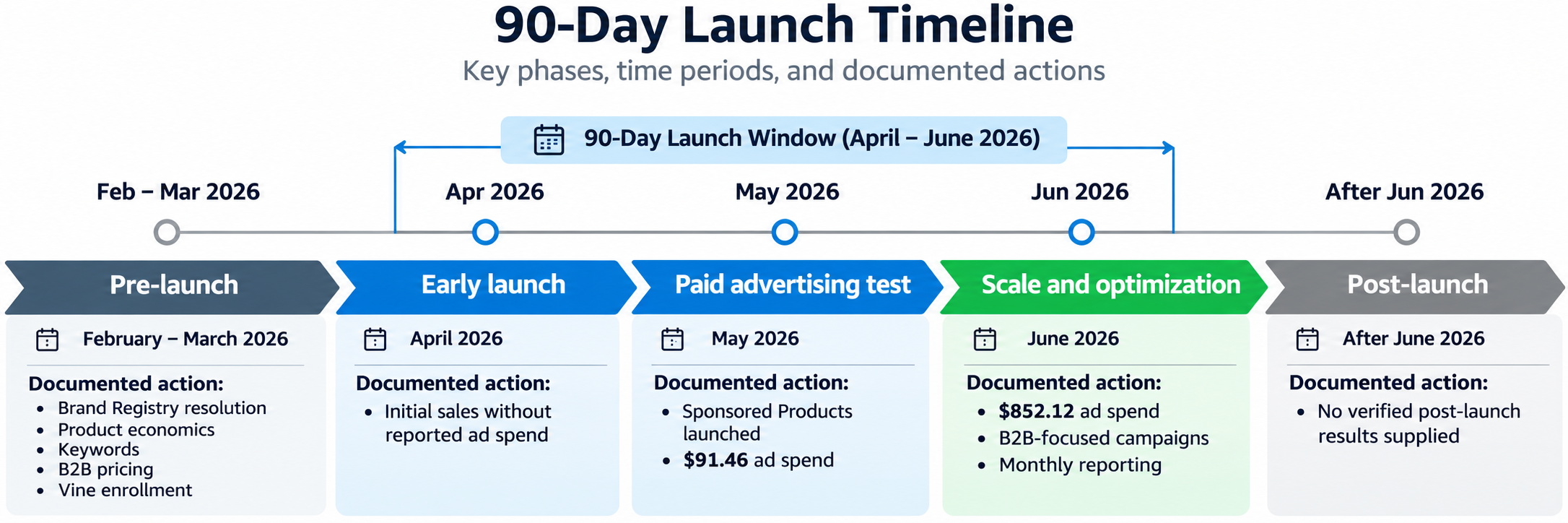
Phase 1: Pre-Launch Foundation
From February through March, the team focused on lowering launch risks.
The original brand name could not get Brand Registry approval. So the business moved to a new brand name and got Amazon Brand Registry approval in March.
Amazon’s current Brand Registry requirements include having the brand name or logo permanently attached to the product or packaging and having an eligible pending or registered trademark.
Before setting the product price, SalesDuo created a per-unit planning model.
The model included:
- Manufacturing cost
- China-to-US freight
- Amazon referral fees
- FBA fees
- Storage costs
- An ad cost assumption equal to 12% of sales
- Vine as a one-time launch cost
The 12% number was only a planning assumption. It was not a confirmed break-even point.
For keyword research, SalesDuo reviewed competitor listings and looked at the words customers used in reviews. The team then used the same keyword set for the listing copy, SEO, and early ad targeting.
The team also set up tiered Amazon Business pricing before launch. This gave B2B customers quantity-based pricing from day one.
In March, the product joined Amazon Vine to build early reviews compliantly. SalesDuo also directs sellers to compliant ways to get early Amazon reviews instead of using tactics that try to control ratings or review opinions.
Phase 2: Launch Traffic and Conversion
April had very little advertising.
The team allowed Vine to help build early review credibility first. All April sales came without ad spend.
The team chose to wait for early review activity before testing paid traffic. The available data does not establish how much this timing affected conversion.
In May, SalesDuo launched Sponsored Products with a small test budget of $91.46.
The goal was to learn which search terms converted before spending more.
In May:
- Ad-attributed sales reached $739.98
- ACoS was 12.36%
- TACoS was 4.9%
Phase 3: Optimization and Scale
In June, ad spend increased to $852.12. That was about 9.3 times higher than May.
The team increased spending only after it had more review and conversion data.
SalesDuo also ran B2B-focused campaigns along with normal consumer campaigns. Tiered business pricing stayed active.
June ACoS was 13.05%, while TACoS was 9.2%.
These numbers should not be used to say the original 12% planning assumption was achieved. The source data doesn't confirm whether the 12% assumption was based on ad-attributed sales or total sales.
The team also reviewed performance with the client every month.
For a broader view of this type of launch sequence, the 90-day Amazon Launch Stack explains how readiness, reviews, paid traffic, and optimization can be organized across a launch period.
The Results
The launch showed strong sales growth.
Monthly sales increased 478.77% from April to June.
In June, ad-attributed sales accounted for about 70.5% of total reported sales. The remaining sales were not attributed to ads in the supplied figures, but that does not prove they were all independent of advertising. Amazon's attribution windows and reporting definitions can affect this comparison. The available data shows strong sales growth but does not isolate incremental advertising impact or establish mature organic demand.
This means the results show strong launch execution, but they do not prove that organic demand was already fully developed.
How the metrics are defined
How launch ROI should be evaluated
Launch ROI = (Incremental profit attributable to the launch − launch investment) ÷ launch investment × 100.
Before calculating ROI, define the baseline sales, the profit measure, and which costs are included. These may include ad spend, agency fees, creative production, promotions, and additional inventory-related costs. Avoid counting the same cost twice.
The data available for this case does not support a verified launch ROI calculation.
Monthly performance
Across the April–June 2026 reporting period, the case-study figures total:
- $12,709.63 in total sales
- 70 units sold
- $943.58 in ad spend
- $7,269.83 in ad-attributed sales
Efficiency and mix
*Overall B2B share is based on $2,459.96 in B2B sales divided by $12,709.63 in total sales.
By the end of June, the product had 17 reviews with an average rating of 4.4 stars.
B2B sales also increased from $0 in April to $2,249.96 in June. That made up about 24% of June sales.
What Actually Moved the Needle
Four decisions were especially important in this launch.
These actions are connected to the results, but they don't prove the same actions will always produce the same results for every brand.
Limits of what this case proves
- June growth still depended heavily on ads. About 71% of June sales were ad-attributed, compared with 40% in May.
- The two- to three-month China lead time made it harder to react quickly to growing demand. The team had to plan a restock during the launch.
- This case covers only one product family and a small launch budget.
- No verified ranking data was provided, so this article does not claim ranking improvement.
- The available data does not prove actual profit, break-even ACoS, contribution margin, or launch ROI.
What This Case Study Means for Brands Evaluating an Amazon Product Launch Agency
A managed agency can help when many launch tasks need to work together and one internal team cannot easily manage everything.
Consulting may be enough when your brand already has the people, systems, and experience to handle the launch.
If advertising is your main problem, compare what different providers offer for Amazon product launch advertising support before choosing a fully managed launch service.
Before hiring any launch partner, ask these four questions:
- Do they build a profitability model before deciding price and budget?
- How do they plan the timing of reviews and ads?
- Do they consider B2B when it makes sense for the category?
- How do they define ACoS, TACoS, and ROI in their reports?
Talk to SalesDuo About Your Amazon Launch
A strong Amazon launch connects product economics, listing readiness, reviews, advertising, inventory, and reporting before ad spend starts to grow.
If your team needs help managing all of these areas together, SalesDuo can review your launch plan and identify the highest-risk execution areas.
Book Your 1:1 Growth Call with SalesDuo
These results describe one specific past engagement and are not a promise of future performance. Results can vary based on category, product quality, pricing, margins, inventory, competition, budget, and execution.
Frequently Asked Questions about Amazon Product Launch Agency
What does an Amazon product launch agency actually do?
An Amazon product launch agency helps manage the different parts of a launch, including listing readiness, ads, reviews, inventory, pricing, and reporting.
The main value is not one single tactic. It is making sure all these parts happen in the right order while the team learns from early performance data.
How long does an Amazon product launch take?
A 90-day period is often useful for tracking performance and making improvements.
However, the real timeline depends on the category, inventory lead time, reviews, price, competition, and budget.
In this case, pre-launch work started in February. We measured the main results from April 1 through June 30, 2026.
What metrics should a product launch case study show?
A product launch case study should clearly show the time period and the main performance numbers.
This may include:
- Total sales
- Units sold
- Ad spend
- Ad-attributed sales
- ACoS or TACoS
- Review growth
- Inventory situation
- Ranking data, if verified
- ROI, if verified
The article should also explain how each metric is calculated so readers can understand the results correctly.
Is TACoS better than ACoS for launch measurement?
No. Both metrics show different things.
ACoS shows how much ad spend was used compared with ad-attributed sales.
TACoS shows ad spend compared with total sales.
During a launch, looking at both helps you understand ad performance and how much the business still depends on advertising.
Can an agency guarantee Amazon ranking improvement?
No.
Amazon ranking depends on relevance, conversions, sales velocity, reviews, price, inventory, and competition.
This case does not report ranking improvement because there was no verified rank-tracking data for the period.
When is product launch consulting enough instead of a full agency?
Consulting may be enough if you already have:
- A stable supply chain
- A ready listing
- Existing reviews
- Experienced Amazon ads and operations team members
A managed agency may be more useful if you need hands-on help across several areas at the same time.
How should a brand evaluate product launch ROI?
First, decide what profit measure you want to use.
Then list all the costs included in the launch.
A useful ROI calculation may include:
- Gross or contribution margin
- Ad spend
- Agency fees
- Creative costs
- Promotions
- Inventory-related costs
- The time period being measured
This case does not claim ROI because the full margin and cost data were not provided.
About the Author
Meet Mamta Mathe, an Associate Content Writer at SalesDuo who specializes in creating practical, research-backed content for Amazon sellers. She enjoys simplifying complex eCommerce topics and helping brands make smarter growth decisions through clear, actionable insights. Outside of work, she loves reading, exploring new ideas, and staying updated on digital marketing trends.