
Amazon Account Management Services Checklist: How to Audit the Right Agency Fit

Amazon account management services should extend beyond basic Seller Central work. This is a checklist of things you should look for in a provider to be able to manage your catalog, ads, inventory, account health, reporting, and Seller/Vendor Central work with clear ownership.
This is not a “best agency” ranking. It is a simple way to understand what an agency really handles before you sign a contract, give account access, or spend more money.
The goal is simple: you need to know if the provider can handle the daily tasks that protect your revenue and help your business grow.
| Reader situation | Immediate answer | Next step |
|---|---|---|
| Need to evaluate a provider | Check the provider across access, catalog, ads, inventory, account health, reporting, and Seller/Vendor Central ownership. | Use the checklist and scorecard before the vendor call. |
| Need pricing depth | Pricing depends on the work included, account complexity, marketplace model, and how much work the provider manages. | Use the cost section to understand what affects fees. |
| Need an agency shortlist | Use clear evaluation points before comparing agencies or proposals. | Score the provider first, then compare fit. |
What Amazon account management services should include
A real account management service links daily account work to both growth and risk control. The provider should do more than just offer advice. They should help with the tasks that affect your product’s visibility, sales, availability, profit margins, and account stability.
In a traditional full-service arrangement, this typically covers catalog and listing management and optimization, Amazon SEO, coordinating advertising efforts, inventory and fulfillment monitoring, case management, reporting, and routine checks on the health of your account.
When a brand needs one team to manage all these connected areas, it may need a full-service Amazon account management partner instead of a provider that handles only one task.
| Service area | What real management includes | Weak answer to watch for |
|---|---|---|
| Catalog and listings | Variation structure, suppressed listings, attributes, A+ content, search performance, and change tracking. | “We only upload what you send us.” |
| Advertising and profitability | PPC structure, wasted spend, budget pacing, ACoS/TACoS context, and catalog readiness. | “Our PPC team works separately.” |
| Inventory and operations | Stockout risk, stranded inventory, FBA/FBM issues, operational cases, and escalation ownership. | “Your warehouse or ops team handles that.” |
| Account health | Policy warnings, Account Health Rating monitoring, claims, documents, and response workflow. | “We check it when there is a problem.” |
| Reporting cadence | Weekly action updates, monthly decisions, owner lists, timelines, and clear next steps. | “You get a dashboard link.” |
| Seller/Vendor Central work | Seller Central permissions, Vendor Central obligations, POs, shortages, chargebacks, and hybrid account handoffs. | “We mostly work in Seller Central.” |
Basic support vs. full-service Amazon account management
Basic support usually solves one small problem. Full-service Amazon account management connects all parts of the account and makes it clear who owns the next step.
This matters because many providers use similar terms. A PPC-only partner, listing vendor, advisory program, and full-service agency may all say they offer account management.
The real difference is what they check, what they fix, how they report, and who takes responsibility when problems affect more than one team.
| Support model | Best fit | Main limitation |
|---|---|---|
| Advisory or Amazon SAS-style support | Brands with internal teams that can act on recommendations quickly. | Advice may not turn into action if no one owns the work. |
| PPC-only provider | Brands with a stable catalog, clean inventory, and a separate internal operations owner. | Ad performance may suffer when listings, stock, or pricing are not managed. |
| Listing-only or creative vendor | Brands that need content improvements but already have account operations covered. | It may not cover ads, inventory, account health, or operational cases. |
| Operations-only support | Brands with strong marketing but weak case, PO, chargeback, or availability processes. | Growth planning may stay separate from daily work. |
| Full-service agency | Brands with Amazon work that is too complex for the internal team to handle alone. | Scope and responsibility must be clearly documented before work starts. |
The Amazon account management audit checklist
Use this checklist before hiring an agency, switching agencies, or expanding an existing agency relationship.
For each area, ask what the provider checks, what proof it can show, what warning signs it watches for, and who fixes problems.
A strong provider should give clear examples, access rules, reporting samples, and clear roles.
A weak provider may give vague answers, push work back to your team, or treat account management as only ads and listings.
Access, permissions, and account security
Do not share your Seller Central password with an agency. External agencies, consultants, and contractors should be authorized as Service Providers through Amazon's approved access process.
Before onboarding a provider, review Amazon's current Service Provider access guidance. Give the provider only the roles and regional access needed for its work, and keep a clear process for reviewing, renewing, or removing access.
Ask what level of access the provider needs, who will use it, how access updates are tracked, and how access is removed when a team member leaves.
The provider should also explain how it limits access to only the permissions needed for the work.
Evidence to request
Request access checklist, onboarding process steps, permissions matrix, and change-log process.
Red flag
The agency asks for the account owner’s password or cannot explain who uses each permission.
Owner to confirm
Confirm your internal account owner and the agency lead responsible for managing access.
Catalog and listing health audit
Catalog problems can hurt sales even when your ads are running, and customers are interested in your products.
The agency should check suppressed listings, product variations, category details, titles, images, A+ content, Brand Registry requirements, and how your listings perform in search.
For a deeper review, use the Amazon listing audit process.
Do not just ask if the provider can “optimize listings.” Ask if they can find catalog issues, understand which ones matter most, fix them properly, and check that the changes actually went live.
Evidence to request
Require a sample of the health report, suppressed listings, variation review, and a tracker of the changes between before and after.
Red flag
The provider only talks about keywords and does not check catalog errors or other account issues.
Owner to confirm
Confirm who handles catalog work, creative and SEO, and who gives the final approval.
Advertising and profitability audit
Don't manage advertising on its own.
A good account audit should look at ads together with listing quality, pricing, inventory, profit margins, budget use, and TACoS/ACoS.
If you need a deeper ad review, use an Amazon PPC audit checklist to see whether the problem comes from bidding or bigger account issues.
Ask the agency how it identifies wasted ad spend, adjusts budgets, and decides when a product isn't ready for more traffic.
A good agency will tell you how it makes decisions rather than just showing campaign screenshots.
Evidence to request
Ask for budget-pacing reports, wasted-spend notes, search term reviews, profitability data, and an action log.
Red flag
The agency only shares ACoS and does not provide information about margins, inventory, listing readiness, or how these factors affect total sales.
Owner to confirm
Verify the ad strategist, the account manager, and approver for any budget changes.
Inventory, fulfillment, and operations audit
Inventory problems can lead to lost sales, even when your overall strategy is strong.
The provider should check for low-stock risks, stranded inventory, restocking needs, fulfillment settings, open cases, and other operations issues.
Amazon sellers can check active listings and stock levels in Manage Inventory. You can also use the Amazon inventory management guide for a deeper review.
The provider should also take responsibility for following up on cases, tracking issues, and handling escalations.
Brands with complex Seller Central and Vendor Central accounts may need dedicated Seller and Vendor Central operations support instead of occasional help.
Evidence to request
Ask for an inventory risk report, stockout list, stranded inventory notes, open-case tracker, and escalation log.
Red flag
The provider insists that inventory is separate from account management, even when stockouts are impacting ads and sales.
Owner to confirm
Confirm who is responsible on both sides: the operations lead, account manager, and your internal supply-chain contact.
Account health and compliance audit
Check account health before it becomes an emergency.
Amazon explains the Account Health Rating as a tool that helps sellers manage account health and deal with policy violations in Seller Central.
Your provider is expected to know how to monitor for issues, log activity, and escalate problems, but not to guarantee outcomes.
A practical account health monitoring routine should include policy warnings, required documents, case history, response timelines, and who owns each action.
It should also separate regular account-health work from urgent reinstatement or appeal work.
Evidence to request
Obtain a sample account-health dashboard, warning-response process, case log, and document checklist.
Red flag
The provider assures that suspensions or case results can be averted or guaranteed.
Owner to confirm
Confirm the compliance lead, account manager, and internal decision maker responsible for policy-related responses.
Vendor Central and hybrid-account audit
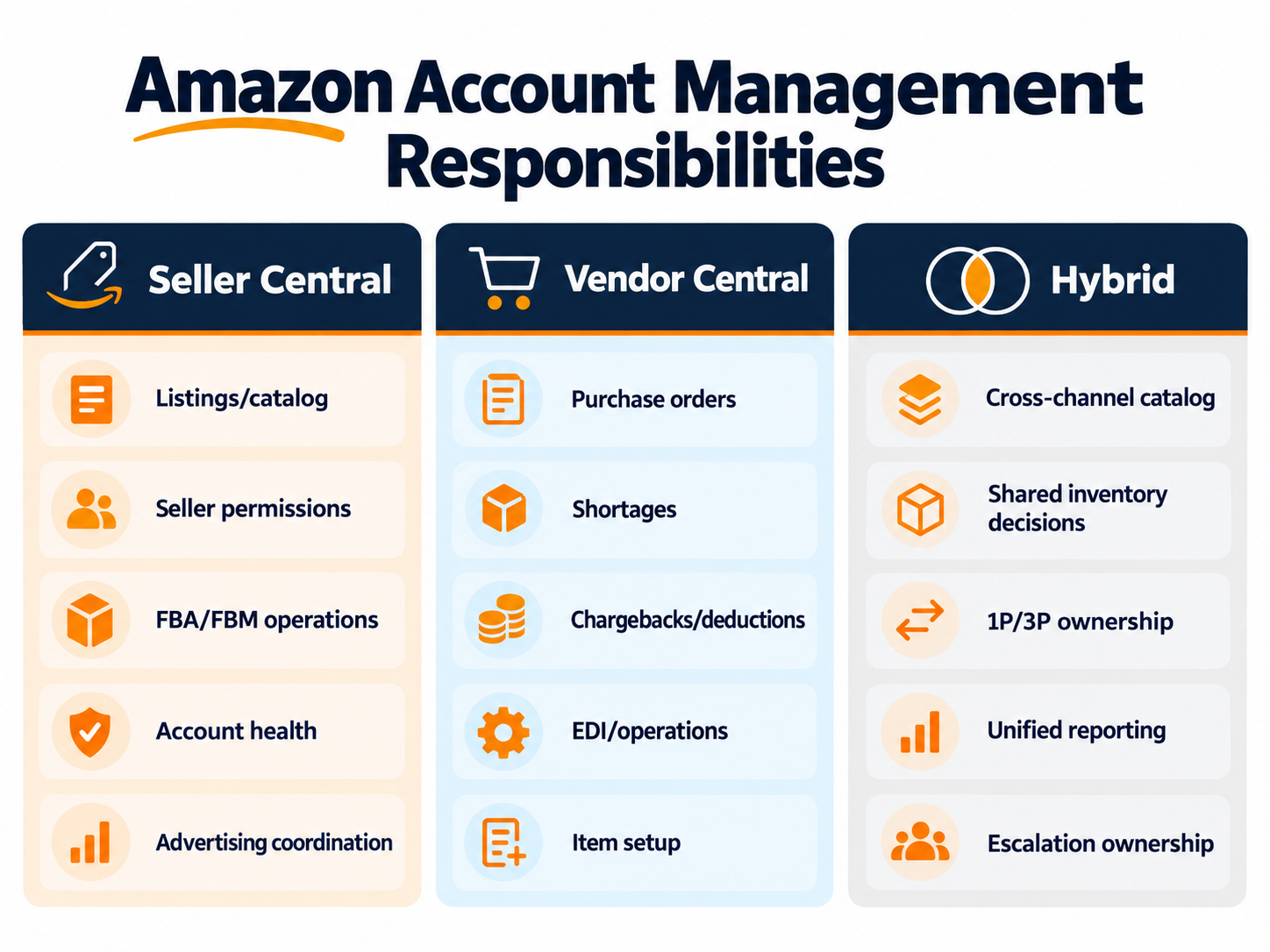
Seller Central and Vendor Central need different types of work.
An agency that mainly works in Seller Central may not know how to handle Vendor Central tasks like purchase orders, shortages, chargebacks, co-op deductions, EDI, and hybrid accounts.
If you mainly need Seller Central support, use a Seller Central management agency checklist to compare the agency’s services with what your own team can already manage.
For 1P or hybrid accounts, inquire about the process for managing purchase orders, shortage claims, chargebacks, item setup, operational issues, and reporting between teams.
If Vendor Central is your main focus, compare Vendor Central management agency options before assuming a Seller Central agency can handle the work.
Evidence to request
Request a definitive list of Seller Central and Vendor Central duties, a chargeback procedure, a PO issue tracker, and a strategy for hybrid-account issues.
Red flag
The agency says it offers “Amazon account management” but cannot clearly explain which Vendor Central tasks it handles.
Owner to confirm
Confirm who will handle Vendor Central, Seller Central, finance-related issues, and overall account management.
Reporting and decision cadence audit
A dashboard alone is not account management.
Good reporting should clearly show what changed, why it matters, what action was taken, who is responsible for the next step, and when the issue will be checked again.
Eligible brand representatives can also use Brand Analytics dashboards like Search Query Performance and Search Catalog Performance to understand how shoppers are finding and buying products.
Ask the agency to show you an example of its weekly report and monthly strategy review.
| Cadence | What it should answer |
|---|---|
| Weekly | What changed? What needs action now? Who owns it? What is blocked? |
| Monthly | What improved or declined? Why? What decisions are needed next? |
| Escalation | What requires immediate attention, who is responsible, and when will it be reviewed again? |
SalesDuo can also use AI-supported Amazon account monitoring to support reporting. But even with AI, a person should still own the decisions, next steps, and escalations.
Evidence to request
Ask for a weekly report sample, monthly review plan, dashboard details, action log, and rules for deciding which issues are most important.
Red flag
The report shows numbers but does not explain what action should be taken, who owns it, when it should be done, or what happens next.
Owner to confirm
Confirm who the account manager is, who owns BI/reporting, and who is responsible for monthly strategy decisions.
| Area | What to check | Evidence to request | Red flag | Owner |
|---|---|---|---|---|
| Access & security | Permissions, access scope, removal process | Permission matrix, onboarding checklist, change log | Agency asks for owner password | Internal account owner + agency lead |
| Catalog & listings | Suppressions, variations, attributes, content, search health | Listing health report, suppression list, change tracker | Focuses only on keywords | Catalog/SEO owner |
| Advertising | Waste, pacing, ACoS/TACoS, margin and inventory context | Budget report, search-term review, action log | Reports ACoS without business context | Ad strategist + account manager |
| Inventory & operations | Stockouts, stranded inventory, cases, escalation | Inventory-risk report, case tracker | Treats inventory as outside account management | Operations owner |
| Account health | Warnings, documents, cases, escalation | Health dashboard, case log, response workflow | Guarantees outcomes | Compliance/account lead |
| Seller/Vendor Central | Platform responsibilities, POs, shortages, chargebacks, hybrid ownership | Responsibility map, PO/chargeback tracker | Cannot explain Vendor Central scope | SC/VC owners |
| Reporting | Actions, owners, deadlines, decision cadence | Weekly report, monthly review, action log | Dashboard with no actions | Account manager + reporting owner |
Questions to ask during the agency call
Use the audit to guide your call with the agency.
The goal is not to find mistakes. You simply want to understand what the agency will manage, who will do the work, and how they'll handle problems.
Ask these questions:
- What will you check in the first 30 days, and what will you give us after the audit?
- Which parts of catalog, ads, inventory, account health, and reporting will your team manage?
- Which tasks will our team need to manage?
- Who will manage our account every day?
- Who will handle special areas like catalog, PPC, Vendor Central, and reporting?
- What will you include in the weekly update?
- How do you decide which problems need quick attention?
- What work is not included in your service?
- How will you tell us if something may cause a delay or extra cost?
A good provider should give clear answers, explain who is responsible for each task, and show examples of how the team works.
If an answer is unclear, it does not always mean the agency is a bad choice. But you should get clear answers before approving the proposal.
How to score an Amazon account management provider
Score each section from 0 to 2.
This is not a pass-or-fail test. It simply helps you see what the provider covers well and where there may be gaps.
- 0 = The provider does not cover it, or the responsibility is unclear.
- 1 = The provider covers some of it, but your team may still need to help.
- 2 = The provider clearly owns the work, shows proof or examples, follows a clear schedule, and has a named person responsible.
Use the scorecard below during your agency evaluation. Score each area based on what the provider actually owns and the evidence it can show.
| Audit area | Score 0 | Score 1 | Score 2 |
|---|---|---|---|
| Access and security | No clear access process. | Basic permissions mentioned. | Permission matrix, access owner, and change log are clear. |
| Catalog and listings | Only keyword edits. | Some listing review. | Catalog health, changes, and issue ownership are tracked. |
| Advertising and profitability | Reports only ACoS. | Some optimization notes. | Ads are tied to margin, inventory, and action decisions. |
| Inventory and operations | Not included. | Monitored when requested. | Stockout, case, and operational risks have owners. |
| Account health | Reactive only. | Warnings checked sometimes. | Regular monitoring, evidence, and an escalation process are in place. |
| Seller/Vendor Central scope | One platform only, unclear. | Basic split explained. | Seller, Vendor, and hybrid responsibilities are clearly mapped. |
| Reporting cadence | Dashboard only. | Monthly summary. | Weekly actions plus monthly strategy decisions. |
| Team model | No named owners. | Only the account lead is named. | Functional owners, backups, and escalation paths are clear. |
| Cost-to-scope fit | Fee is not connected to the work. | Broad scope notes. | Pricing matches scope, complexity, and the owner list. |
| Onboarding process | No timeline. | Loose kickoff plan. | Access, audit, priorities, cadence, and first actions are documented. |
Add all the scores together. The highest possible score is 20.
- 0 to 8: The provider may not be the right fit, or it may not be clear who is responsible for each task.
- 9 to 14: The provider covers some areas, but the scope needs clearer explanation.
- 15 to 20: The provider may be a good full-service fit. You should still check its experience in your category, team capacity, and onboarding process.
After scoring the provider, you can compare Amazon account management agencies and better understand what each agency should be able to show.
When to hire, switch, or stay in-house
The right choice depends on complexity, speed, cost, internal capacity, and account risk.
A brand with one small problem may not need a full-service partner. But a brand with connected problems across catalog, ads, inventory, reporting, and account health usually needs stronger ownership.
Use cost as part of the decision, but do not compare fees without looking at the work included.
A cheaper provider may become expensive if your internal team still has to manage every problem.
Use an Amazon account management pricing guide when you need more information about different fee models.
| Decision | Use this path when | Main risk to check |
|---|---|---|
| Stay in-house | The work is limited, your team understands Amazon, and execution is fast. | Your internal team may struggle when several problems happen at once. |
| Use a point solution | You need a specialist for PPC, listings, creative, or one operational problem. | The specialist may not manage problems that affect several teams. |
| Hire a full-service agency | Catalog, ads, inventory, reporting, and account health need connected ownership. | The contract must clearly define scope, owners, cadence, and escalation. |
| Switch providers | Your current agency is reactive, disconnected, or unclear about who owns the work. | Switching without an onboarding plan can create access and continuity problems. |
A simple unmanaged-risk calculation
Do not expect a checklist alone to prove ROI.
Instead, use it to compare the cost of unmanaged problems with the cost of better account management.
Monthly unmanaged-risk cost = estimated lost sales from stockouts + wasted ad spend + unresolved chargebacks or shortages + margin leakage from catalog or pricing issues.
For example, imagine a brand estimates $12,000 in lost sales from stockouts, $8,000 in wasted ad spend, and $5,000 in unresolved operational deductions.
Its estimated unmanaged-risk cost is $25,000 per month, not including internal staff time.
This is only an example. Use your own account data before deciding.
Use the checklist before you sign
The best Amazon account management partner is not proven by a pitch deck.
It is proven by what the team checks, what it owns, how it reports, and how quickly it turns problems and signals into action.
If your account management problems are spread across catalog, advertising, inventory, reporting, and account health, a point solution is unlikely to fix the whole system.
Book a 1:1 Growth Call with SalesDuo to review where your Amazon account needs full-service ownership.
Frequently Asked Questions about Amazon Account Management Services
What are Amazon account management services?
Amazon account management services help with the daily work of running an Amazon account. This can include listings, ads, inventory, account health, reporting, and Seller or Vendor Central tasks.
How do I audit an Amazon account management agency?
Check what the agency manages, what proof it can provide, who handles each task, how often it reports, how it gets account access, and how it handles problems.
How much do Amazon account management services cost?
Costs depend on the amount of work, the size and complexity of your account, the number of SKUs, ad support, reporting needs, and Seller or Vendor Central work.
Should I choose an agency or hire in-house?
Hire in-house if the work is limited and your team can manage it quickly. Consider an agency if you need help across several areas like listings, ads, operations, and compliance.
What access should an Amazon agency get?
Give the agency only the account access it needs through Amazon’s proper permission settings. Do not share passwords or the account owner’s login details.
What should an Amazon account audit include?
An Amazon account audit should check listings, catalog health, ads, inventory, account health, reporting, operations, account access, and Seller or Vendor Central responsibilities.
Do I need Seller Central or Vendor Central management?
Seller Central management applies to brands operating as third-party sellers, while Vendor Central management applies to brands selling to Amazon through a 1P relationship. Some brands operate across both models and may need coordinated support for each.
How often should account management reporting happen?
Most accounts should get weekly updates and a monthly strategy review. More complex accounts may need more frequent updates and faster issue tracking.
About the Author
Meet Mamta Mathe, an Associate Content Writer at SalesDuo who specializes in creating practical, research-backed content for Amazon sellers. She enjoys simplifying complex eCommerce topics and helping brands make smarter growth decisions through clear, actionable insights. Outside of work, she loves reading, exploring new ideas, and staying updated on digital marketing trends.