
How The Blissful Dog Grew Amazon Sales 91% with Vendor Central Catalog and Advertising Improvements

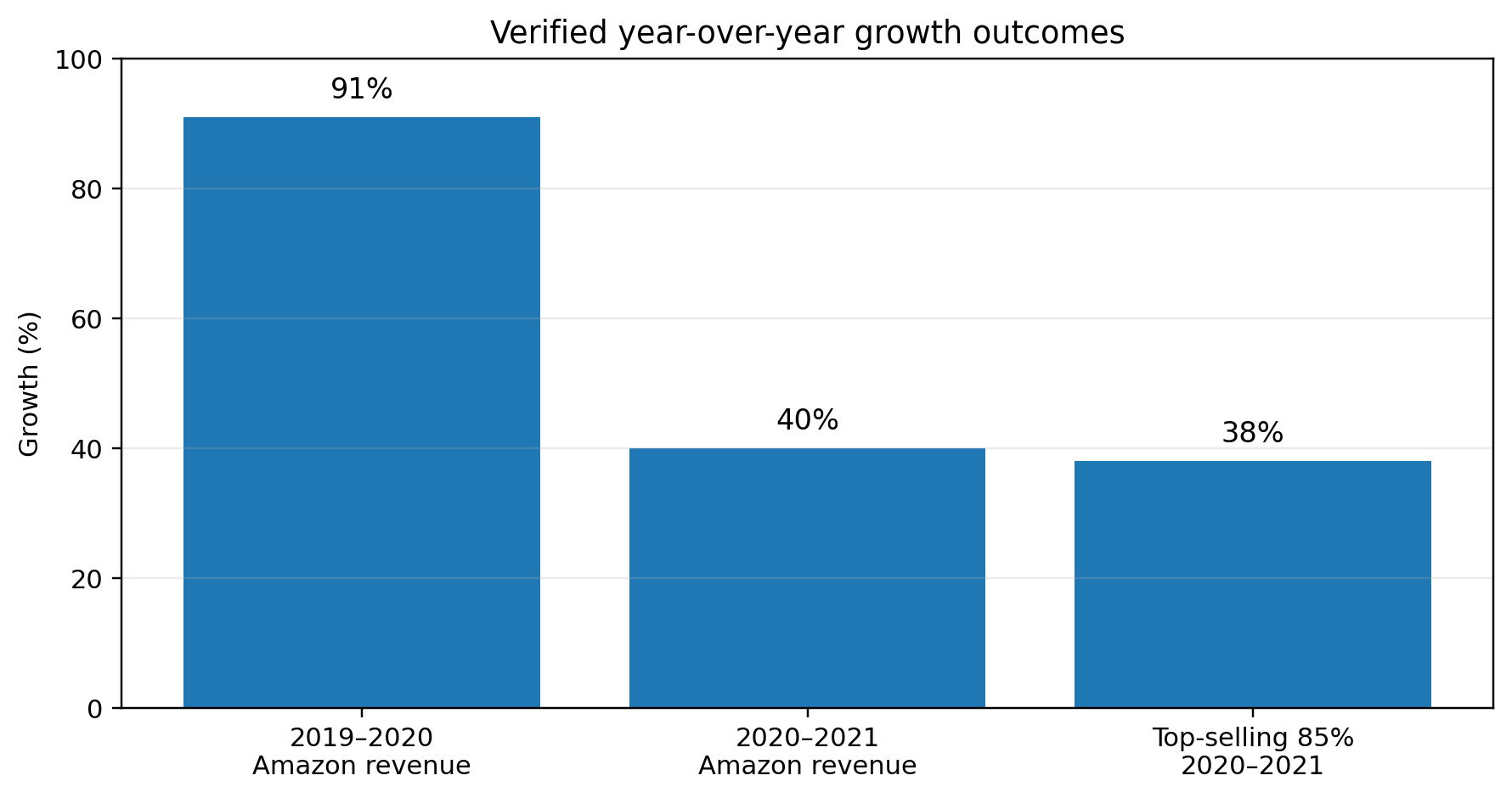
The Blissful Dog, a large pet-care brand on Amazon Vendor Central, turned to SalesDuo to help address issues with catalog splintering, listing suppressions, availability gaps, and ad inefficiency. This Amazon Vendor Central pet brand case study highlights how the team prioritized work across catalog, compliance, detail pages, availability, and advertising. The client is reporting 91% year-over-year growth in Amazon revenue after the first full year of the engagement.
The client reports 91% year-over-year Amazon revenue growth from 2019 to 2020. The result should be presented beside a concise methodology note that identifies the Vendor Central revenue definition, Amazon.com scope, report owner, and client approval.
Result Snapshot
| Case-study field | Documented scope |
|---|---|
| Brand | The Blissful Dog |
| Category | Pet care/pet supplies |
| Marketplace and model | Amazon.com; historical Vendor Central first-party context |
| Channel/ad type | Amazon Vendor Central; Sponsored Products and historical display-ad activity |
| Challenge | Large catalog, fragmented relationships, suppressed listings, availability constraints, detail-page quality, and advertising readiness |
| Core intervention | Audit → catalog relationships → claim/suppression remediation → detail pages → availability support → advertising |
| Time period | 2019–2020 first documented year; engagement began in 2019 and advertising expanded through 2021 |
| Verified result | 91% year-over-year Amazon revenue growth from 2019 to 2020. |
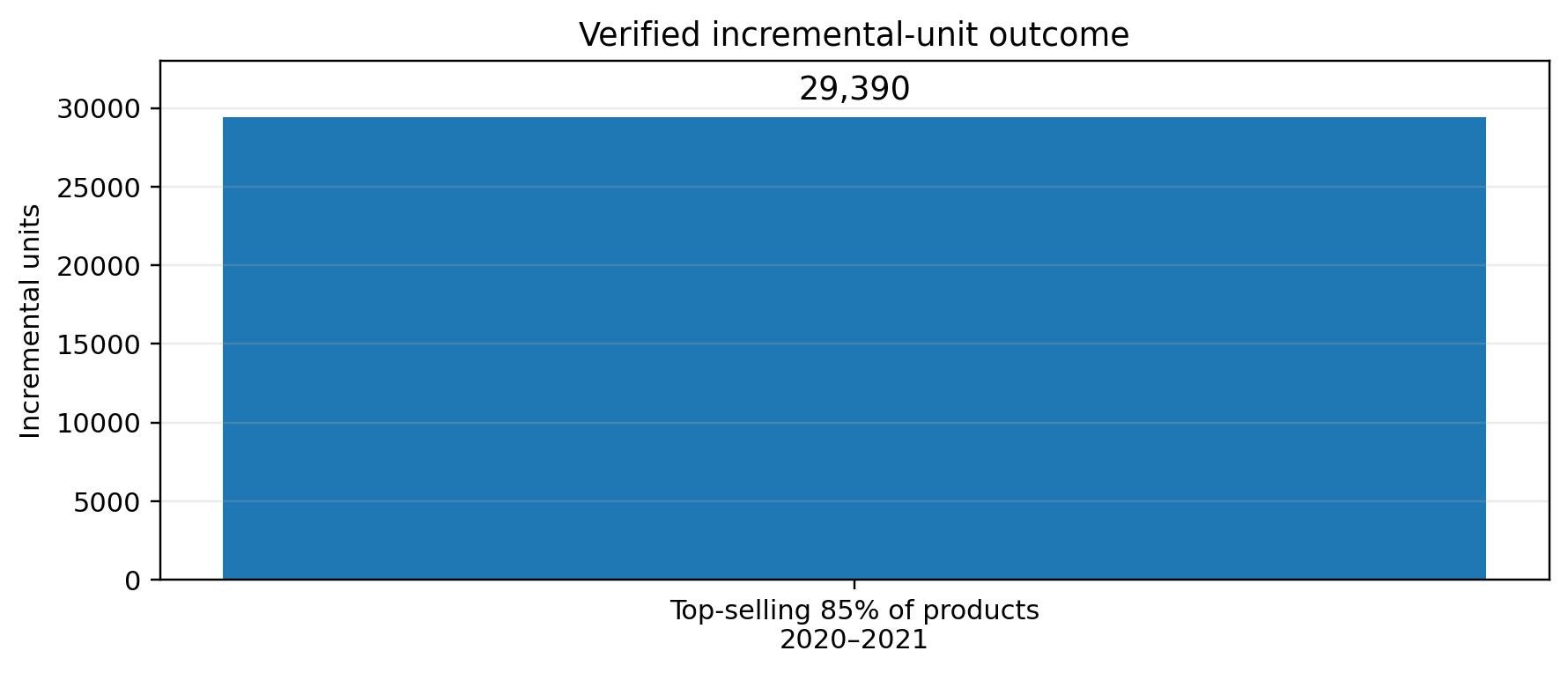
| Additional KPI | 40% next-year revenue growth; 38% growth across the top-selling 85% of products; 29,390 incremental units |
| Ad KPI | Sponsored Products: 7.40% average ACoS, 150,000–250,000 impressions, and 700–1,500 clicks. Sponsored Display: 14.77% average ACoS in 2021; Q4 reached 950,000–1.02 million impressions, 3,000–5,000 clicks, $16,000–$21,000 attributed sales, and 22% average ACoS. |
| Methodology | Revenue growth compares 2020 with 2019. Amazon Ads metrics use the stated campaign scope and attribution window and are separate from total Amazon revenue. |
Managing a mature Amazon catalog with similar constraints? See how SalesDuo approaches full-service Amazon account management.
Client and Amazon Account Context
The Blissful Dog is a Northern Minnesota pet-care business whose Amazon operation historically ran through Vendor Central. Amazon describes Vendor Central as the wholesale model in which invited manufacturers and distributors sell products directly to Amazon.
At the start of the documented engagement in 2019, The Blissful Dog managed approximately 3,656 SKUs in its Amazon.com Vendor Central catalog. SalesDuo’s catalog work included three-level variation relationship changes across approximately 1,600 ASINs during the 2019–2020 recovery period. The catalog snapshot reflects the start of the documented 2019 engagement.
The operating problem also crossed team boundaries. Catalog structure affected how related products were presented, managed, and supported across the account. Suppressed or unavailable products could not convert. Weak detail pages limited shopper confidence. Advertising performance therefore depended on work that sat outside the ad console.
Challenge — growth was constrained by an operating system, not one campaign
SalesDuo’s first task was to separate symptoms from root causes. Increasing bids would not solve an unavailable ASIN, a broken product relationship, or a detail page that could not support the claim being made.
- Catalog relations were atomized, so choice was harder to navigate, and shared reviews and uniform content were less valuable.
- A few high-priced listings were culled when Amazon detected claims or compliance issues.
- The detail page content and media must be reviewed for accuracy, quality, and compliance with current Amazon policies.
- Stock needed a fallback option so that demand generation wouldn’t send shoppers to an out-of-stock product.
- Marketing should be conducted in the context of retail readiness, rather than as a separate growth funnel.
The account also needed technical catalog judgment. SalesDuo’s Amazon brand normalization error case study shows a different catalog-identity problem, while the regulated-product Amazon compliance case study covers a separate compliance and channel-transition context.
Strategy — sequence the fixes before scaling media
Engagement timeline
| Phase | Verified period |
|---|---|
| Account audit | 2019 |
| Catalog relationship consolidation | 2019–2020 |
| Claim/suppression remediation | 2019–2020 |
| Detail-page improvements | Q4 2020 first optimization batch |
| Availability support | 2019–2021 |
| Advertising expansion | 2020–2021 |
The strategy had a dependency order: first account the facts, then repair catalog and compliance constraints, then improve retail readiness, then protect availability, and finally grow media. This ordering made each subsequent signal easier to decode.
- Construct a mono-issue inventory for catalog relations, suppressions, content holes, availability, and ad readiness.
- Prioritize work based on commercial significance and dependencies: you don’t want to advertise high-value products before they are stable and purchasable.
- Track each catalog or compliance adjustment with associated ASINs, proof, owner, date, and anticipated outcome of operation.
- Ensure quality of the detail page and availability before driving demand.
- Analyze sales, units, availability, and advertising signals collectively and then decide on the next bottleneck to work on.
Account audit and prioritization
SalesDuo looked at the account as an integrated system and not a collection of isolated to-do items. The team determined which product families were most commercially significant, which ASINs were suppressed or highly unstable, where content quality constrained conversion, and which products were media-ready.
A serviceable audit output is a decision queue, not a generic checklist. Each workstream should record the affected ASINs, the observed issue, the evidence available, the owner, the next action, and the condition that must be met before advertising expands.
This prioritization also protects the measuring plan. When multiple account changes occur simultaneously, the team needs a record of what changed, when it changed, and which products were affected. That record doesn’t prove causality by itself, but it helps to distinguish a catalog fix from an inventory replenishment, a seasonal demand shift, or a campaign change. It also gives the client a clear governance trail for future updates.
Catalog consolidation and retail readiness
SalesDuo is a combination of catalog relationships across around 1,600 ASINs, bringing related products into the three-level variation relationship format approved. This decluttered the catalog, brought product family consistency, and established a more solid base to roll out detail-page updates and advertising.
Catalog relationship before/after
| Before the intervention | After the intervention |
|---|---|
| A 3,656-SKU Vendor Central catalog with fragmented relationships, repeated reversion of changes, and suppressed ASINs. | Approximately 1,600 ASINs organized through an approved three-level variation relationship on Amazon.com. |
| Related product families were harder to manage consistently across the catalog. | Product families were consolidated into a more coherent structure for content, availability, and advertising work. |
The business purpose was clear: make related selection easier to manage, present, and advertise. Broader detail-page work—including titles, bullets, descriptions, images, and videos—belongs to the dedicated Amazon listing optimization service page; in this case study, it matters only as part of the client’s recovery sequence.
Detail-page improvement and the learning loop
SalesDuo then reviewed the product information and media that shoppers encountered after clicking a listing or ad. The objective was not to apply a generic keyword formula. It was to make each detail page accurate, complete, compliant, and persuasive enough to support the product’s role in the catalog. That work could include clearer titles and bullets, stronger image sequencing, better descriptions, and removal of unsupported or risky claims.
The team also needed a feedback loop. Suppression status, buyability, conversion, sales, and advertising reports should be monitored on a synchronized schedule. If an item becomes unavailable, media might have to be constrained. Once a page becomes eligible and conversion rate increases, the team can experiment with wider traffic. If no impact is seen on the signal, the account record will state whether the suspected source lies with catalog data, content, inventory, pricing, or campaign execution.
Suppression and claim remediation
The public case study indicates Amazon suppressed multiple products after finding language "similar to a pesticidal or repellent claim." The safe lesson here is don't keep a banned-word list, or think that removing a phrase "fixes" the legal situation. The right response begins with the very Amazon notice, the claims intended for the product, documentation to support them, and a competent compliance review.
EPA guidance explains that explicit or implied pesticidal claims can affect how a product is regulated, and that the full claim context matters. Brands should review EPA guidance on treated products and pesticidal claims, as well as the agency’s pesticide labeling questions and answers, and obtain legal or regulatory advice when needed.
Amazon suppressed the pesticidal claims for several top-selling ASINs during the stated 2019-2020 cure period after it found claims including “pesticide free” and “helps repel flies, mosquitoes, chiggers, gnats and other bugs and pests.” SalesDuo checked the notice and product claims, noted Amazon’s request for an EPA certificate, modified the product title, About the Product, and Long Description fields, and tracked the affected listings’ reinstatement during the cure period. This was specific to one account, and it does not mean that will be a universal legal or marketplace solution.
Suppression-resolution record
| Field | Verified account detail |
|---|---|
| Issue | Amazon suppressed multiple top-selling ASINs after detecting pesticidal or repellent claims. |
| Claims identified | “Pesticide free” and “helps repel flies, mosquitoes, chiggers, gnats and other bugs and pests.” |
| Evidence requested | Amazon requested an EPA certificate. |
| Action | SalesDuo reviewed and refreshed the product title, About the Product, and Long Description fields to remove the account-specific triggering claims. |
| Outcome | The affected top-selling products returned to sellable status during the documented recovery period. |
| Scope note | This was an account-specific remediation and is not a universal legal or marketplace shortcut. |
Availability and Dropship support
Availability was seen as a requirement for growth. Vendor Central Dropship was for eligible products as an alternate availability path throughout the reported engagements from 2019 to 2021, to support buyability while the default Vendor Central In-Network purchase-order model was still in effect and to keep advertising on buyable ASINs.
The strategic principle is durable: do not fund demand for products that shoppers cannot buy. Brands facing broader operational leakage can review SalesDuo’s guidance on Vendor Central shortage claims and chargebacks, while keeping this case study focused on retail continuity and buyability.
Advertising execution in context
Advertising was broadened once the team had greater certainty around catalog structure, content, eligibility, and availability. The first phase of Sponsored Products was a test on best sellers that account for 60% of brand sales, with $200–$500 ad spend, 150,000–250,000 impressions, 700–1,500 clicks, and an average ACoS of 7.40%. Sponsored Display activity continued to grow through 2021 and averaged an ACoS of 14.77%; in Q4, it broke 950,000–1.02m impressions, 3,000–5,000 clicks, $16,000–$21,000 in attributed sales, and an average ACoS of 22%.
Ad-phase scorecard
| Phase | Dates | Objective | Campaign type | Spend | Impressions | Clicks | Attributed sales | ACoS |
|---|---|---|---|---|---|---|---|---|
| Phase 1 | 2019–2020 | Build visibility for best sellers generating 60% of brand sales | Sponsored Products | $200–$500 advertising budget | 150,000–250,000 | 700–1,500 | Not available | 7.40% average |
| Phase 2 | 2021; Q4 peak | Expand brand visibility and reach | Sponsored Display | Not available | 950,000–1.02M in Q4 | 3,000–5,000 in Q4 | $16,000–$21,000 in Q4 | 14.77% average in 2021; 22% in Q4 |
Measurement rule
The example above is arithmetic, not a recommended threshold. ACoS must be interpreted with margin, inventory, lifecycle, total sales, campaign objective, and attribution scope.
Results — what changed and what remains to be verified
From 2019 to 2020, The Blissful Dog’s Amazon revenue increased 91%. Present this as total Amazon revenue, separate from ad-attributed sales, and place the approved Vendor Central revenue definition, Amazon.com scope, source owner, and client approval beside the result.
Verified revenue and unit outcomes
| Outcome | Comparison period | Verified result | Scope |
|---|---|---|---|
| Total Amazon revenue | 2019–2020 | 91% year-over-year growth | Amazon.com Vendor Central |
| Total Amazon revenue | 2020–2021 | 40% year-over-year growth | Amazon.com Vendor Central |
| Top-selling 85% of products | 2020–2021 | 38% growth | Product subset; do not combine with total-revenue growth |
| Incremental units | 2020–2021 | 29,390 units | Top-selling 85% of products |
| Outcome area | Documented change | Evidence needed for final publication |
|---|---|---|
| Catalog | Related selection was reorganized, and detail pages were improved. | Before/after relationship map, ASIN list, change log, and dates |
| Suppression | Affected product content was reviewed, and listings were returned to sellable status. | Exact notice, case log, approved remediation, and reinstatement dates |
| Availability | A historical backup availability path was used for eligible products. | Program records and in-stock trend |
| Advertising | Sponsored Products activity expanded after retail-readiness work, followed by display activity. | Campaign exports, spend, attributed sales, clicks, impressions, ACoS, and attribution window |
| Revenue and units | Revenue grew 91% from 2019 to 2020 and a further 40% from 2020 to 2021. Across the top-selling 85% of products, the account recorded 38% growth and 29,390 incremental units versus 2020. These figures use total Amazon revenue and unit definitions and are not additive or attributable to one intervention. | Metric definition, marketplace, comparable periods, denominator, source owner, and client approval |
Methodology: Vendor Central revenue growth is for directly comparable periods and includes total Amazon revenue for Amazon.com. Metrics for Amazon Ads are for the specified campaign scope and attribution window. Sales, pricing, inventory interruptions, product launches, seasonality, and pandemic-time demand might have also influenced the result. This result is not indicative of or guaranteed to be.
Client Testimonial
“Our sales grew from mid-six figures to 200% over last year with SalesDuo's help!” Kathy Dannel Vitcak, CEO, The Blissful Dog
The methodology disclosure risks should also present any major contextual information that could affect interpretation. Like-for-like periods should be based on the same income and unit definitions. Promotions, price changes, stock-outs, product launches, category seasonality, and pandemic demand should be reported when significant. Advertising effects should specify the attribution window and the campaign universe. An incremental-unit estimate should specify a baseline period and should not suggest that a single treatment is causing an entire difference in outcomes.
This bar for evidence strengthens the case study even though it may dampen the dramatic claim. A sophisticated buyer needs to understand what the figure means, not just how big it is. Well-defined metrics also allow SalesDuo to reuse the page in sales discussions without asking prospects to accept an unsupported metric.
Why the operating sequence worked
The approach worked as a dependency stack. Each layer reduced noise in the next layer and made media decisions more useful.
| Layer | Decision question | Why it mattered in this account |
|---|---|---|
| 1. Eligibility | Can the product legally and operationally remain active? | Suppressed listings could not convert or support advertising. |
| 2. Buyability | Can a shopper purchase the product now? | Availability gaps would waste demand and distort performance. |
| 3. Catalog governance | Are product relationships and attributes stable? | A coherent catalog reduced rework and improved control. |
| 4. Conversion readiness | Does the detail page explain and present the product well? | Content and media had to support shopper decisions. |
| 5. Media amplification | Which ready products should receive incremental demand? | Advertising could scale after the lower layers were stable enough to measure. |
That coordinated model is the central lesson of this Amazon Vendor Central pet brand case study. It is also why the relevant service handoff is full-service Amazon account management, not a promise that one campaign setting can reproduce the same outcome.
Where this approach applies — and where it does not
This operating model is suitable for mature brands with substantial catalog complexity and sufficient data to distinguish operational constraints from media performance. It doesn’t mean that you will get the same result for every pet brand or every Amazon account.
| Strong fit | Poor fit or separate need |
|---|---|
| Established Amazon demand and product-market fit | A brand still validating product-market fit |
| Vendor Central or hybrid 1P/3P complexity | A request for isolated PPC changes while catalog or stock issues remain unresolved |
| Large or unstable catalog relationships | No access to comparable sales and advertising data |
| Access to catalog, sales, availability, and ad reports | A need for legal advice rather than account execution |
| A cross-functional owner who can approve content and compliance decisions | An expectation that a historical 91% claim is a standard outcome |
Conclusion: use proof to find the constraint, not to promise the result
The Blissful Dog story is useful because it shows how Amazon growth can stall when catalog, eligibility, content, availability, and media are managed separately. The transferable lesson is the sequence; the 91% outcome is client-specific and is not a benchmark or guarantee.
The Blissful Dog’s result came from coordinating catalog health, availability, content, compliance evidence, and advertising—not from one isolated tactic. Established brands with similar complexity can bring their account data to a SalesDuo growth call to identify the highest-leverage constraints and determine whether a full-service engagement fits.
Want results like these for your brand? Our Amazon advertising agency builds and manages campaigns around your catalog and goals.
Frequently Asked Questions
What did SalesDuo change for The Blissful Dog on Amazon?
SalesDuo tackled the account one step at a time: catalog review and relationship work, claim and suppression remediation, detail-page improvements, availability assistance, and then Amazon Ads activation. The key difference was synchronization across these dependencies rather than a single isolated campaign tactic.
How was the reported 91% Amazon sales growth calculated?
The 91% figure compares The Blissful Dog’s total Amazon revenue in 2020 with 2019. The published methodology should identify the Vendor Central report, Amazon.com scope, exact revenue definition, and client approval. It is separate from ad-attributed sales and is not guaranteed.
Was the growth driven by advertising or catalog improvements?
The supplied evidence does not support a clean causal split. Catalog stability, listing eligibility, detail-page quality, availability, and advertising all changed during the engagement. The safest conclusion is that advertising operated within a broader retail-readiness system.
What does Vendor Central change about an Amazon growth strategy?
Vendor Central is a wholesale relationship in which invited manufacturers or distributors sell products to Amazon. That model makes catalog governance, purchase orders, availability, and first-party operational data central to growth decisions. Media should be interpreted alongside those retail signals.
How did catalog consolidation help the account?
The project aimed to organize related selection into a more coherent structure, reduce management clutter, and improve the consistency of product presentation. The exact number and type of relationships should be published only after the catalog records confirm them.
How should brands handle suppressions involving pesticidal claims?
Start with the exact Amazon notice and the product’s intended claims. Determine whether the issue is marketplace enforcement, federal or state regulation, or both. Do not rely on a word-deletion shortcut. Preserve the case record and involve qualified legal or regulatory counsel when needed.
What ACoS did the campaigns achieve?
The initial Sponsored Products phase achieved an average ACoS of 7.40% during 2019–2020. Sponsored Display activity maintained an average ACoS of 14.77% over 2021 and averaged 22% during Q4 2021. ACoS equals ad spend divided by attributed ad sales; it should be interpreted alongside margin, inventory, lifecycle, total sales, and campaign objective, not as a universal benchmark.
Is this approach suitable for every pet brand?
No. It is most relevant to established brands with a complex catalog, stable demand, access to account data, and operational constraints that affect advertising. A new brand or a simple Seller Central account may need a different sequence.
Can SalesDuo support catalog operations and Amazon Ads?
Yes. The case study shows why coordinated execution matters. Brands can evaluate SalesDuo’s full-service account-management and Amazon advertising capabilities through the linked service pages, while using this page as client-specific proof rather than a service overview.
What should an established brand prepare for a growth call?
Bring the current catalog scope, sales and unit reports, advertising exports, suppression or support-case history, availability data, margin constraints where shareable, and the names of decision-makers who own catalog, operations, compliance, and media.