
Walmart Listing Optimization in 2026: A Practical Guide for Sellers

If your products are already live on Walmart.com, start by identifying which part of the product experience is limiting visibility, clicks, or conversion.
Walmart listing optimization is the ongoing process of improving the content and offer details that affect how shoppers find, review, and buy an item on Walmart.com.
In 2026, the best place to start is Walmart’s Listing Quality breakdown. It covers Content quality, Price competitiveness, Shipping, Published & in stock, and Ratings & reviews.
Use these item-level results to find the problems with the clearest sales or search opportunity. This is more useful than rewriting every SKU at once.
This guide is for sellers and ecommerce teams managing active Walmart catalogs. It shows how to identify weak listings, improve product content, use Walmart’s GenAI tools carefully, and measure the results through Search Insights.
What Walmart Listing Optimization Means in 2026
Optimizing a Walmart listing is not just about writing a better title or throwing keywords in there. For a live product, this means identifying the biggest issue affecting visibility or sales, addressing what your team can control, and quantifying the results.
This is different from setting up and structuring Walmart product listings. Initial setup focuses on creating an item and completing the required fields. Ongoing optimization starts after the product is live. It uses Walmart’s quality and search data to decide what needs attention.
One of the most important differences is between Content quality and full Listing Quality.
Content quality covers the product information that shoppers see and Walmart reviews as content. Full Listing Quality also includes pricing, shipping, availability, and ratings and reviews.
Treating these as the same thing can lead your team toward the wrong fix.
This difference also affects who should own each task. A content or SEO specialist may handle item names, descriptions, key features, images, and keyword research. Pricing, inventory, fulfillment, and customer service teams may handle the rest.
An efficient process gives each problem to the right owner. It does not send every low-scoring product to the copy team.
Better product copy may help an item with weak content. It will not fix an out-of-stock product, an uncompetitive price, or slow delivery. Start by finding the real problem instead of rewriting the listing by default.
Start With Walmart Listing Quality: The 5 Components
Walmart’s Listing Quality: Overview says Listing Quality includes 5 component categories.
Walmart provides an item-level score and a catalog-level score. The catalog score averages the item-level scores. A component may show N/A when Walmart excludes it from the full calculation.
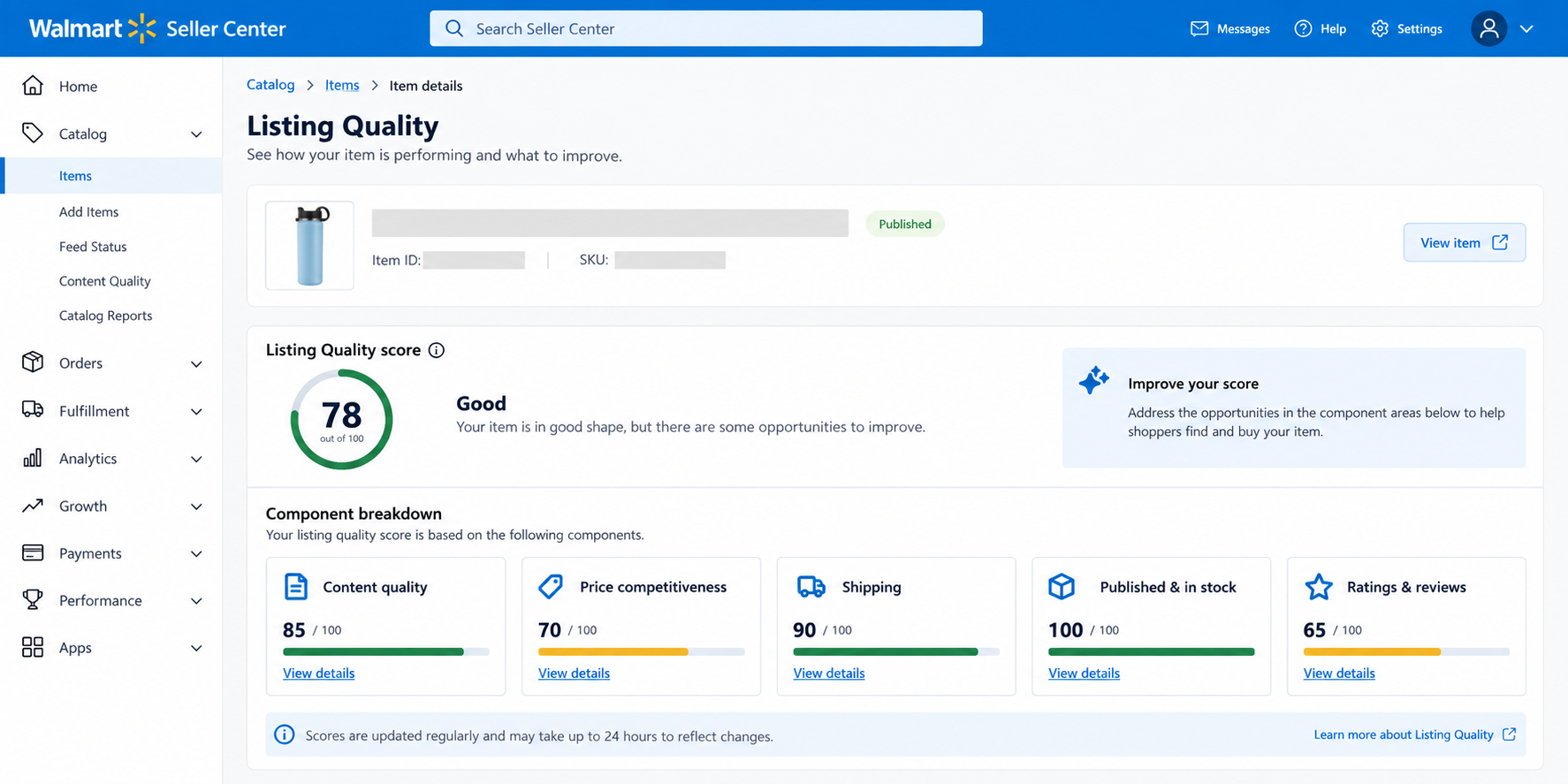
Content Quality
Content quality is the content-focused part of Listing Quality. Walmart currently reviews the item name, item description, key features, and images.
If this part is weak, check the product information for accuracy, clarity, completeness, and relevance. If Content quality is the weak component, review the item name, description, key features, and images. Check relevant attributes separately when you are diagnosing categorization, filtering, or search-discovery issues. For deeper content-specific diagnosis, see SalesDuo’s Walmart Content Quality Score guide. Do not treat the full Listing Quality score as a content-only problem.
Price Competitiveness
Price competitiveness is its own section of Listing Quality.
If a product or listing is lacking in this area, check the price, competing offers, and margin limits before rewriting the copy. Strong offer content can still perform poorly if shoppers think the offer is too expensive.
Shipping
Shipping evaluates the delivery speed you promised.
If this score is poor, fulfillment changes may matter more than listing copy changes. Check the shipping settings and the delivery promise shown to customers at checkout before assigning the issue to the content team.
Published & In Stock
Even a well-written listing cannot generate sales if customers cannot buy the product.
When availability is the main problem, fix the inventory or publishing issue first. This prevents the team from running content tests while the item is unavailable.
Ratings & Reviews
Ratings and reviews reflect customer feedback. They do not measure the quality of the title or description.
If this area is weak, look at the customer experience and Walmart-approved programs that may support review generation. Do not treat a review problem as a copy problem.
For a closer look at the content component, see Improving Walmart Content Quality.
How to Improve the Product Content Shoppers and Walmart Review
Once you confirm that Content quality is the problem, work on the fields that help customers understand the product and help Walmart place it in the right category.
Do not copy Amazon content into Walmart without checking it first. Also, avoid following fixed character or keyword rules unless Walmart’s current US guidelines support them for that product type.
Before making changes, compare the live product page with a trusted source of product information.
Confirm:
- Model
- Size
- Color
- Pack count
- Included parts
- Materials
- Compatibility
- Product-specific claims
This step prevents a common problem: making a page sound more convincing while making the product information less accurate.
Accuracy should come before adding keywords. Every later change depends on accurate product facts.
Item Name, Description, and Key Features
Start with truths just the facts. The product name needs to clearly describe what the product is and any details essential for a customer to differentiate it from similar products.
The description should explain what the product is, what buyers need to know, and how they can use it. Remove filler and avoid claims that you cannot support.
Key features should present the most useful buying details in an easy-to-scan format.
Use relevant search terms naturally. Do not turn the content into a list of keywords.
A strong listing should read like helpful product information written for a person. Repeating the same keyword across every field usually makes the page less useful.
Images, Attributes, and Categorization
Images should help shoppers understand and compare the product.
Use clear, accurate images that show the item, key details, and helpful use cases.
Attributes and product type also matter. They help Walmart identify the item and place it in search filters and categories. Missing or incorrect data can reduce visibility, and better copy may not fix it.
If an item appears under the wrong product type, treat it as a catalog problem. Use Walmart’s reports or troubleshooting options. Do not fill the description with category keywords to make up for incorrect structured data.
Keywords and Search Insights
Use Walmart Search Insights instead of guessing which terms matter.
These reports can show how shoppers find and interact with products through:
- Impressions
- Clicks
- Add-to-carts
- Sales
Search-query and related-keyword data may reveal useful terms. Add them only when they accurately describe the product.
The goal is not to place every search term in the item name. Use the data to find missing language, then add it where it helps the shopper.
Leave out any term that makes the listing less accurate, even if the term receives searches.
Search data can also show where the problem appears in the buying process.
If an item receives few impressions for relevant searches, review its product type, attributes, content relevance, and search-term coverage.
If impressions are healthy but clicks are low, review what shoppers see before opening the page. This may include the item name, main image, price, and delivery details.
If clicks are healthy but add-to-carts or sales are low, review the product page, offer, ratings, reviews, and customer value.
Use this process to narrow down the problem before changing the listing.
Content ownership is another issue to check before editing. Walmart prioritizes content from brand owners and authorized resellers. Some fields may stay locked or unavailable even when they are blank.
That is usually an ownership issue, not a Seller Center error.
How to Choose Which SKUs to Fix First
For a large catalog, editing the listing is often easier than deciding which listing deserves attention.
You can see Listing Quality scores and the items that need attention in Seller Center. If you're new to the dashboard, our Walmart Seller Center guide shows where each report lives.
A practical review should consider:
- Business importance
- Search opportunity
- Size of the problem
- Whether the team can make the change
- Time and work required
For example, imagine that you have 3 published SKUs.
SKU A is in stock, receives useful impressions, and has a content problem your team can fix. SKU B has little demand and a field your team cannot edit because of content ownership. SKU C has strong content but often goes out of stock.
SKU A will usually be the best listing project to start with. SKU C needs an inventory fix. SKU B needs an ownership review or another support path.
Do not create one universal “good Listing Quality score” or use fixed score weights unless your team has tested them against its own catalog.
Walmart’s recommendations, along with your own sales and search data, are more useful than a general cutoff.
The same idea applies to large catalog projects. Don't sort thousands of SKUs by one score and start with the lowest.
Create separate work lists instead:
- High-value items with content gaps your team can edit
- Availability problems for the operations team
- Ownership-restricted fields that need support or escalation
This keeps each team focused on problems it can solve. It also makes the results easier to measure.
How to Use Walmart GenAI for Listing Optimization
Walmart now offers GenAI suggestions in certain Seller Center tools.
In the Update item content individually flow in Seller Center, eligible sellers can choose “Enhance with GenAI” for content they can update.
Walmart also offers an “Edit listings with Gen AI” option in Success Hub.
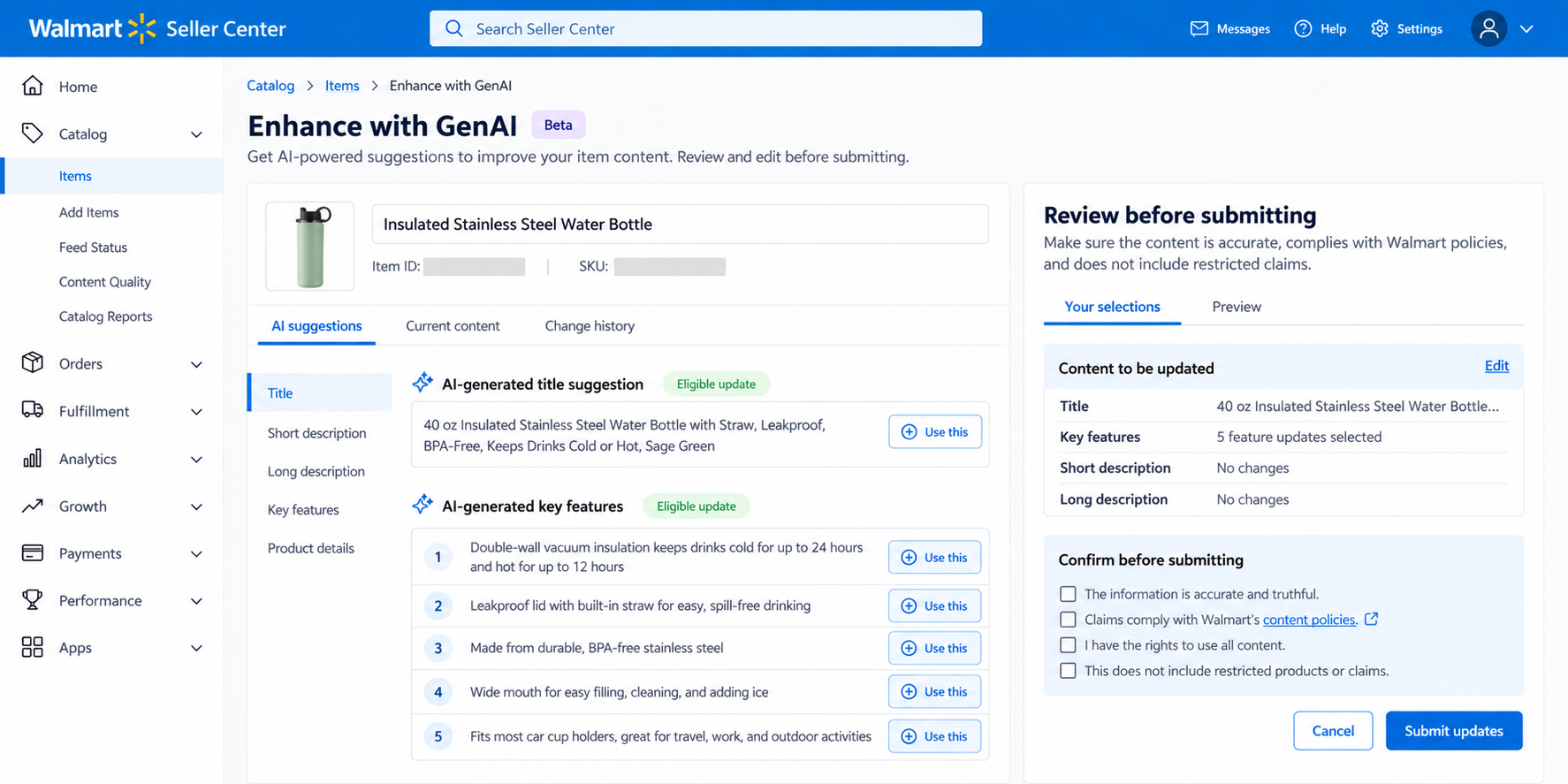
Walmart GenAI can suggest eligible content updates, but the seller still needs to review the facts, claims, rights, and policy compliance before submitting them .
Treat these suggestions as working drafts, not content to publish without review.
Walmart says AI-generated content must be accurate, truthful, compliant with content rights, and consistent with Marketplace policies. Sellers must review every suggestion because AI can make mistakes. The seller remains responsible for the product information.
The Success Hub GenAI guide focuses on the product name, description, and key features.
This makes the tool useful for content changes, but it does not replace the other Listing Quality components. Rewriting text cannot fix an out-of-stock item, weak price, or shipping problem.
Content ownership rules still apply. GenAI cannot help you get around a field restriction if Walmart does not allow you to update that field.
Check whether you can edit the content before building a plan around an AI suggestion.
- Open an eligible item-editing or Success Hub tool.
- Review the current content and Walmart’s suggested version.
- Check every product fact, claim, measurement, spelling, and use statement.
- Make sure the suggestion does not create policy, content-rights, or brand-voice issues.
- Submit only the changes you have permission to make.
- Record the edit so you can track the result.
How to Measure Whether Listing Changes Worked
The work is not complete until you measure the result.
A higher Listing Quality component score may show that Walmart accepted or recognized the change. Search and sales data can then show whether shoppers respond differently.
Walmart’s Search catalog performance report includes search impressions, clicks, add-to-carts, and sales.
The report may also show past trends and notes around content or price changes. This can help with before-and-after reviews.
Compare similar time periods and record any other changes that may affect performance.
A listing edit made during a promotion, advertising launch, stockout recovery, or seasonal demand increase cannot be measured on its own with complete confidence. Treat one before-and-after change as a useful signal, not final proof that one edit caused the result.
If advertising changes during the same measurement period, account for those changes before attributing performance shifts to the listing alone. For a deeper look at the paid-media side, see SalesDuo’s Walmart advertising strategy guide.
Listing changes rarely produce an immediate, isolated result. Review performance over a meaningful period and account for other changes such as advertising, inventory, promotions, seasonality, and customer demand before deciding whether the listing update helped.
If this process becomes difficult to manage across a large catalog, SalesDuo’s full-service Walmart growth support can help coordinate listing, catalog, pricing, inventory, and performance work across teams.
Common Walmart Listing Optimization Mistakes
Treating Walmart like Amazon with different labels: Basic product facts can stay the same, but Walmart has its own categories, attributes, policies, ownership rules, and tools. Adapt the listing instead of copying Amazon content.
Confusing Content quality with full Listing Quality: Better copy cannot solve every problem. Review all 5 components before assigning work to the content team.
Adding too many keywords or unsupported claims: Search relevance matters, but inaccurate language can make the product page less useful and create compliance problems.
Editing fields you do not control: Check whether Walmart allows your account to update the field before resending the same content.
Ignoring price, shipping, stock, or reviews while rewriting copy: If operations caused the weak score, fix the operational problem first.
Changing too many things without recording the date: If you do not track edits, it becomes difficult to tell what may have affected Listing Quality or search behavior.
For a wider marketplace comparison, see Walmart vs. Amazon listing differences.
When Walmart Listing Optimization Services Make Sense
Walmart listing optimization is often manageable in-house when your team can identify the weak Listing Quality component, control the required change, and measure the result.
Outside support becomes more useful when the problem spans several areas or teams. For example, content may depend on catalog ownership, pricing may sit with a commercial team, inventory may sit with operations, and measurement may involve both search and sales data.
The question is not simply whether you need someone to rewrite the listing. It is whether your team can diagnose the issue, route it to the right owner, make the change, and verify the result consistently.
Outside support may help when you have:
- A large catalog
- Repeated ownership or catalog problems
- Many tasks that depend on several teams
- No clear owner for auditing, editing, and measuring results
In these cases, the value goes beyond writing better copy. The service should help coordinate the right changes across the parts of Listing Quality that need attention.
If you are comparing providers, review Walmart SEO agencies. If you need ongoing catalog support, see SalesDuo’s full-service Walmart growth support.
Build a Repeatable Walmart Listing Optimization Cycle
Walmart listing optimization in 2026 should not be a one-time keyword rewrite.
Start with Walmart’s 5 Listing Quality components. Choose the item with the clearest opportunity. Fix the problem your team can control, then use Search Insights to see what happens.
If your catalog needs ongoing Walmart listing optimization across content, pricing, inventory, and performance, see how SalesDuo manages Walmart growth or book a Walmart growth conversation.
For your Amazon catalog, an Amazon listing optimization agency can apply the same principles to titles, bullets, and images.
Frequently Asked Questions about Walmart Listing Optimization
How Do I Optimize a Walmart Listing?
Start with the item-level Listing Quality breakdown. Find out whether the main problem is Content quality, Price competitiveness, Shipping, Published & in stock, or Ratings & reviews.
Fix the most serious issue your team can control. Record the change, then use Listing Quality and Search Insights to measure the result.
What Is Walmart Listing Quality Score?
Walmart Listing Quality is a score that reviews product quality across 5 areas: Content quality, Price competitiveness, Shipping, Published & in stock, and Ratings & reviews.
Walmart provides scores for individual items and an average for the catalog. Some components may show N/A and will not be included in the calculation.
What Is the Difference Between Walmart Content Quality and Listing Quality?
Content quality is one part of Walmart’s broader Listing Quality framework. It focuses on product content such as the item name, description, key features, and images. At the same time, Listing Quality also considers Price competitiveness, Shipping, published and in-stock status, and ratings and reviews.
How Can I Improve Product Listings on Walmart?
Start with live, in-stock products that have clear business or search value. Find the weakest Listing Quality component, then fix the related content or operational problem. If you need the field-by-field creation process instead, use the guide to setting up Walmart product listings.
Can Walmart AI Optimize My Product Listings?
Walmart offers GenAI suggestions for eligible content in Seller Center and Success Hub.
Use these suggestions as drafts that still need human review. Walmart requires AI-generated content to be accurate, truthful, compliant with content rights, and consistent with Marketplace policies.
Why Can’t I Edit Some Walmart Product Content?
Walmart prioritizes content from brand owners and authorized resellers.
If you don't have those rights, some fields may remain locked or unavailable even when blank. Check your content ownership status and Walmart’s troubleshooting process before resending the same edit.
How Often Should I Review Walmart Listing Quality?
Choose a regular schedule that fits your catalog size and how often it changes. Also check listings after major changes to content, price, inventory, or fulfillment.
Walmart does not require the same review schedule for every seller. Choose one your team can follow and measure.
Do I Need a Walmart Listing Optimization Service?
Not always. An in-house team can manage a smaller catalog when it controls the product data and needed changes.
Outside support may be more useful when catalog size, ownership issues, cross-team work, or regular measurement become too much for the internal team.
Can I Use the Same Product Listing on Amazon and Walmart?
The main product facts can stay the same, but adapt the listing to Walmart’s categories, attributes, policies, ownership rules, and platform tools.
Do not copy Amazon’s structure and assumptions without checking Walmart’s requirements.
About the Author
Meet Arjun Narayan, a Business Dynamo with two decades of conquering boardrooms and founding two companies that didn't just survive but thrived. When he's not navigating business strategies and delivery teams, you'll find him immersed in his love for cars and exploring new models, geeking out over tech trends, globe-trotting for new adventures, and occasionally pondering the mysteries of the universe over a good cup of coffee.