
Running Walmart and Amazon PPC Together: Budget Split and Strategy

There is no universal Amazon–Walmart PPC budget split. Ratios such as 80/20, 70/30, or 50/50 may work for individual brands, but the right allocation depends on profitable demand, product readiness, and the evidence available from each marketplace.
Begin with the amount that you can spend. Prioritize the protection of profitable Amazon campaigns and only move on to investing in Walmart advertising once your products, inventory, and reporting are ready.
Work out how much Walmart needs for a useful test according to the clicks and orders that your category could realistically produce.
The percentages you allocate to different budget categories should be determined as part of the planning process, not by using fixed percentages.
The one budget has to serve two purposes: it must protect the sales that are already being made, and it must also be used to find out whether Walmart is able to generate more profitable sales.
Achieving these objectives requires different methods of measuring success.
Before transferring money between different platforms, compare the profit margins for each SKU, use the same reporting periods, and decide on when the results are to be reviewed.
It makes sense to start with zero Walmart ad spending if Walmart isn't ready to give useful results.
What is the correct way to divide your PPC budget between Walmart and Amazon?
Begin by safeguarding the Amazon campaigns which are already performing well.
Only use the remaining budget for Walmart once you have checked that its products, listings, inventory, and reporting are all ready.
When both of the marketplaces have a reliable record of performance, it is necessary to compare the expected profit after advertising costs rather than focusing solely on ROAS.
Example: If a brand has a $10,000 monthly PPC budget, then in its existing successful Amazon campaigns, take away $7,500, and you are left with $2500 as a test for Walmart. If a Walmart test with the given product readiness, expected traffic, and conversion volume makes sense, the brand could test with a 75/25 split.
This is an illustrative scenario, not a recommended industry allocation or a minimum Walmart advertising budget. If Walmart is not ready or the available budget cannot generate useful evidence, the brand may be better off postponing the test.
Before deciding on any advertising actions, it is necessary to compare the total costs of selling on both platforms.
SalesDuo’s guide to selling on Walmart vs. Amazon explains the business costs and operational differences beyond PPC.
What Changes Between Amazon Ads and Walmart Connect?
Amazon Ads and Walmart Connect both offer cost-per-click (CPC) Sponsored Products advertising.
However, the way shoppers, ad placements, and reporting are handled varies from one platform to another.
Consider them to be separate advertising channels, each with its own costs and potential opportunities.
Data to align before comparing Amazon and Walmart PPC
Generate separate native reports per marketplace, and convert the definitions into a Finance or BI worksheet. Reported attribution sales should not be treated as incremental revenue.
The documentation for Amazon Sponsored Products CPC advertising and the criteria for product eligibility.
The overview of Walmart Connect Sponsored Products includes information on Walmart placements, relevance, and CPC billing.
Amazon Ads and Walmart Connect use separate advertising and reporting systems. Their sales attribution rules, conversion lookback periods, and available report fields may differ by ad product and account. Before comparing performance, confirm which sales each report credits, when those sales are reported, and how the periods align. Neither platform's product overview establishes that one marketplace consistently has lower CPCs or better returns.
If you want further information about setting up a campaign and regarding eligibility, refer to the SalesDuo Walmart Sponsored Products guide.
Build Your Starting Allocation in Five Steps
A good starting budget split should follow five checks:
- How much you can spend
- Which products are ready for advertising
- How much demand is available
- What your test needs to measure
- When you will review the results
Make a record of your assumptions so that you will be able to justify any future changes to the budget.
1. Set the Spending Limit and Protect Profitable Amazon Campaigns
Begin with the monthly advertising budget which has been approved by your Finance team.
First, find the Amazon campaigns that are already generating profitable results.
Consider their spending to be a protected initial budget rather than something you can immediately transfer to Walmart.
For example, if Amazon takes $7,500 out of the $10,000 budget, then $2,500 is left for Walmart.
If the amount of $2,500 isn't sufficient for carrying out a useful Walmart test, then the test should be postponed, or permission should be obtained to alter the budget.
2. Choose the SKUs That Are Ready for Advertising
Before making any ad spending, check the product's offer, product listing, price, promotions, inventory, eligibility for advertising, and profit margin.
A product that does well on Amazon might not perform in the same way on Walmart.
The fees for selling, the costs of fulfillment, returns, and discounts vary from one marketplace to another.
Do not start Walmart PPC for products with:
- Unstable or low inventory
- Advertising eligibility problems
- Weak product listings
- Negative profit margins before advertising
- No one responsible for reviewing results
For campaign setup, eligibility, and Walmart-specific advertising mechanics, refer to SalesDuo's Walmart PPC campaign guide.
3. Estimate Clicks, Orders, and the Data You Need
Plan the test using the CPC, conversion rate, customer demand, and purchase timing data that you have available.
When introducing new SKUs, be sure to indicate that the forecasts are merely estimates.
Two simple formulas can help:
Estimated clicks = Advertising budget ÷ CPC
Estimated orders = Estimated clicks × Conversion rate
For example, assume:
- Walmart advertising budget: $2,500
- CPC: $1.00
- Conversion rate: 4%
If the full $2,500 budget were spent at an average CPC of $1.00, it would generate an estimated 2,500 clicks. At a 4% conversion rate, that would imply approximately 100 orders. Actual results may be lower if there is insufficient relevant demand, limited ad delivery, changing CPCs, or weaker conversion. These are planning assumptions, not Walmart performance benchmarks.
These figures are based on assumptions concerning future planning and not an indication of Walmart's usual performance.
If the category is not likely to produce a sufficient number of relevant clicks and orders, then you should either give it more time for testing or concentrate on a smaller number of SKUs.
4. Set Aside a Separate Walmart Testing Budget
Set aside a certain amount of money to find out what works on Walmart.
Keep the money apart from the budget so as to protect the profitable Amazon campaigns.
Rather than distributing the test over the entire catalog, concentrate it on a useful subset of the eligible products.
Also split the money spent on finding new search terms from the money spent on supporting demand that has already performed well.
If the cost of the testing goes beyond the amount that had been planned, then you should either reduce the scope of the testing or look over the budget.
5. Choose a Review Date and Assign Owners
Decide who owns reporting, who reviews financial results, and when the team will make the next budget decision.
The review should take place only after a sufficient period of time has elapsed so that the data from customer purchases and advertising reports becomes useful.
Decide on the grounds that would lead to increasing, maintaining, or decreasing Walmart's spending.
A simple approach is to:
- Keep the current Amazon budget.
- Each week, check whether Walmart is ready.
- Only change spending if the profit expected from the next increase justifies doing so.
Make a record of each decision, together with its possible disadvantage, the actual outcome, and any changes to inventory or pricing that might have affected performance.
Compare Budget Choices by Profit, Not ROAS Alone
ROAS indicates the amount of sales revenue that you get from advertising for each dollar spent on advertising.
ACoS is presented as the amount spent on advertising expressed as a percentage of sales attributable to advertising.
The metrics do not take into account product costs, marketplace fees, fulfillment, returns, or other expenses.
The amount of profit left after advertising can vary between Amazon and Walmart.
Amazon’s ACoS and ROAS guide uses these formulas:
ROAS = Ad-attributed sales ÷ Ad spend
ACoS = (Ad spend ÷ Ad-attributed sales) × 100
Simplified break-even ROAS = 1 ÷ Pre-ad contribution margin rate
Illustrative contribution after ads = (Attributed sales × Pre-ad contribution margin rate) − Ad spend
The pre-ad contribution margin covers the relevant product costs, referral fees, fulfillment, promotions, and returns. Advertising costs are not included.
When comparing the two marketplaces, apply the same rules to revenue and taxes.
Example: $10,000 Monthly PPC Budget
The figures given below are purely hypothetical and do not represent SalesDuo's actual results or serve as industry benchmarks.
In this hypothetical example, Walmart reports a higher ROAS of 4.2×, but Amazon retains more modeled contribution after advertising for every dollar spent: $0.14 versus $0.05.
It doesn´t automatically follow that the other dollar has to go to Amazon. The brand needs to understand expected contribution from extra spend, available demand, inventory, and the variance in those estimates before shifting its budget between the platforms.
If the contribution margin from sales at Walmart before advertising increased from 25 percent to 30 percent and all the other factors remained unchanged, its contribution after advertising would amount to $650.
That is the reason why changes in profit margins can affect your budget decisions even if the ROAS remains unchanged.
These calculations serve as comparative tools and do not demonstrate that the ads caused the sales.
Amazon and Walmart could be using different rules for attributing sales and different reporting periods. It is also possible for customers to shop on both channels.
The number of sales that are attributed to advertising doesn't show you how many orders would not have taken place anyway.
Combine the marketplace reports with the net sales and margin data that your Finance team has.
If you want more conclusive evidence that advertising has led to extra sales, then you can carry out controlled tests.
It should be noted that average performance does not ensure that the next dollar will yield the same return.
Run Each Platform Differently While Coordinating the Plan
For Amazon and Walmart PPC, use a single shared budget plan, but manage the search terms, the bids, the targeting, and the campaigns separately.
Amazon search terms can be useful when planning Walmart campaigns, but they should not be copied directly into Walmart without first testing them.
Before allocating large budgets to those terms, it is necessary to check Walmart demand and conversion.
Each platform should have two clear spending goals:
- Demand that is already profitable should be protected.
- Offer tests in order to attract new demand.
At Walmart, it is important to keep the new keyword tests separate from those campaigns which are already showing acceptable results.
When using Amazon, do not terminate strong campaigns merely in order to hit a desired budget percentage.
SalesDuo’s Amazon PPC strategy covers more details about managing Amazon campaigns.
The updates regarding pricing, promotions, inventory replenishment, catalog problems, and SKU-level profit margins should be provided by both marketplace teams.
A discount may improve conversion but still make a sale unprofitable, especially when inventory is low.
This 30/60/90-day schedule is an example, not a required timeline.
Products with longer buying cycles, seasonal demand, or fewer orders may need more time.
A sudden inventory problem may require an earlier decision.
Use matching date ranges and keep total marketplace sales separate from sales credited to advertising.
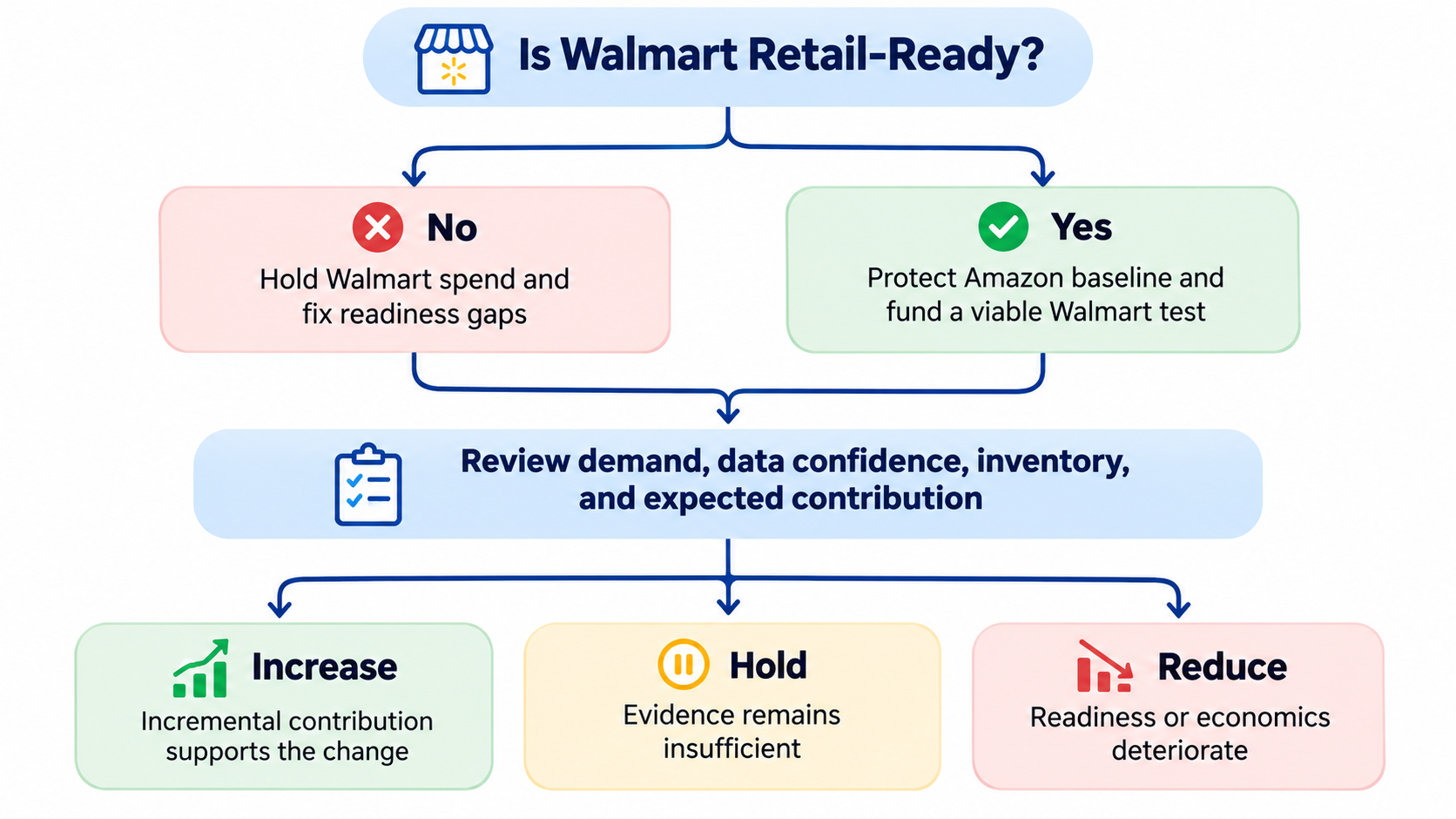
When to Increase, Hold, or Cut Walmart Spend
Increase Walmart spending only when inventory, demand, and expected profit from extra advertising support the decision.
Keep spending steady when there is not enough reliable data.
Reduce or pause spending when product availability or profit margins change enough to make the original plan unsuitable.
At every budget review, record the SKU or campaign, current spend, stock position, pre-ad margin, available demand, reporting limitations, and expected contribution from the proposed change. Compare that opportunity with the Amazon spending it would replace. Document the decision, owner, next review date, and conditions that would trigger a reversal.
Compare the expected results of extra Walmart spending with the opportunities available on Amazon.
When the data is uncertain, make smaller budget changes and set another review date.
One day of high ROAS is not enough reason to change the full advertising plan.
For brands running both channels, one person should be responsible for the shared budget decision and reporting.
Common Mistakes When Managing Walmart and Amazon PPC Together
The biggest mistake is treating a convenient budget split as a rule for performance.
A fixed 80/20 or 70/30 split does not make sense without knowing how much Amazon needs, which Walmart products are ready, and what budget is required for useful testing.
Another mistake is moving money based only on the ROAS shown in two dashboards without checking how each platform credits sales.
Copying Amazon bids, match types, and campaign structures directly into Walmart also ignores differences in shopper demand and advertising controls.
Running ads for products with low inventory or eligibility problems can waste your testing budget.
Reporting mistakes can create confusion, too. Teams should not mix ad-attributed revenue with organic sales or assume orders credited by both platforms represent separate new customers.
Claims about results should match what the evidence actually proves.
For example, SalesDuo’s Izzo Golf Walmart advertising case study covers Walmart advertising performance.
It does not prove that splitting a budget between Amazon and Walmart caused additional sales.
For shared-budget decisions, use real performance records from both marketplaces or clearly labeled example calculations.
Make Your Next Budget Shift Based on Evidence
A useful Amazon and Walmart PPC budget split starts with your spending limit, a protected Amazon budget, Walmart products that are ready for advertising, and enough money for testing.
Change the split only after comparing profit-adjusted results and deciding what additional spending is expected to achieve.
Sometimes the right Walmart budget is a small, focused test. Other times, it is zero until listings, inventory, or reporting improve.
If your brand already runs profitable Amazon campaigns and is evaluating Walmart expansion, explore SalesDuo's Walmart ad agency services to review product readiness, budget priorities, and reporting responsibilities before moving spend.
Frequently Asked Questions about Walmart PPC
Is an 80/20 Amazon-to-Walmart PPC Split a Good Starting Point?
Only when your actual Amazon spending needs and Walmart testing budget support that split.
There is no universal percentage. Start with what each channel needs, not a fixed ratio.
Should I Take Budget Away From Profitable Amazon Campaigns?
Not just to start advertising on Walmart.
Protect campaigns that generate positive contribution profit while demand is available.
Move budget only when the evidence suggests the next Walmart advertising dollar may produce a better return after considering risk.
Can I Reuse Amazon PPC Keywords and Bids on Walmart?
You can use Amazon search terms, product themes, and customer language as ideas.
But check Walmart eligibility, targeting options, bids, and conversion results before using them.
Do not copy campaign settings directly.
Which Marketplace Has the Better ROAS?
Neither marketplace automatically has better ROAS.
Compare profit after costs, reporting rules, and expected results from additional spending.
A higher average ROAS can still produce less contribution profit.
How Long Should I Test Walmart Ads Before Shifting Budget?
Test long enough to collect useful clicks and orders while allowing for the customer buying cycle and reporting delays.
Set review dates, but make your decision based on the quality of the evidence.
Do Amazon and Walmart Use the Same Attribution Window?
Do not assume they do.
Check each account’s ad type, reporting definitions, conversion lookback period, and reporting delays before comparing metrics.
When Should I Hire a Walmart PPC Agency?
Consider an agency when preparing products for ads, managing campaigns, and reporting across both platforms requires more time or expertise than your team has available.
Make sure the agency understands who controls the budget and what contribution-profit targets it must follow.
About the Author
Meet Aryan Suyal, an SEO Content Writer Intern at SalesDuo who excels at turning patterns into precise, on-point content. He brings sharp insights and analytical thinking, along with a builder's instinct for creating systems that help ideas work smarter. Outside of work, you'll find him getting lost in books, tinkering with and building AI systems, or losing hours to a good documentary.