
Search Suppressed Amazon Listings And How to Fix It
A search-suppressed Amazon listing can still be found in the catalog, but it is hidden from browse or search because the content does not provide sufficient information, is non-compliant, or is under review. In Seller Central, go to Manage All Inventory or Fix Your Products, locate the item with the alert, fix the problem with that specific field or policy, and then check to see that it is visible again.
Focus on the problem Amazon shows, rather than on declining sales or an unsuccessful keyword search. The same symptom can also be caused by a deactivated listing, stranded inventory, a deleted detail page, keyword non-indexation, or Buy Box negation and each status requires a separate workflow.
60-second triage
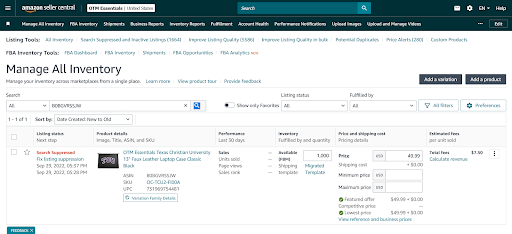
- Navigate to Inventory > Manage All Inventory and look at the listing-status filters for “Search suppressed” or “At risk of search suppression.”
- Open the issue tab or Fix Your Products and note the precise field, policy message or document request.
- When responding, correct the root cause only that was flagged, save proof evidencing of the change made, and apply the processing window as shown in your account.
- If the status still doesn't clear within that window, review catalog contribution control and file a documented support case.
Search-Suppressed vs. Inactive, Stranded, Blocked, Unindexed, and Buy Box-Suppressed
A true search-suppressed listing is a catalog visibility problem: the ASIN exists, but Amazon hides it from search or browse until the stated information or policy issue is resolved. It is not a catch-all label for Amazon listing errors and error codes, offer inactivity, or account enforcement.
| What you see | Likely state | Verify first | First action | Do not confuse with |
|---|---|---|---|---|
| ASIN or direct link exists, but shoppers cannot find it in search | Search suppressed | Manage All Inventory / Fix Your Products | Open the flagged issue and correct that field or policy problem | Keyword non-indexing |
| Warning says “at risk of search suppression” | Pre-suppression warning | Activate listings > At-risk quick filter | Resolve the warning before visibility is restricted | Already suppressed |
| No active offer, no price, or no inventory | Inactive listing or offer | Manage All Inventory / inventory tools | Restore a valid offer, price, or inventory | Search suppression |
| FBA inventory is disconnected from an active listing | Stranded inventory | Fix Stranded Inventory | Reconnect or repair the offer-listing relationship | Search suppression |
| Detail page is removed or a policy notice appears | Blocked or removed listing | Account Health / Performance Notifications | Follow the evidence or appeal path | Editable field issue |
| Detail page is visible, but a keyword does not return the ASIN | Keyword non-indexing | Search-term and indexing checks | Review search terms and relevance | Search suppression |
| Detail page is visible, but the offer is not featured | Buy Box suppression | Pricing and Featured Offer diagnostics | Diagnose offer eligibility and pricing | Search suppression |
Use the Amazon keyword indexing and search terms guide when only specific queries fail. Use the Buy Box suppression diagnosis guide when the page is discoverable but the Featured Offer is missing.
If Account Health shows a listing removal or account-level action, follow the applicable policy notice and the Amazon account reinstatement and appeals workflow instead of repeatedly editing the catalog field.
How to Find the Exact Suppression Reason in Seller Central
For Amazon.com accounts, the current public guidance points sellers to Inventory > Manage All Inventory, then Activate listings and the “Search suppressed” or “At-risk of search suppression” quick filters. The labels and right-side issue panel can vary by account rollout, product type, and marketplace.
1. Filter the catalog. Open Manage All Inventory and select the relevant suppression or at-risk filter. If the filter is absent, confirm that the account currently has affected listings.
2. Open the issue. Read the exact message and identify whether Amazon is requesting an attribute, image, content change, compliance document, or different workflow.
3. Check Fix Your Products. Use the editable Issue(s) field when available. For larger catalogs, download the suppressed listings report if that option appears in the account.
4. Check adjacent systems only when the signal points there. Use Listing Quality for catalog-quality warnings, Account Health for policy violations, and Performance Notifications for removal details.
5. Capture the source of truth. Save the ASIN, SKU, screenshot, current value, requested value, timestamp, and any file or batch ID before making changes.
Amazon’s suppressed listings help page describes direct edits in the issue column and image replacement for image-related suppressions. Its discoverability guidance also documents the current quick-filter path for suppressed and at-risk listings.
Search Suppression Causes: Use the Signal, Not Guesswork
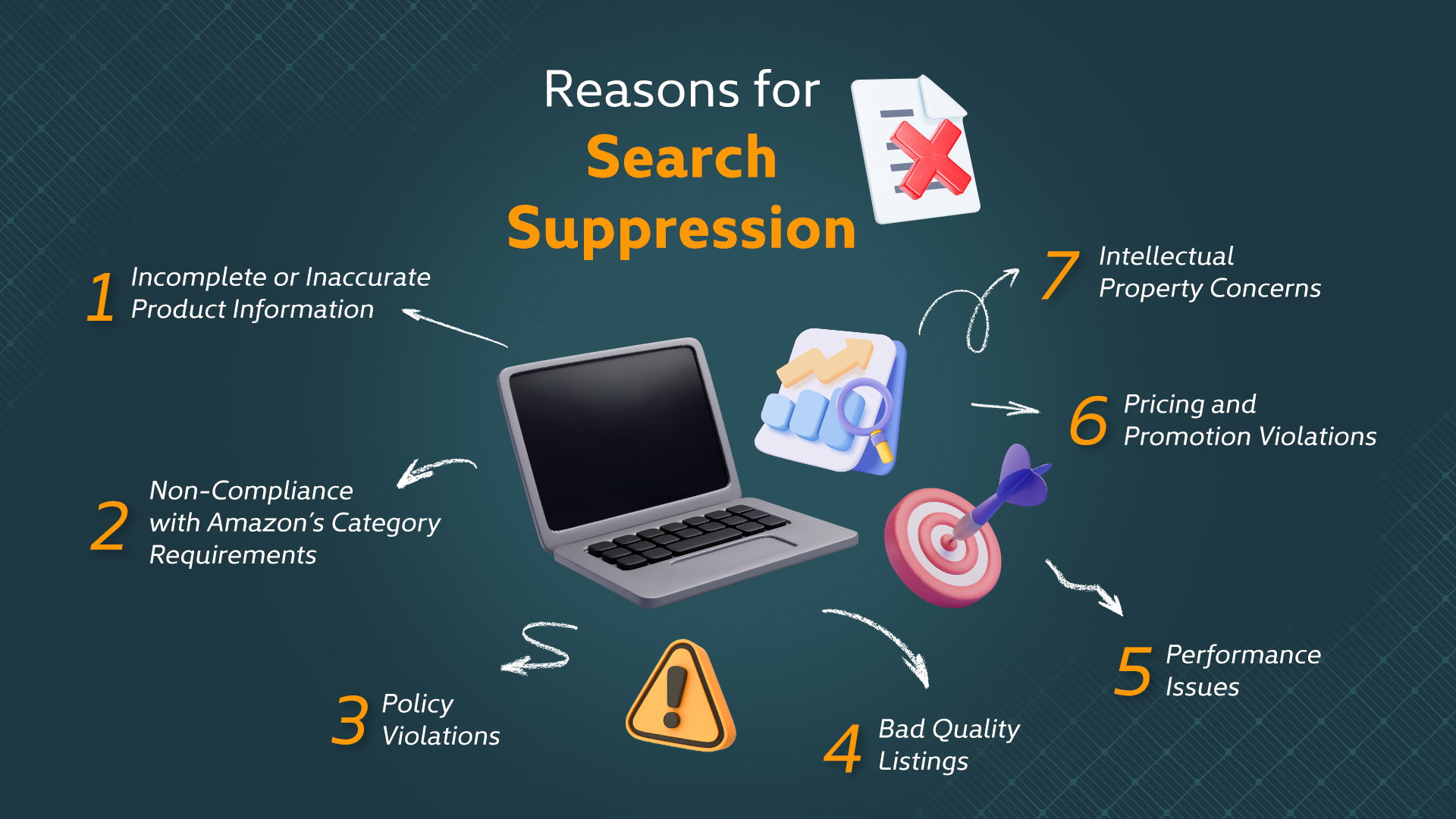
Amazon does not use one universal list of suppression triggers across every product type. Treat the message shown in Seller Central as the primary evidence, then place it in the closest issue family below.
| Issue family | Typical signal | Where to verify | First action | Escalation trigger |
|---|---|---|---|---|
| Missing or invalid attributes | A named field is blank, invalid, or rejected | Issue(s) column / Edit Product Info | Correct the requested category-specific value | The saved value does not publish |
| Title, image, bullets, or description | Amazon flags a specific content element | Fix Your Products / image or content editor | Correct the exact non-compliant element | Image review or catalog contribution blocks it |
| Restricted product, claim, or documentation | Policy or document request appears | Account Health / Manage Your Compliance | Remove unsupported claims or submit authentic evidence | The issue requires review or appeal |
| Variation, duplicate, or contribution conflict | Edits save but the live detail page does not change | Live page, submissions, Brand Registry, case history | Correct relationship data or submit evidence through the right channel | Another contribution controls the field |
| Different visibility state | No suppression signal appears | Inventory, pricing, FBA, indexing, Account Health | Move to the owner workflow | The problem is not search suppression |
Fix Path 1: Missing or Invalid Required Attributes
Follow this path when Seller Central tells you an attribute is missing or invalid. Don't steal a generic required-field list from another category; required values may vary by product type / marketplace.
- Paste the exact attribute name and error text into the incident log.
- Enter a simple value in the Issue(s) editable cell. Edit Product Info for context, unit, or related attributes.
- If you have Multiple SKUs, use the current category template or the supported bulk workflow and keep the submission or batch ID.
- Test the saved value in Seller Central and on the live detail page. A good save does not guarantee that the catalog contribution has been changed.
- Kick up a valid but not publishing value, or a field is locked, contested, or mapped to the wrong product type.
Bias the change narrowly. If you edit an unrelated field, that can create new conflicts, overwrite useful content, and/or make it harder to demonstrate which submission resolved the suppression.
Fix Path 2: Title, Image, Bullets, or Description Problems
Content should only be considered as the cause when Amazon informs you of that content. A substandard listing may convert poorly without getting search suppressed, so rest assured you don't need to rewrite the entire page if a single field is the one being flagged. A weak listing can convert poorly without being search suppressed, so there’s no need to rewrite the entire page if one field is flagged.
Title checks
Amazon Title requirements from 21st January 2025: Most categories are applicable to a 200-character maximum, ban some special characters, and in general forbid repeating the same word more than twice (exemptions for common function words). Check the current category rule before editing. For deeper policy context, use the Amazon product title requirements guide.
Main-image checks
Amazon’s current image recommendations include a professional, clear main image with a white background, the product occupying at least 85% of the image area, no text or watermarks, and at least 1,000 pixels on the longest side to enable zoom. Verify the category exceptions and re-upload the correct image through the issue panel or image manager. See Amazon’s product image requirements.
Bullets and descriptions
Fix the cited content, but do not insert unsubstantiated claims, irrelevant keywords, competitor brand names, or text that contradicts the product. If a direct edit doesn't publish, log the old and new values and, instead of resubmitting the same content time after time, move to the contribute-conflict workflow.
Fix Path 3: Restricted Products, Claims, or Documentation
A path of evidence is needed for, let's say, compliance-related suppression. Don't hide a prohibited word, delete a mandatory disclosure, or keep submitting the content without fixing the underlying issue with the product, claim, or documentation.
- Read the exact Account Health policy or compliance request and know what product, claim, documentation, and deadline are involved.
- Only strip out unsupported or disallowed claims. Retain legally required warnings and disclosures.
- Gather genuine, unedited test reports, certificates, invoices, authorization files, or product images, if any, for the issue raised.
- Upload the documentation via the workflow provided by Amazon, such as Manage Your Compliance or the listing-level appeal path.
- Watch the case and account-level status separately from the search-suppression flag.
Use the restricted keywords and claims on Amazon guide for language review, and the Amazon compliance documentation guide for document preparation. Amazon’s restricted products policy warns that inaccurate descriptions used to evade restrictions can trigger enforcement.
For account-level monitoring, use the Amazon account health and policy monitoring workflow. Amazon also provides a Manage Your Compliance dashboard for submitting and tracking product compliance information.
Fix Path 4: Variation, Duplicate, and Contribution Conflicts
A contribution conflict can occur when Seller Central accepts a submission for edit, but the live detail page still shows the old value, a field is locked, or a child ASIN inherits incorrect shared content. Amazon detail pages are shared catalog records; anyone who sells or manufactures the product may contribute information .
- Compare the live detail page to your submitted value, the child or parent ASIN concerned, and the suppression message.
- Verify the variation relationship, product ID, product type, brand, and category are accurate prior to modifying content.
- Apply a supported category file for the relationship or to fix several attributes at once. Retain the processing report and batch ID.
- If the value still does not publish, open a case with a concise change log and product evidence. Do not submit multiple cases; they split the record.
- Have support examine the disputed attribute or catalog entry, and supply the manufacturer or brand source to demonstrate the correct value.
Amazon explains that sellers and manufacturers can contribute product information, but a suggested change is not guaranteed to be accepted. Review its product detail page contribution guidance before escalating. Use the broad listing-error hub for variation and feed errors that do not involve search suppression.
What to Do When the Listing Is Still Suppressed
First, use the processing status and the time frame that appears in your account. Amazon's guidance outlines different windows based on workflow, so there is no safe universal restoration promise. When the window displayed has passed, quit blind editing and construct a single evidentiary packet.
Persistent-suppression checklist
- The correct field is saved, but the live catalog still shows the old value.
- The image is uploaded but remains under review, rejected, or not selected as the main image.
- The product type, category, or variation relationship makes the requested value invalid.
- Another catalog contribution appears to control the field.
- A policy or compliance review is still open.
- The listing is actually blocked, inactive, stranded, unindexed, or Buy Box-suppressed.
Case evidence packet
| Packet section | Include |
|---|---|
| Identity | Marketplace, ASIN, SKU, parent/child relationship |
| Amazon signal | Exact suppression reason, issue screen, date and time |
| Change record | Old value, new value, method used, submission time |
| Submission proof | Batch ID, processing report, spreadsheet, or image upload |
| Product evidence | Manufacturer page, packaging, GS1 or brand documentation when relevant |
| Validation | Live-page screenshot, search check, and suppression status after the stated processing window |
| Case control | Single case ID, owner, last response, next action |
Amazon’s search-suppression escalation guidance specifically recommends the ASIN, suppression reason, attempted steps, batch IDs or spreadsheets, manufacturer evidence, and screenshots when a corrected listing remains suppressed.
How to Fix Suppressed Listings in Bulk
For a large inventory, consider suppression an incident queue, not a manual-browsing job. Download the available suppressed-listings report, normalize the issue messages, assign an owner, and track validation separate from submission.
- Export the affected ASINs and at-risk warnings.
- Group them according to issue family and remediation.
- Prioritize compliance, revenue at risk, active advertising, and date-sensitive (seasonal) issues.
- Make direct edits, category files, image uploads, or evidence submissions in manageable batches.
- Retest the suppression and live page; log recovery or escalation.
- Run a root-cause review for recurrent issue families.

Watch this Youtube video by Amazon Seller University on how to fix suppressed or inactive product listings.
SalesDuo revenue-at-risk priority score
Priority score = (daily ordered revenue of the ASIN in recent days × the number of estimated suppressed days) + at-risk active advertising spend + inventory risk weight + compliance risk weight.
Example for illustration: ASIN A has an average sales of $500/day, has been suppressed for 2 days, has $120/day in active ad spend, and a $250 medium compliance-severity weight. Priority score = ($500 × 2) + ($120 × 2) + $250 = $1,490.
Apply the SalesDuo operating model to sales only for your internal workload management. It doesn’t prove lost revenue, because users might buy other ASINs, ads might stop running, seasonality can fluctuate, and some direct traffic might stick around.
Amazon Search Suppression Incident Log template
| Stage | Required fields |
|---|---|
| Detection | Date detected; marketplace; ASIN; SKU; revenue tier; ad status |
| Diagnosis | Suppression state; Amazon message; issue family; source screen |
| Action | Owner; change made; method; evidence; batch ID; case ID |
| Validation | Recheck timestamp; status; live-page result; search result |
| Prevention | Root cause; preventive control; closure date; repeat incident |
Brands with repeat or multi-ASIN incidents may need full-service Amazon account management to keep ownership, evidence, and validation consistent across the catalog.
Prevent Repeat Search Suppression
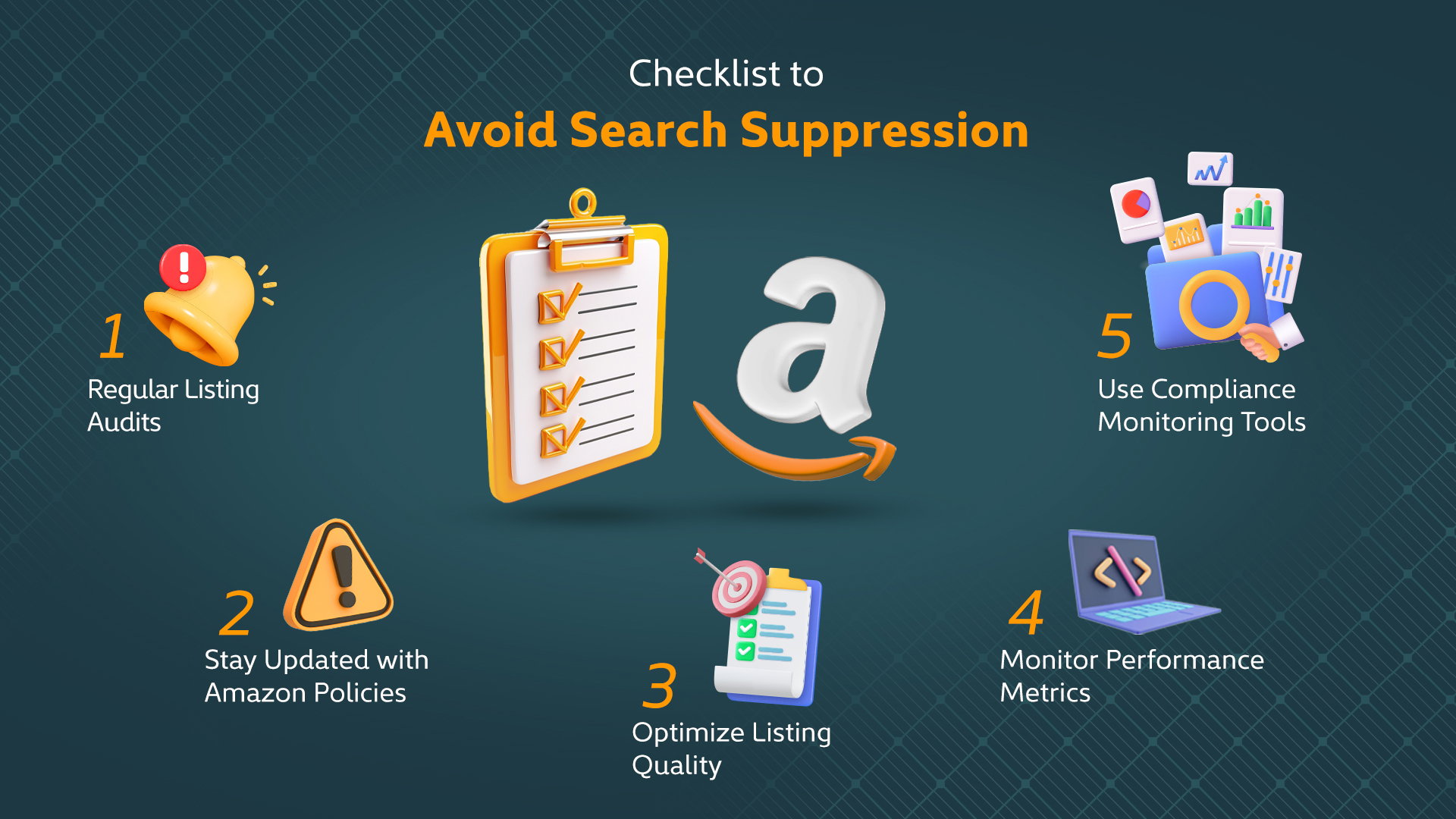
Prevention is effective when the catalog has owners, checkpoints, and proofs. “Audit regularly” is not enough specify which signal is audited, who takes action, and how remediation is verified.
| Cadence | Control | Owner |
|---|---|---|
| Before publishing or major edits | Validate required category attributes, title, main image, claims, variation structure, and documentation. | Catalog owner |
| After a content or relationship change | Check submission processing, live-page values, suppression filters, and high-priority search visibility. | Change owner |
| Daily for high-risk catalogs | Review alerts, Account Health, active policy requests, and newly suppressed high-revenue ASINs. | Operations lead |
| Weekly | Download or review suppressed and at-risk listings; assign owners; close or escalate aged incidents. | Catalog manager |
| Monthly | Analyze repeat causes, contribution conflicts, category migrations, and controls that failed. | Catalog + compliance lead |
| Event-driven | Recheck after Amazon policy updates, category changes, bulk uploads, or account-role changes. | Relevant SME |
Use an Amazon product listing optimization checklist for broader quality controls, but keep search-suppression monitoring as its own operational queue. Track leading indicators such as at-risk warnings, unresolved document requests, failed bulk submissions, locked fields, and repeated cause families.
When to Use SalesDuo
Self-serve fixes are successful when there is a field that can be edited named by Amazon, and the update is live. Professional assistance is more valuable for repeated suppression, mass-ASIN, controversial contributions, compliance evidence, or when the in-house catalog owner is not obvious.
SalesDuo can support catalog diagnosis, content correction, monitoring, and recovery through Amazon listing optimization support and managed account operations.
If search suppression keeps returning—or your team is managing hundreds of ASINs—SalesDuo can help diagnose catalog conflicts, correct listing content, monitor at-risk products, and manage the recovery workflow.
Conclusion: Classify, Fix, Validate, Escalate, Prevent
The fastest safe route is to classify the visibility state, follow the exact Seller Central signal, correct the root cause, and validate the live result. When the change does not persist, stop repeating edits and escalate with a complete evidence packet. For recurring or multi-ASIN problems, add an incident log, ownership rules, and a prevention cadence so suppression becomes a controlled operating issue rather than a recurring surprise.
Book a 1:1 growth call with SalesDuo to review the affected catalog and the operating controls needed to keep listings searchable.
Frequently Asked Questions About Search Suppressed Listings
1. What does “search suppressed” mean on Amazon?
A search-suppressed product is one that is in Amazon’s catalog but is not visible on search or browse due to missing, invalid, non-compliant, or under review information as determined by Amazon. The Product detail page may still be accessible via a direct link. Please check the status in the Manage All Inventory, Fix Your Products page before you re-list.
2. How do I find search-suppressed listings in Seller Central?
Open Manage All Inventory (page); select Activate listings; then select the quick filter Search suppressed. For the latest Amazon.com guidelines. Filter out warnings with At-risk of search suppression. User interfaces may change, and a filter may only be shown when there are listings affected.
3. What is “at risk of search suppression”?
This is a preemptive warning before Amazon decides to suppress search visibility. Open the warning, note precisely what is wrong, and fix it by the stated deadline / enforcement point. An at-risk listing should not be treated as if it is already suppressed, and check that the warning disappears after the change.
4. Can an Amazon listing be active but not searchable?
Yes. A search-suppressed ASIN can remain in the catalog and may be reachable by direct link while being hidden from search or browse. A listing can also be active but fail to index for a particular keyword, which is a search-term issue rather than automatic proof of suppression.
5. Why is my listing still suppressed after I fixed the issue?
The update may still be processing, the image or content may be under review, the product type or category may reject the value, or another catalog contribution may control the field. Use the processing window shown in your account, then submit one evidence-led case with the change log and screenshots.
6. How long does it take Amazon to restore a suppressed listing?
There is no reliable universal restoration time. The window depends on the field, update method, review state, product type, and marketplace. Follow the processing message displayed in Seller Central. If that window passes, validate the live value and escalate with a documented case packet.
7. Does a missing image suppress an Amazon listing?
It can when Amazon flags the required main image for that listing. Upload an image that meets the current requirement and confirm it becomes the selected main image. Do not assume every image-quality problem is a suppression trigger; use the exact issue shown in Seller Central.
8. Can restricted keywords cause search suppression?
Restricted or unsupported claims can lead to listing-level or account-level action, depending on the product and policy. Remove only the non-compliant claim, preserve required disclosures, and submit authentic documents when requested. Do not disguise restricted language or resubmit without correcting the root cause.
9. Is search suppression the same as Buy Box suppression?
No. Search suppression limits discovery of the ASIN in search or browse. Buy Box suppression affects whether an offer is displayed as the Featured Offer on a visible product page. Check the listing-status signal first, then use the workflow that owns the actual state.
10. How can I monitor suppressed listings across a large catalog?
Use the suppressed and at-risk report or filters, group incidents by cause, prioritize revenue and compliance exposure, assign an owner, and log every change and validation. Review high-risk alerts daily, the full queue weekly, and repeat causes monthly so the same issue does not keep returning.
About the Author
Meet Sparsha Chatterjee, a seasoned content writer specializing in Amazon businesses, crafting compelling, sales-driven content that boosts visibility and conversions. Beyond work, he enjoys reading storybooks, traveling to new places, and watching captivating movies.