Top Amazon Influencer Marketing Agencies 2026
Amazon influencer marketing agency that helps brands discover and manage creators, coordinate on content and usage rights, monitor traffic from off-Amazon sources, and fuel campaigns to drive sales goals on Amazon.
Before choosing an agency, look closely at its Amazon experience, creator-vetting process, reporting, content-rights terms, and experience in your product category.
This guide compares five agencies using the same criteria. It also explains the differences between managed agencies, self-serve platforms, in-house teams, Amazon Creator Connections, and affiliate programs.
Quick answer: Which Amazon influencer agency is right for which brand?
No one agency is right for every Amazon brand. The more relevant question is which agency best fits your channel mix, internal resources, creator demands, reporting requirements, and content rights needs.
The table below is a factual comparison, not a ranking.
| Agency | Best for | Amazon-specific creator scope | Creator sourcing / vetting | Measurement | Rights | Channels | Pricing transparency | Primary limitation | Evidence checked |
|---|---|---|---|---|---|---|---|---|---|
| SalesDuo | Amazon brands that want influencer campaigns connected to broader marketplace work | Managed influencer strategy, campaign management, analytics, reporting, and AI-powered execution | SalesDuo identifies creators aligned with the brand and evaluates factors such as audience fit, engagement, Amazon experience, category knowledge, content quality, location, and brand safety. | Public service page highlights analytics and reporting; confirm the exact Amazon Attribution setup in the proposal. | Content creation is included publicly; confirm exact usage rights in the contract.t | Not clearly listed on the current service page | Custom / not publicly listed | No influencer-specific client result was verified in the supplied materials | 18 Sep 2026 |
| BellaVix | Brands looking for Amazon-focused influencer and micro-influencer support | Public Amazon Influencer Program page covers creator identification, collaboration, negotiation, execution, and reporting | BellaVix publicly describes identifying niche influencers, soliciting creators for collaboration, negotiating terms, and using relevant metrics to identify suitable influencers | Campaign analytics are described; Amazon Attribution use is not clearly stated | UGC access is described; exact licensing and reuse terms should be confirmed | Instagram and Amazon influencer activity are publicly described | Not publicly listed | Public page includes older review-program language that should be checked against current policy | 18 Sep 2026 |
| WebFX | Brands that want a large digital agency with broad creator and marketing services | General influencer service covers research, outreach, contracts, and tracking; separate Amazon services are also offered | WebFX publicly documents audience research, data-driven influencer research, creator matching, outreach, and vetting based on audience/brand fit, reputation, history, followers, views, engagement, and past content performance. | Influencer reporting is public; Amazon-specific influencer tracking is not clearly explained | Contract management is included; exact cross-channel usage rights are not public | Instagram, TikTok, YouTube | General influencer service starts at $750/month; Amazon pricing differs | Strong influencer and Amazon services are public, but the integrated Amazon-influencer workflow is less clear | 18 Sep 2026 |
| Best Seller Hunter | Amazon sellers that want influencer support tied to external traffic | Influencer marketing service is focused on driving traffic to Amazon listings and reporting results | Not publicly detailed | Reporting and payback are discussed; Amazon Attribution setup is not clearly stated | Not publicly detailed | Channels are not clearly listed | Not publicly listed | Limited public detail on creator vetting, rights, and tracking setup | 18 Sep 2026 |
| Sequence Commerce | Brands using TikTok as a major creator channel with Amazon integration | Amazon × TikTok program includes creator selection, briefing, contracts, Spark Ads, Amazon listings, ads, and reporting | Sequence publicly states that creators are screened for category fit, audience demographics, past TikTok Shop performance, GMV per follower, repeat-campaign metrics, brand alignment, creative style, voice, and prior partnerships | Public page mentions Amazon Attribution API, AMC, and TikTok measurement | Usage rights are contracted in advance, and UGC can be reused across channels | TikTok, Amazon, Meta, and other paid channels | Custom / not publicly listed | The model focuses heavily on TikTok and may not suit brands that need a wider creator mix | 18 Sep 2026 |
How we evaluated Amazon influencer marketing agencies
This comparison uses public first-party information available on September 18, 2026.
SalesDuo is included because this article is published by SalesDuo. Instead of pretending this is an independent ranking, the comparison focuses on details buyers can check for themselves.
We looked at:
- Amazon-only creator feature: Is it possible for the agency to tie creator content to Amazon listings, Stores, paid ads, or marketplace operations?
- Creator recruitment and vetting: What process does the agency use to recruit creators and verify audience quality, authenticity, and category fit?
- Measurement: Without viewing attribution as evidence of increased sales, how does it quantify creator traffic and relate it to Amazon performance?
- Content Rights: Will the agency provide information on licensing, editing, utilization in paid media, geography, duration, and ownership of the asset?
- Compliance: Does it cover disclosures, product claims, approvals, monitoring, and remediation?
- Operational fit: What kind of brand, team, and channel mix does the offering seem to address?
- Pricing transparency: Are the prices, minimums, scope, and limits public, or do they have to be ascertained during the proposal?
Creator-network size, client counts, revenue figures, AI claims, and performance results can change. Buyers should verify these details directly before choosing an agency.
Best Amazon influencer marketing agencies compared
SalesDuo

SalesDuo is a full-service Amazon and ecommerce agency with a dedicated influencer marketing program. Its current service page describes AI-powered strategy, compliance and risk management, content creation, analytics, reporting, campaign management, strategic partnerships, and personalized campaign planning.
Amazon-specific scope: SalesDuo may suit brands that want influencer work connected to a broader Amazon plan rather than running it as a separate social campaign. See the SalesDuo influencer marketing program.
The public page details real-time analytics and granular reporting. However, buyers should verify how Amazon Attribution is utilized, how creator contracts are managed, and what content-reuse rights are granted.
Best fit: Amazon brands looking for influencer work that is integrated with their listings, ads, content, and other ecommerce operations.
Major limitation: The provided resources and public service page do not have a proven influencer-related case study or public pricing. Buyers should ask for examples of campaigns and a clear pricing structure before committing.
BellaVix is an agency specialized in Amazon with a public Amazon Influencer Program page. The page explains how to find relevant influencers, contact them, negotiate terms, run campaigns, and report results. It also makes mention of having access to micro-influencers as well as user-generated content.
Amazon-specific scope: BellaVix may suit brands that want influencer work managed alongside other Amazon services rather than through a general social-media agency. Their influencer work is integrated with the rest of the Amazon account, including advertising and creative services.
Best for: Brands seeking to have their influencer campaigns managed by the same team handling their other Amazon services.
Major limitation: The page under review contains outdated language about review programs and review requests. Buyers need to verify the process against the most recent rules described in communications from Amazon. Buyers should also confirm content-usage rights and the campaign's measurement approach in writing before signing.
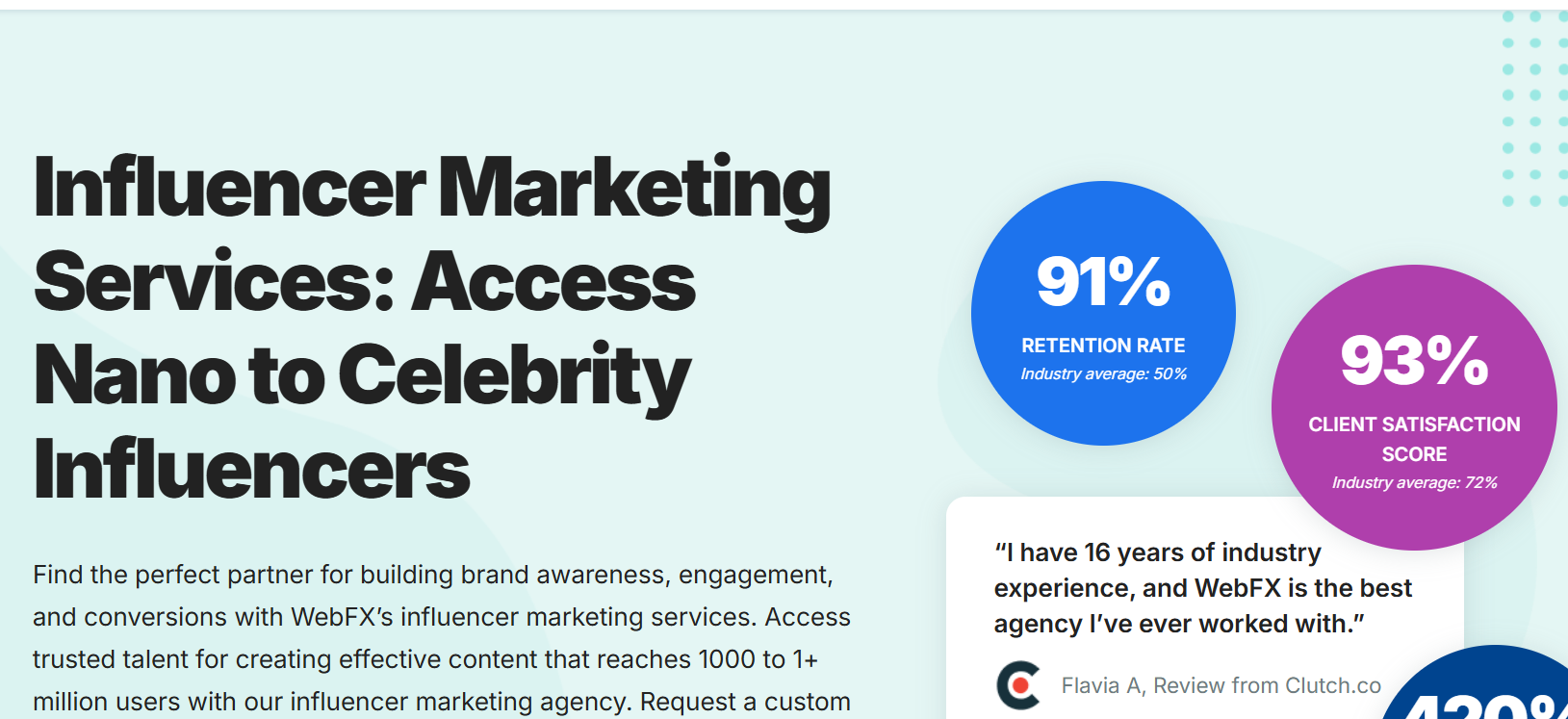
WebFX provides influencer marketing services as part of a standalone Amazon marketing practice. Its influencer services include creator research, outreach, contracts, campaign execution, tracking , and ROI reporting for Instagram, TikTok, and YouTube.
Amazon-specific scope: WebFX may fit brands that already want one large digital agency handling social, search, ecommerce, and Amazon. Its Amazon services include Store management, SEO, PPC, consulting, and review management.
Best for: Larger teams or brands that want broad digital marketing support.
Major limitation: Public information shows influencer and Amazon capabilities in detail, but it offers less information on how the two services are combined. Buyers should ask who handles the Amazon handoff, how Amazon sales are tracked, and whether content can be recycled in listings and paid ads.
WebFX lists general influencer pricing starting at $750 per month, but this should not be treated as pricing for an Amazon-specific influencer campaign.
Best Seller Hunter is an Amazon-focused marketing company that offers influencer marketing. Its public page describes influencer content as a way to bring outside traffic to Amazon listings. It also mentions weekly reporting and related Amazon services such as PPC.
Amazon-specific scope: The agency may suit sellers who want influencer activity connected to broader Amazon marketing work.
Best fit: Amazon sellers that want influencer support alongside PPC and external-traffic campaigns.
Primary limitation: The public influencer page gives limited detail about creator vetting, fake-follower checks, content licensing, supported channels, or Amazon Attribution.
Buyers should ask for these details in the proposal instead of assuming they are included.
Sequence Commerce offers an integrated Amazon TikTok program. Their public page details creator selection, briefing, contracts, TikTok Shop, Spark Ads, Amazon PPC and DSP, listing coordination, UGC reuse, and combined reporting.
Amazon-specific scope: Sequence gives clear information about cross-channel measurement. Its public page says it uses Amazon Attribution API and Amazon Marketing Cloud alongside TikTok measurement.
The company also says creator usage rights are agreed on in advance, and that successful UGC can be reused on Amazon and other paid channels.
Best Fit: Brands for which TikTok is a key discovery platform, and Amazon is a significant sales destination.
Major Limitation: The service is very TikTok-centric. Brands that lean more towards YouTube, Instagram, blogs, or other creator channels should verify the agency can accommodate those requirements.
What an Amazon-specific influencer agency should manage
A real Amazon influencer agency should handle more than finding creators.
Its work should connect creator campaigns with Amazon readiness, tracking, content rules, and the marketplace team that will use the results.
- Creator sourcing and vetting: Consider category fit, audience quality, authenticity, historical sponsored content, and true reach.
- Briefs and approvals: What are the product claims, product demonstrations, prohibited statements, required disclosures, links to include, and deadlines?
- Contracts and content rights: Add unique terms for channels, editing, paid advertising, time, place, exclusivity, whitelisting, and ownership of the material.
- Compliance Disclosures (U.S. FTC) - Disclosure policies and reminders if applicable, substantiation, monitoring, and corrections.
- Measurement: Use tagged links, Amazon Attribution where eligible, and affiliate or promo-code tracking where appropriate. Reporting should distinguish directly reported platform metrics from estimates or broader business inferences.
- Reporting: Review results (imbalance of creator output, engagement, clicks, attributed Amazon sales, quality of content, and potential next steps).
- Handoff to Amazon: Coordinate creator campaigns with inventory, pricing, listing quality, promotions, and retail readiness so the marketplace is prepared for incoming traffic.
For the day-to-day process, see SalesDuo’s guide on how to manage an Amazon influencer program.
Agency vs platform vs in-house: Which model fits?
An agency is just one option for handling influencer marketing. The best arrangement for you will depend on your internal resources, how much control you want, and whether your team can support creator relationships, contracts, compliance, and reporting.
| Model | Choose it when | Main advantage | Main trade-off | You still need to own |
|---|---|---|---|---|
| Managed agency | You need execution support and one accountable owner | Less day-to-day work for your team | Higher management cost and dependence on contract scope | Final brand approvals, substantiated product claims, internal Amazon readiness, business goals, and contract decisions |
| Platform / native tool | You have an internal operator but need discovery or workflow tools | More control and less dependence on an agency | Your team still handles briefs, negotiations, compliance, and analysis | Campaign administration and follow-up |
| In-house | Influencer marketing is a major channel, and you can staff it | Full control over relationships, data, and learning | Requires dedicated staff, process, legal support, and strong measurement | Long-term relationships, brand voice, and testing |
For software options, compare Amazon influencer marketing platforms.
For Amazon’s own creator marketplace, see Amazon Creator Connections.
If your team wants to manage outreach internally, use the guide on how to reach out to Amazon influencers.
How to choose and vet an agency before signing
A good buying process asks for proof before promises.
Ask every agency the same questions so you can compare them fairly.
- Ask for two or three relevant campaigns. Provide the category, campaign duration, number of creators involved, objective, tracking method, and results your agency could achieve.
- Ask about the process for vetting creators. Learn how the team verifies audience quality, suspicious engagement, category fit, sponsorship history, and relevance.
- Verify who owns creator relationships. Find out whether the brand, agency, or platform has those relationships post-contract.
- Agree content rights prior to production. Specify Amazon reuse, social use, paid advertising, editing, length, geography, exclusivity, and renewals.
- Define the measurement plan before launch. Ask which outcomes the agency will track, which systems provide each metric, and whether separate Amazon Attribution tags or campaign structures will be used for different creators where eligible. Require the agency to explain what attribution can and cannot prove.
- Review the compliance workflow. Confirm who prepares creator briefs, approves product claims, checks required disclosures, monitors published content, and handles corrections when a post does not meet the agreed requirements.
- Verify the reporting and access to raw data. Find out what data you will get, how often, and whether you can keep exports after the campaign ends.
- Contrast full price. Consider creator payments, products, shipping, licensing, paid media, tools, and internal staff time.
- Review cancellation and renewal terms. Understand notice periods, creator commitments, asset delivery, and ongoing use rights.
For more on costs, see SalesDuo’s guide to Amazon influencer program costs and ROI.
Vendor due-diligence checklist
| Area | Question to ask | Evidence to request |
|---|---|---|
| Creator sourcing | How are creators found and approved? | Clear process, category fit, audience data, and brand approval rights |
| Authenticity | How do you spot suspicious followers or engagement? | Documented checks and escalation rules |
| Briefing and claims | Who approves product claims? | Written brief, supporting source, approval owner, and correction process |
| Disclosure | How are sponsorship disclosures handled? | FTC process plus platform-specific requirements |
| Rights | What reuse is included? | Channels, term, location, editing, paid use, whitelisting, and exclusivity |
| Measurement | How is creator traffic connected to Amazon? | Separate tracking where eligible and clear attribution limits |
| Reporting | What data will we receive? | Dashboard or raw exports, creator-level fields, and reporting schedule |
| Creator relationships | Who owns the relationship after the campaign? | Contract terms for future contact and renewals |
| Costs | What is not included in the management fee? | Creator fees, products, shipping, media, rights, tools, and taxes |
| Exit terms | What happens when the contract ends? | Notice period, open commitments, asset handoff, and data retention |
Measurement and compliance requirements
Influencer campaigns can be easy to overstate because views, clicks, attributed orders, repeat purchases, and incremental sales are not the same thing.
A good agency should clearly explain what it can measure and what remains an estimate.
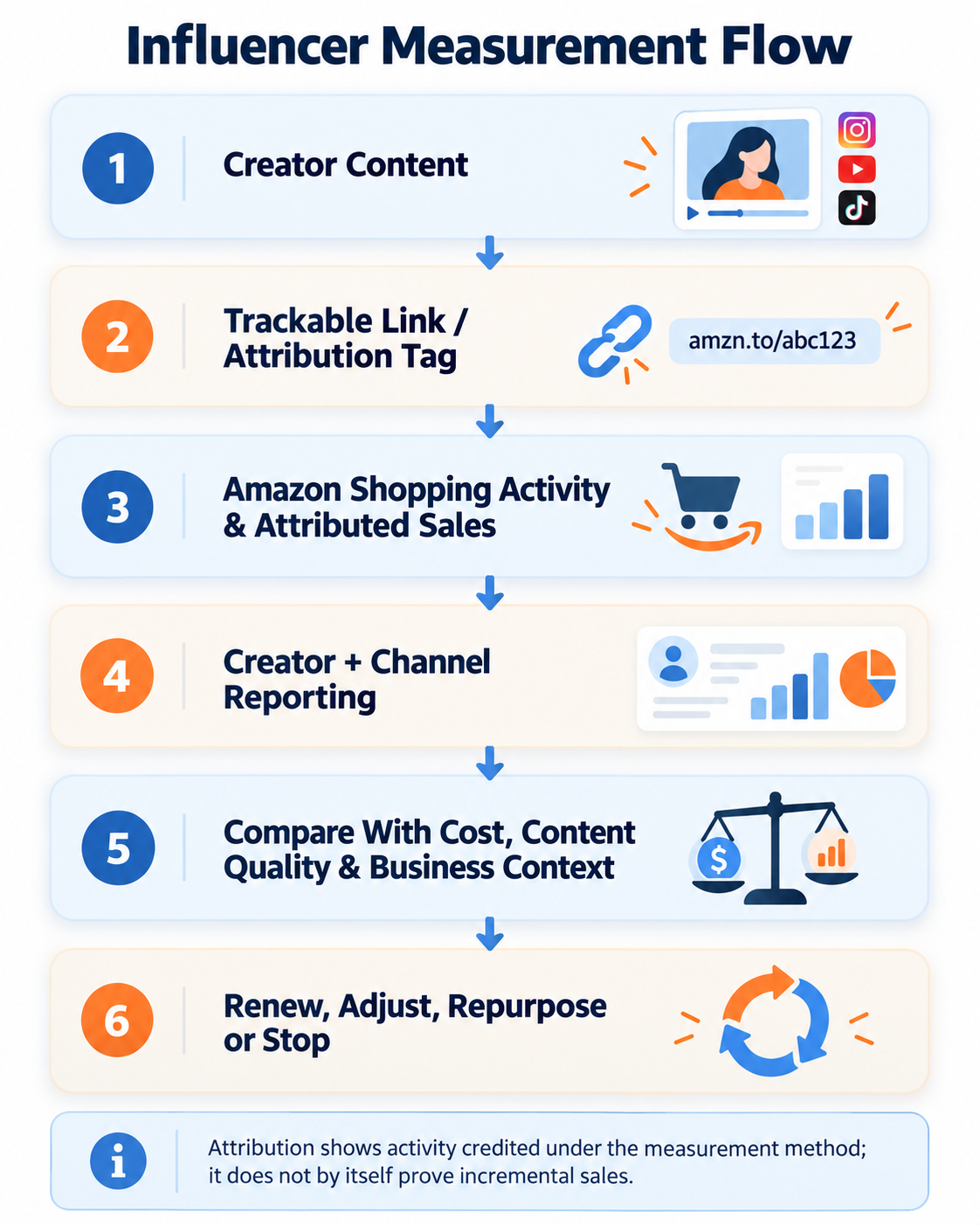
Amazon describes Amazon Attribution as a free measurement tool for eligible advertisers. It can track non-Amazon channels, including affiliate and influencer campaigns.
Where possible, use separate tags for creators or campaigns. Then compare Amazon results with creator costs and content performance.
Attributed sales show activity credited by Amazon’s tracking method. They do not prove that every sale happened because of the influencer campaign.
The FTC’s influencer guidance says material connections may include payments, free or discounted products, jobs, or personal and family relationships.
Disclosures should be clear, easy to see, and placed with the endorsement.
Content rights should also be clearly written into the contract. Paying for a creator post does not automatically give a brand unlimited rights to edit it, use it on Amazon listings, run it as an ad, or reuse it in every country.
For tracking details, see SalesDuo’s Amazon Attribution guide. For ongoing influencer-affiliate programs, see Amazon affiliate program management.
A simple way to compare two agency proposals
Do not choose an agency based only on the management fee.
The example below uses simple assumptions and is not a SalesDuo benchmark.
| Cost component | Proposal A | Proposal B |
|---|---|---|
| Management fee | $6,000 | $4,000 |
| Creator compensation | $8,000 | $9,000 |
| Product + shipping | $1,500 | $1,500 |
| Usage rights | $2,000 | Included for 90 days |
| Paid amplification | $3,000 | $3,000 |
| Internal labor allocation | $1,500 | $3,000 |
| Illustrative total | $22,000 | $20,500 |
Plan B seems more affordable, but based on price alone, we can't determine which plan is a better value. Plan A may still be worthwhile if it provides longer usage rights, stronger creator vetting, better access to data, or additional campaign management.
Compare the full campaign cost and expected contribution, not just the agency fee.
Why consider SalesDuo for managed influencer growth
SalesDuo may suit brands that want influencer campaigns connected to a wider Amazon and ecommerce program.
Its current influencer service page describes campaign management, analytics, reporting, compliance and risk management, content creation, strategic partnerships, and personalized strategy.
Use the same buying process you would use for any other agency. Ask for influencer-specific proof, creator-vetting details, measurement methods, usage rights, pricing, reporting fields, and a clear list of responsibilities.
If that model fits your needs, explore the SalesDuo influencer marketing program.
Conclusion: Shortlist by evidence, not promises
The right Amazon influencer marketing agency should show a clear creator process, useful measurement, suitable content rights, strong compliance steps, and an operating model that fits your team.
Start with two or three agencies that match your product category and channel mix. Then compare them using the same due-diligence questions.
Need a managed program that connects creator work with Amazon execution?
When comparing influencer agencies, consider how an Amazon marketing agency coordinates creator campaigns with your listings, advertising, and inventory.
Book Your 1:1 Growth Call with SalesDuo.
Frequently Asked Questions about Amazon Influencer Marketing Agency
What does an Amazon influencer marketing agency do?
It usually handles creator sourcing, vetting, briefs, negotiations, approvals, content rights, disclosures, product claims, tracking, reporting, and coordination between creator campaigns and Amazon teams.
How is an Amazon influencer agency different from a platform?
An agency provides managed strategy and execution. A platform usually provides creator discovery, workflow tools, data, or access, while your internal team handles more of the campaign.
How much does an Amazon influencer marketing agency cost?
Costs depend on the management scope, creator payments, commissions, products, shipping, usage rights, paid advertising, software, and internal staff time.
Compare the full program cost instead of relying on one standard agency fee.
Should I manage Amazon influencers in-house or hire an agency?
An in-house program can work if influencer marketing is an important channel and you have staff for creator operations, compliance, legal support, and measurement.
An agency may be more useful if your team doesn't have enough time or specialist support.
Can Amazon Attribution measure influencer campaigns?
Yes, for eligible advertisers and supported campaigns outside Amazon. Amazon says Attribution can measure affiliate and influencer activity.
Attributed sales, however, are not the same as proven incremental sales.
What should I ask an agency about creator vetting?
Ask how it checks audience fit, suspicious engagement, category relevance, previous sponsored work, content quality, brand conflicts, and approval rights.
Ask for the actual process rather than relying on a large creator-network claim.
Who owns influencer content after a campaign?
The contract decides.
It should clearly state where the content can be used, whether it can be edited, whether paid advertising is allowed, the license term, geography, exclusivity, whitelisting, and renewal terms.
Paying a creator does not automatically give a brand unlimited rights.
What disclosures are required for sponsored influencer content?
For U.S. audiences, the FTC requires clear disclosure of material connections such as payment or free products.
The disclosure should be easy to notice and appear with the endorsement. Amazon and social platforms may have their own requirements, too.
Is Creator Connections the same as hiring an influencer agency?
No. Creator Connections is an Amazon-native program that helps brands and creators connect.
An agency may provide broader strategy, creator management, contracts, content rights, cross-channel execution, compliance, and reporting.
About the Author
Meet Arjun Narayan, a Business Dynamo with two decades of conquering boardrooms and founding two companies that didn't just survive but thrived. When he's not navigating business strategies and delivery teams, you'll find him immersed in his love for cars and exploring new models, geeking out over tech trends, globe-trotting for new adventures, and occasionally pondering the mysteries of the universe over a good cup of coffee.