
Amazon Consultant: What They Do, When to Hire One, and How to Choose the Right Fit

An Amazon consultant assists brands in identifying problems and making improvements in relation to their listings, advertising, catalog health, inventory, account issues, and marketplace strategy. The appropriate consultant should make clear the areas on which they will be giving advice, those on which they will carry out actions, the matters that will need approval from your team, and how progress will be assessed.
The guide outlines the role of an Amazon consultant, when it is appropriate to use one, what to anticipate during the first 90 days, and how to select the appropriate level of Amazon support without causing additional operational confusion. You should use it as a decision-making tool before deciding to hire a consultant, before assigning work to an internal manager, before using Amazon-side support, or before switching to a full-service agency.
What Is an Amazon Consultant?
An Amazon consultant is an external expert who assists a brand in working out what is causing its Amazon account to slow down and what actions should then be taken. While some consultants merely offer advice, others also help to resolve issues in the ads, the listings, the catalog, the reporting, or the account operations.
Since the term “consultant” has many different meanings, it is the scope that is more important than the title itself. The consultant should establish what their work will be before getting involved with the account; specifically, they should clarify what they will review, what they will carry out, what data they will need, who will approve changes, and how frequently they will report on progress.
What an Amazon Consultant Can Help With
A consultant is able to assist with a great many aspects of an Amazon account, but it's wrong to assume that all problems have one identical solution. A well-defined scope should divide the tasks among diagnosis, execution, approvals, and reporting so that your team will know which member is responsible for each decision.
An effective consultant will likewise make clear the areas in which they do not take responsibility. For instance, although they might recommend inventory measures, your team will still have to make up their minds about purchase orders, cash-flow trade-offs, and the timing of supplies.
They can also provide advice in cases involving account health, but they must not promise any policy exceptions or guaranteed outcomes for cases.
Amazon Consultant vs Agency vs In-House Manager vs Amazon Support
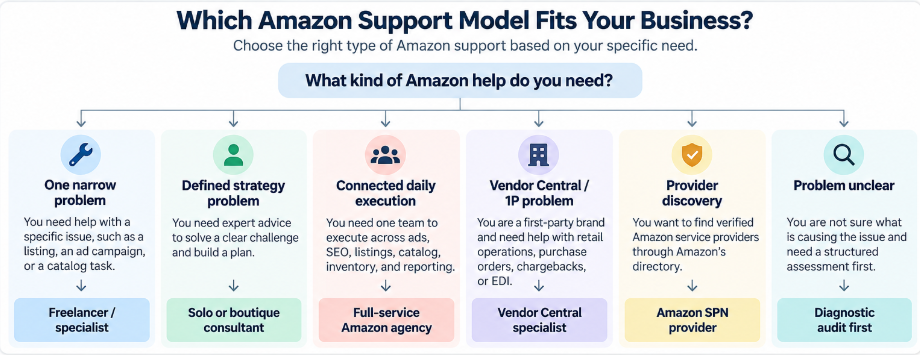
The appropriate support model will vary according to what you need most advice, carrying out the task, ownership, or guidance from Amazon.
A consultant is suitable in the case where you need a clear diagnosis and a plan; agencies are generally more appropriate when various aspects of the account have to be dealt with at the same time.
If you want to compare Amazon's side services in more detail, refer to SalesDuo’s Amazon Strategic Account Services guide to see how SAS-style support differs from outside consulting, agency execution, and internal ownership.
When Hiring an Amazon Consultant Makes Sense
It is sensible to hire an Amazon consultant if your team is able to carry out part of the work but requires better diagnosis, more clearly defined priorities, and stronger accountability.
It is also of assistance in the case of disagreements among internal teams regarding the actual problem; for instance, the issue might appear to be an ads one, but it could instead be related to listings, inventory, pricing, catalog health, or account health.
Common triggers include:
- Growth has slowed even as traffic, ad spending, or catalog size has increased.
- The ACoS, the TACoS, or the amount of wasted spend is going up, and the team is unable to explain why.
- Listings get traffic but have weak conversion, poor content, or confusing variation logic.
- For a launch, you need a well-defined plan covering content, ads, inventory, review compliance, and reporting.
- Errors in the catalog, the suppression of listings, chargebacks, problems with purchase orders, or warnings about account health continue to appear.
- Reporting exists, but no one connects the numbers to decisions, owners, and next steps.
A consultant proves less useful when the client simply requires routine tasks to be carried out, and there is no strategy gap; in such a situation, a properly trained internal operator or a dedicated freelancer would be sufficient.
The essential question is: does the business require better thinking, more assistance with execution, or both?
What Should Happen in the First 90 Days?
In the first 90 days, the vague need for help should be turned into a definite method of working.
What we want to do is not to address all the problems at the same time; instead, we want to get a good understanding of the account, ensure that access is protected, identify the major obstacles, assign owners, and then develop a plan that can be measured.
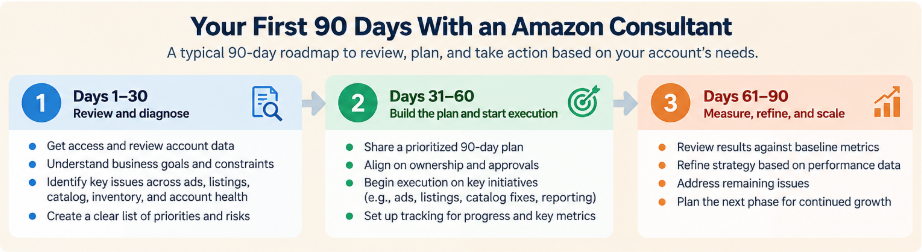
Access control must be included at the beginning of the process and not dealt with at a later stage.
You should not give a consultant access to the primary owner's login information. Instead, use scoped user permissions, restrict sensitive settings to the owner or admin only, and make sure it is recorded who has the authority to change the bank, tax, legal, identity, brand, and user-access information.
It is just as important to have decision ownership as it is to carry out execution.
The consultant could identify the problem, suggest the solution, and arrange the change; but the team of your organization should still approve any situation that has an impact on brand claims, pricing, supply, margin, legal risk, or account ownership.
How Much Does Amazon Consulting Cost?
The cost of Amazon consulting varies according to a number of factors, such as the scope of the work, the complexity of the account, the number of marketplaces, the number of ASINs, the amount of ad spending, the severity of the issues, the reporting requirements, and whether or not the consultant will also carry out the work.
Amazon consulting does not have one standard price. Costs depend on the work involved, the complexity of your account, and whether the consultant only provides advice or also handles execution.
It's better to consider the cost drivers; a strategy-only audit doesn't cost the same as a multi-month project which includes ad management, catalog cleanup, Seller Central fixes, Vendor Central support, and reporting.
For broader service pricing context, compare the scope against SalesDuo’s Amazon agency pricing guide.
A simple break-even check can help keep the decision practical:
- Break-even monthly value needed = monthly consulting cost / gross margin rate.
- Wasted ad spend opportunity = monthly ad spend x audit-confirmed wasted-spend percentage.
- The value of the operational issue is equal to the revenue at risk plus the avoidable fees or chargebacks plus the internal hours saved multiplied by the loaded hourly cost.
These are decision tools, not guarantees.
Use your own margins, ad spending, and operational data; if you include a worked example, mark it as illustrative unless it is drawn from an approved case study.
How to Choose the Right Amazon Consultant
Choose a consultant by checking scope clarity, proof, category fit, reporting, access safety, and who will actually do the work.
Before the contract is signed, a good proposal ought to simplify the understanding of the operating model.
Use this checklist before you compare proposals or review a deeper guide on choosing the right Amazon consultant.
- Scope clarity: Ask what they will audit, advise, execute, monitor, and escalate.
- Access safety: Ask what permissions they need and what should stay with the owner or admin.
- Reporting: Ask which metrics will be reviewed weekly or monthly and who will act on each finding.
- Category fit: Ask for experience with your catalog size, sales model, and issue type.
- Evidence from case studies: When you ask for examples that relate to your particular problem, don't regard the results as certain.
- Escalation process: Ask how catalog, account-health, Vendor Central, or ad issues will be logged and followed up.
- Team structure: Ask who does the work, who reviews it, and who joins calls.
- Rules regarding decisions: Find out how decisions on budget, pricing, content, inventory, and risk are approved.
- Contract exit and handover: Ask what happens if the engagement ends. Confirm the notice period, how account access will be removed, which reports and data can be exported, who owns working files and dashboards, and how campaigns, catalog work, open cases, and ongoing responsibilities will be handed back to your internal team or next provider.
Red flags are usually easy to notice.
One should be careful about any proposals that promise assured rankings, revenue, ownership of the Buy Box, case results, or special treatment.
Be on the lookout for vague key performance indicators, unclear reporting, the absence of an access plan, a lack of category context, or a situation where the salesperson vanishes after the kickoff meeting.
When a Full-Service Amazon Agency Is a Better Fit
A full-service Amazon agency is a better fit when the problem is not just one isolated task.
Many Amazon issues are connected. Ads depend on listings. Listings depend on catalog control. Catalog control affects conversion. Inventory affects both Buy Box and cash flow.
Consider agency-led support when your brand needs one team to manage advertising, SEO, listing content, catalog fixes, reporting, Seller Central, Vendor Central, inventory signals, account health, and stakeholder communication.
This is especially useful for brands with large catalogs, mixed 1P and 3P operations, repeated escalations, or leadership teams that need clearer reporting.
A consultant can still be the right first step if you need a diagnosis, roadmap, or second opinion.
But if the audit keeps creating work your team cannot execute, the real gap is not advice. The real gap is ownership.
If your brand needs both strategic guidance and ongoing execution across advertising, SEO, catalog, Seller Central, Vendor Central, inventory, account health, and reporting, review SalesDuo’s Amazon consultant services to compare consulting support with a broader managed-service model.
Next Step: Choose the Right Level of Amazon Support
The right Amazon consultant is not just someone who gives advice.
The right fit depends on what work needs to be diagnosed, executed, measured, and owned across the account.
If your team needs a clearer operating model, start with a consulting-led review.
If your team needs strategy plus cross-functional execution, move toward agency-led ownership.
For brands that need Amazon growth experts, full-service execution, account management, ads, SEO, catalog, Vendor Central, Seller Central, and reporting support, Book Your 1:1 Growth Call with SalesDuo.
Frequently Asked Questions about Amazon Consultant
What does an Amazon consultant do?
An Amazon consultant reviews your account, finds growth or operational blockers, builds a strategy, and may help with execution.
The exact scope can include advertising, listing SEO, catalog health, inventory signals, account issues, Vendor Central, Seller Central, reporting, or marketplace strategy.
Is an Amazon consultant the same as an Amazon agency?
No. A consultant may advise, audit, specialize, or help execute work within a clear scope.
An agency usually has a wider team that can execute across several areas, such as ads, SEO, catalog, operations, and reporting.
When should I hire an Amazon consultant?
Hire a consultant when your team has traction but does not have a clear diagnosis or operating plan.
Common reasons include stalled growth, rising ad costs, catalog problems, account-health risk, launch planning, or reports that do not lead to action.
What should happen in the first 90 days?
The first 90 days should include access review, baseline metrics, issue mapping, quick wins, an execution roadmap, reporting cadence, and approval paths.
The goal is to create clarity before making bigger changes.
Can a consultant manage Seller Central?
Some consultants can manage Seller Central tasks if the scope and permissions are clear.
Your brand should still keep owner-level control of sensitive account, tax, legal, identity, and banking information.
Can a consultant help with Vendor Central?
Yes, if they have Vendor Central experience.
Vendor work may include catalog issues, retail operations, purchase orders, chargebacks, reporting, and escalation support.
The scope should be clear because 1P operations are different from Seller Central work.
Is Amazon SAS the same as hiring a consultant?
No. Amazon SAS is paid support from Amazon, while an outside consultant works for your brand.
Amazon-side programs can provide guidance and program support, but they should not be treated as a full-service external account-management team.
How do I choose the right Amazon consultant?
Make your choice by referring to scope clarity, the evidence available, category suitability, the reporting arrangements, access control, the team structure, and any red flags.
The correct partner is the one who makes clear who is responsible for diagnosis, execution, approvals, escalation, and measurement.
About the Author
Meet Aryan Suyal, an SEO Content Writer Intern at SalesDuo who excels at turning patterns into precise, on-point content. He brings sharp insights and analytical thinking, along with a builder's instinct for creating systems that help ideas work smarter. Outside of work, you'll find him getting lost in books, tinkering with and building AI systems, or losing hours to a good documentary.