
How a 20-Year Trademarked Brand Lost 25% of Its Revenue Overnight — And Got It Back

When Brand Registry Turns Against the Brand Owner
Amazon Brand Registry is created to help brand owners protect intellectual property, verify brand ownership, and access tools for reporting suspected infringement and counterfeit activity.
But what happens when Amazon’s own system blocks the brand it is supposed to protect?
That is exactly what happened to Planner Pads Co. in May 2025. Planner Pads Co. is a US-based company that sells professional planners and organizers. The company had been selling on Amazon for eight years and had owned a federally registered trademark for more than 20 years.
Even with this history, Amazon suddenly flagged the brand for possible trademark misuse.
- 10 ASINs were deactivated.
- Sales dropped quickly.
- Product rankings disappeared almost overnight.
Amazon’s explanation did not make the situation any clearer. The responses were vague, automated, and often repeated the same information.
The brand then spent 37 days working to reinstate the listings. The disruption also affected sales, rankings, advertising, and inventory, with the case study recording an approximately 25% annual-revenue impact over the following two months.
The Challenge – When Amazon’s System Misfires
Planner Pads Co. generated more than $1 million in annual company revenue, with Amazon representing approximately 60% of the business. During the measured baseline period, average Amazon monthly sales were about $40,000.
On May 23, 2025, the company received a notification through Account Health that said:
“We have taken this measure because we suspect that your listing includes unauthorized use of a trademarked term…”
Amazon immediately deactivated 10 ASINs.
These were some of the company’s best-selling products. They were also ranking within the top 100 products in their category.
Within a few days, those rankings disappeared.
Impact included:
- Advertising campaigns paused
- Inventory stuck in FBA
- Loss of organic rankings
- Higher advertising costs after the brand relaunched the products
Over two months, the brand lost approximately 25% of its annual revenue.
Strategy – Addressing the Issue With Calm and Precision
Instead of sending appeals without understanding the problem, the team first spent two days reviewing the issue and finding the real cause.
Root Cause Identified:
The team’s review indicated that Amazon had incorrectly treated the brand’s own registered trademark as unauthorized.
Documentation Prepared:
- Trademark Certificate showing 20 years of registration
- GS1 Certificate
- Proof of trademark ownership
- Documents showing that the listings had used the same brand information for years
Appeal – Structure Over Emotion
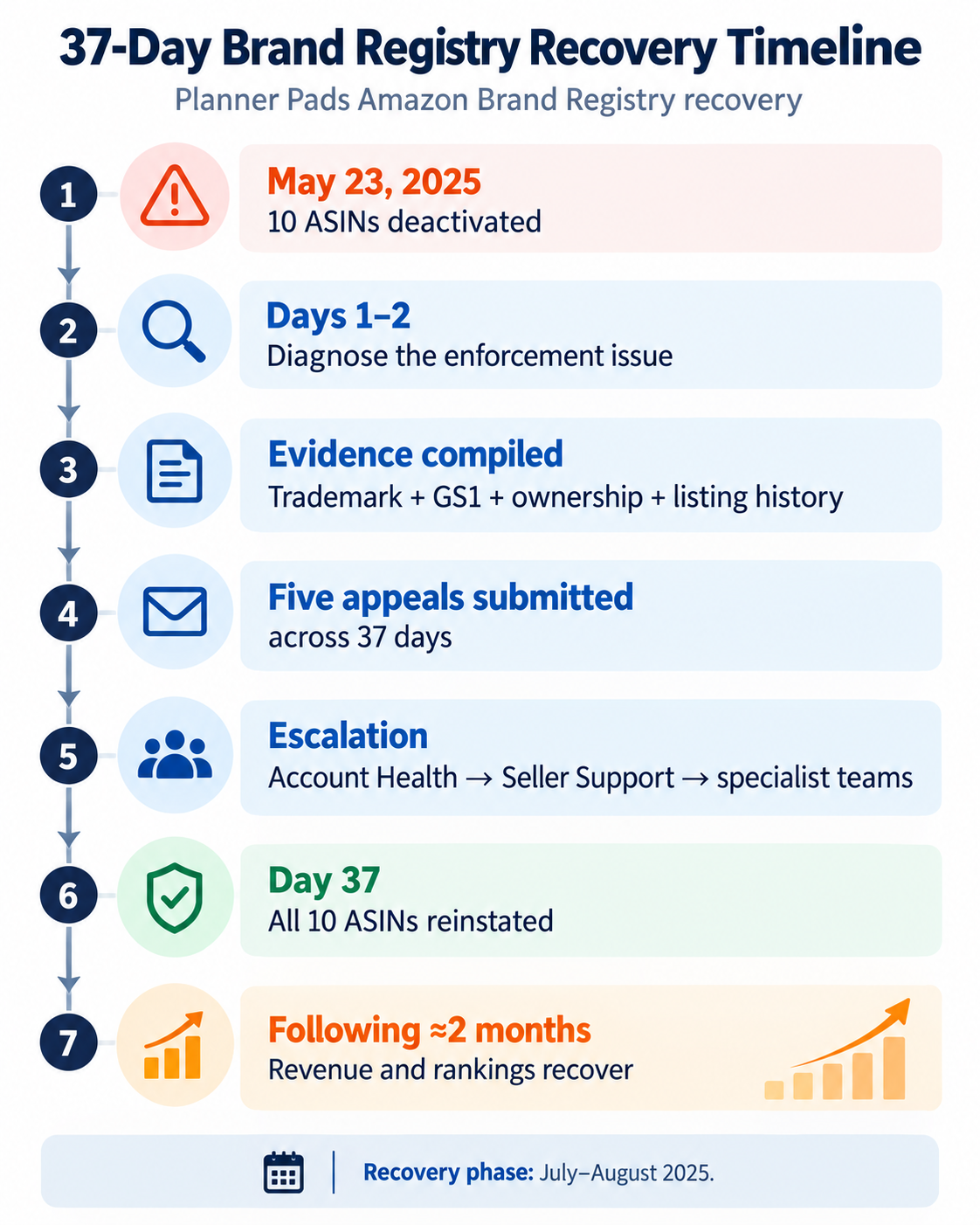
The team filed 5 structured appeals over 37 days.
Each appeal was in the same simple structure:
- Explicitly state the infringement
- Indicate the timeframe of trademark ownership
- Refer to the documents that prove your case
- Describe the system error
- Make it crystal clear what Amazon had to do next
The team submitted appeals through Account Health, Seller Support, and specialist escalation channels.
When Amazon continued sending standard template responses, the team escalated the case to higher-level specialist teams.
Resolution
After 37 days, Amazon reinstated all 10 ASINs without any modifications to the listings, clearing the trademark enforcement action.
Why It Worked
- Clear and organized documents
- A clear timeline showing trademark ownership
- Specific appeals instead of generic messages
- Strategic escalation when earlier appeals were rejected
- Strong knowledge of the account from managing it for a long time
Performance After Reinstatement
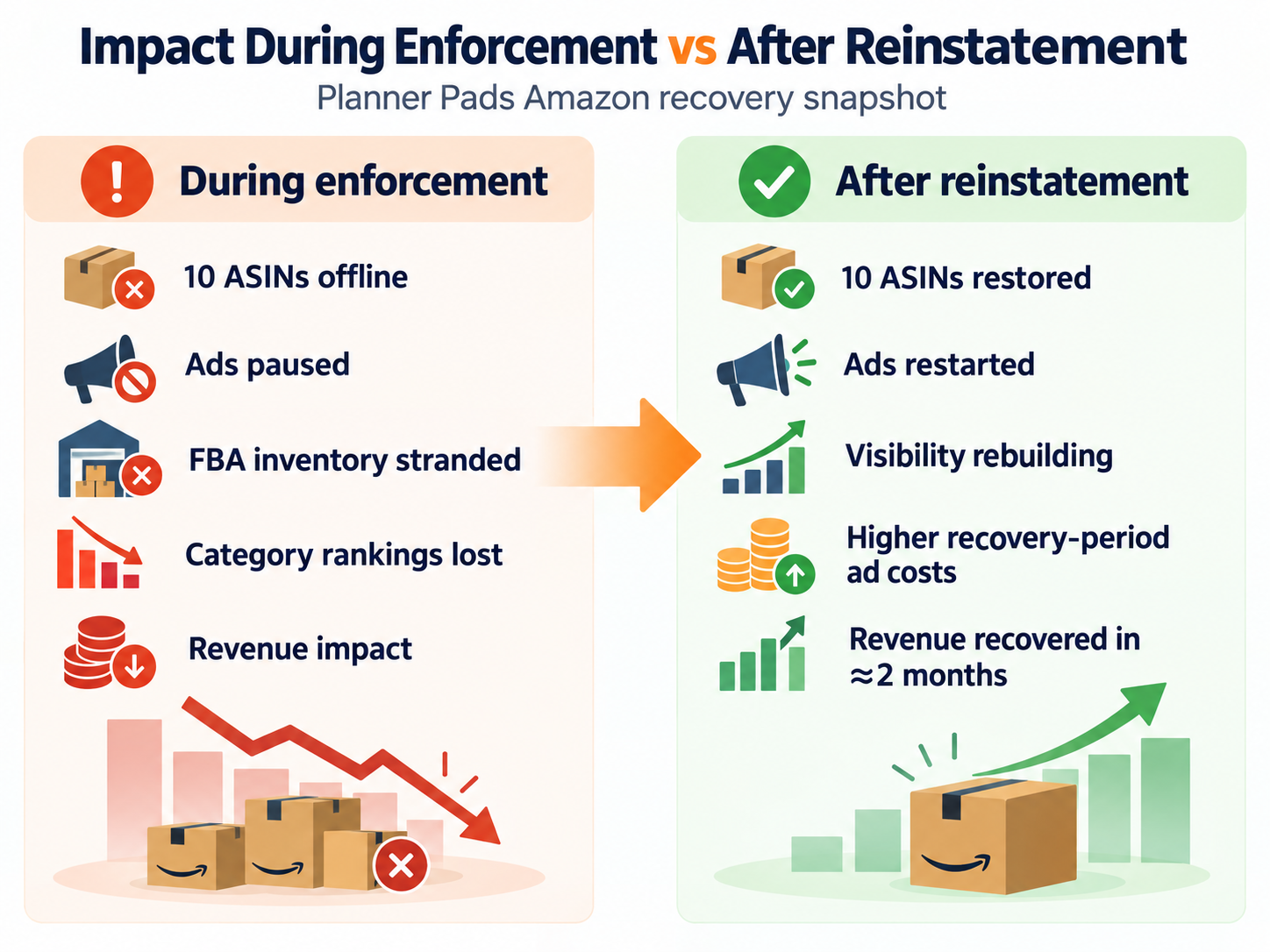
Having the listings back online did not equal immediate sales.
The affected products had lost their previous category-ranking positions and needed time to regain visibility. The costs of advertising also increased over the period.
It took about two months for the brand to recover its revenue fully.
Bonus Read: Amazon Brand Registry Guide With Answers to Common Questions
Takeaways for Amazon Sellers
- Find the real cause of the problem before submitting an appeal.
- Keep every appeal clear and well organized.
- Attach supporting documents and explain what each document proves.
- Keep a record of every conversation with Amazon.
- Escalate the issue carefully if regular support cannot solve it.
- Be ready for extra costs while rebuilding lost rankings.
- Check your Brand Registry setup from time to time.
Final Thoughts
Amazon’s automated systems can sometimes make mistakes.
When that happens, sellers need to follow the right steps, provide clear proof, and escalate the issue when needed.
In this case, staying organized and following a clear process helped fix the problem.
For brands managing ongoing account-health, catalog, and escalation work, an Amazon account management agency can help maintain case records and coordinate follow-up across operational issues.
Book your 1:1 growth call with SalesDuo today!
Frequently Asked Questions About Amazon Brand Registry and Brand Protection
What is Amazon Brand Registry and how does it protect brands?
Amazon Brand Registry helps brand owners protect their brand and intellectual property on Amazon.
It confirms trademark ownership and gives sellers tools to report fake products, remove trademark violations, and gain more control over their product listings.
This helps protect the brand and makes the Amazon marketplace more trustworthy.
Why can Amazon deactivate listings even for registered brand owners?
Amazon may deactivate listings if its automated systems find possible trademark misuse, intellectual property violations, or problems with brand ownership.
Even sellers who are part of Amazon Brand Registry can have listings removed if Amazon’s system incorrectly flags a trademark, keyword, or other brand-related content.
How can sellers resolve Amazon Brand Registry trademark violations?
Which specific resolution path you should take depends on the nature of the Amazon notice and the enforcement. In the Planner Pads case, the team utilized Account Health, Seller Support, proven trademark evidence, and direct access to specialist escalation lanes.
The appeal may include trademark certificates, proof of brand ownership, GS1 documents, listing history, and a clear explanation of why the reported intellectual property issue is incorrect.
What documents are required for Amazon Brand Registry appeals?
Depending on the type of issue, relevant evidence can include trademark registration information, proof of brand ownership, GS1 data, product or packaging images, and listing history. The evidence must directly pertain to the exact violation that Amazon identified.
How long does it take to reinstate listings after an Amazon Brand Registry issue?
The time needed to reinstate a listing depends on how complex the case is.
Amazon may resolve some intellectual property issues within a few days. More difficult trademark disputes or system errors may need several appeals and escalations over a few weeks.
Can Amazon Brand Registry suspend or block a brand owner’s own listings?
Yes. In rare cases, Amazon’s automated systems may incorrectly flag a brand owner’s own listings for trademark misuse or unauthorized brand use.
This means even verified Amazon Brand Registry accounts may sometimes have listings deactivated because of a system error.
How do sellers escalate unresolved Amazon Brand Registry issues?
Sellers should attach clear documents, point to the specific violation, and follow up regularly. This may help to increase the possibility of relisting.
Sellers should provide clear documents, mention the exact violation, and follow up regularly. This can increase the chances of getting the listings active again.
What are the main benefits of Amazon Brand Registry for sellers?
Amazon Brand Registry gives sellers several tools to protect and manage their brands.
These tools include counterfeit reporting, automated brand protection, more control over listings, A+ Content, Brand Analytics, and better visibility into possible intellectual property violations on Amazon.
About the Author
Adhithya G is an experienced e-commerce professional with a strong passion for solving real-world business challenges. With a background in Amazon vendor management, online cataloging, content writing, and problem-solving, he brings clarity and structure to complex workflows. Adhithya enjoys leading teams, managing projects, and collaborating to develop effective, scalable solutions.