Turning Amazon into a Controlled Growth Asset

SalesDuo partnered with Polder Products, a private-equity-backed consumer brand, to turn Amazon into a predictable and controlled business asset instead of an unpredictable marketing channel.
The work focused on building a clear growth system around four areas that matter to private equity teams:
- Revenue quality: improving conversion and how much revenue each visitor generates.
- Controllability: improving Buy Box control and keeping pricing stable.
- Acquisition economics: managing advertising with clear spending limits and performance rules.
- Continuity and risk control: quickly fixing Amazon issues, correcting fee errors, and following a weekly operating process.
Across the measured Jan-Nov YoY period, the Amazon channel grew while also becoming more efficient per visitor and easier to control.
Private Equity Context
Private equity investors do not look at “Amazon growth” alone. They want growth that is repeatable, controllable, and able to produce reliable cash flow.
Amazon gives PE teams a steady stream of operating data during due diligence. Investors can track traffic, conversion, price realization, Buy Box control, advertising efficiency, and how often problems occur.
At the same time, this data can reveal weak operations. Problems may include pressure from third-party sellers, pricing leakage, listing suppressions, incorrect fees, and sales spikes that only happen because of heavy ad spending.
Polder had a clear goal: build an Amazon business that works like a controlled asset. That meant having measurable KPIs, documented processes, and a regular operating schedule that could also be used across other portfolio companies.
Objectives
Scale the channel while improving revenue quality: increase sales and units without depending on heavy discounts or short-term promotional spikes.
Increase monetization per visitor: make sure sales grow faster than sessions by improving conversion and content.
Improve controllability: reduce revenue leakage by improving Buy Box stability and managing pricing during repeated pressure from third-party sellers.
Run advertising as a governed acquisition portfolio: focus ad spend on efficient campaigns and proven winners while keeping clear limits on marketing intensity.
Institutionalize an execution cadence: hold weekly inventory coverage and performance reviews and quickly fix Amazon issues that could hurt revenue.
Operating Model Implemented
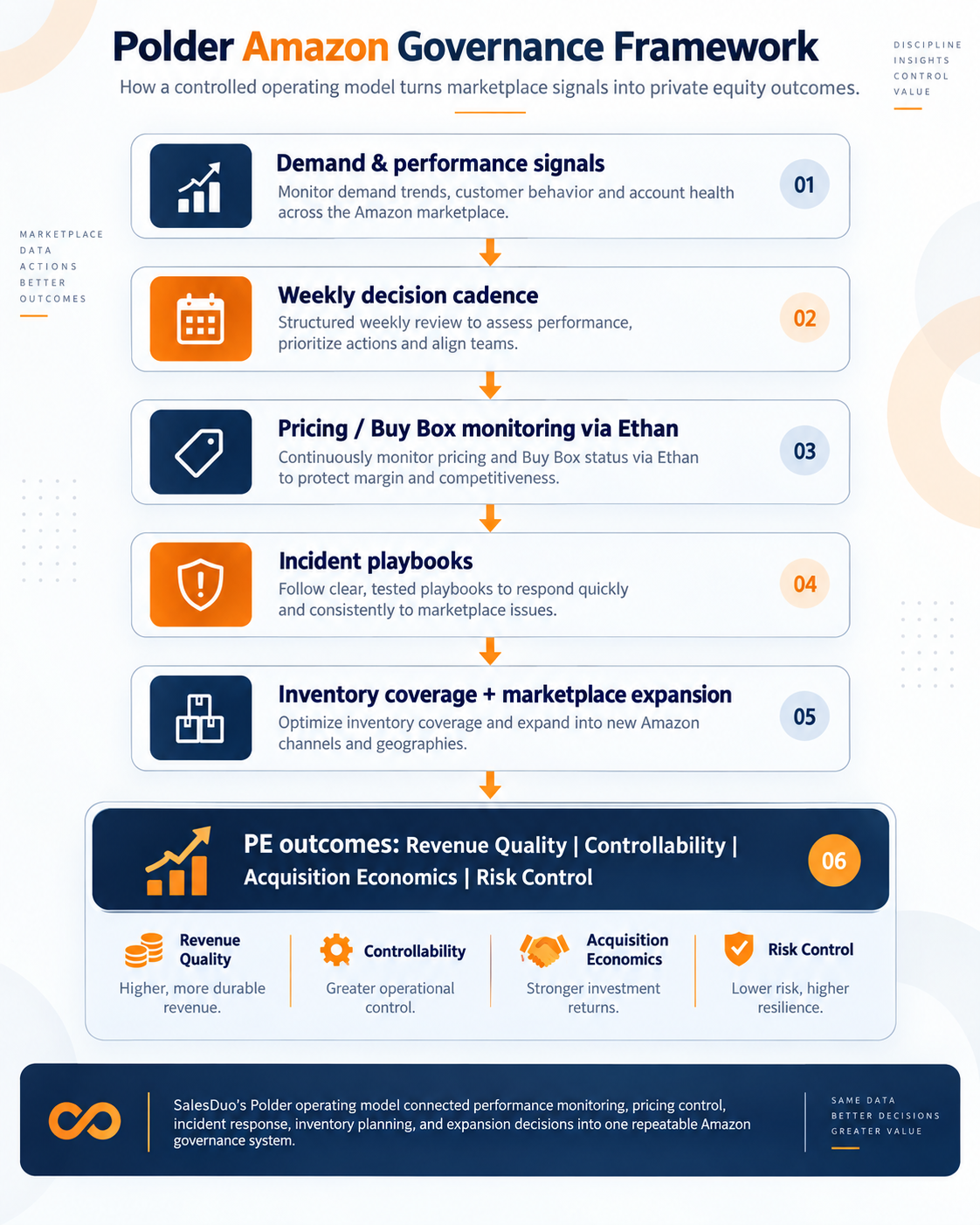
SalesDuo built a multi-layer operating model focused on control, clear records, and repeatable processes.
Weekly performance and decision cadence: the team regularly reviewed demand capture, conversion signals, and advertising allocation. Actions were recorded and assigned to specific owners.
Pricing and Buy Box control loop (Ethan notifications): continuous monitoring identified pricing changes, Buy Box losses, and competitor pressure so the team could respond quickly instead of discovering problems later.
Incident response playbooks: clear processes were created for listing suppressions, catalog risks, and fee mismatches. These processes helped protect revenue when problems occurred.
Cross-channel expansion logic: Amazon demand data was used to decide which products should be added to Walmart. After the products were listed, advertising was adjusted to help build sales faster.
Private Equity Translation
Investment Thesis Translation (Amazon -> PE Value)
Amazon performance is normally discussed using retail terms such as sales, sessions, and ACOS. For a private equity team, these same metrics can be translated into value creation.
Revenue growth quality shows whether demand is repeatable instead of being created by short-term promotions.
Conversion efficiency shows how well the business turns visitors into revenue and whether it can grow without depending too much on discounts.
Buy Box control shows how much control the brand has over its Amazon channel and how much revenue may be leaking to other sellers.
TACoS shows marketing intensity and whether growth is sustainable. In simple terms, it helps show how much revenue must be “bought” through advertising.
Operational problems such as suppressions and fee errors show where preventable revenue volatility and margin leakage can occur.
For a PE team, the value is simple: Amazon becomes easier to measure, manage, and forecast. SalesDuo's role was to put clear KPIs, faster issue resolution, and a repeatable decision process around the channel.
Governance Architecture
Polder’s Amazon system was built around a simple but strict rule: manage the channel using leading indicators instead of waiting for bad results and explaining them later.
The team monitored leading indicators such as sessions, conversion efficiency, Buy Box stability, TACoS, and suppression risk. When one of these signals changed, action could be taken while there was still time to influence the final result.
This helped reduce unpleasant surprises at the end of the month and reduced the need to explain problems after they had already affected performance.
This is especially important for PE-backed businesses because reporting follows a regular schedule, and investment decisions depend on having confidence in the operating data.
Buy Box and Pricing Pressure (Control Under 3P Attack)
For many brands, Buy Box performance slowly gets worse when third-party sellers repeatedly create pricing pressure.
This problem may not be obvious at first. It often becomes noticeable only after the business starts seeing unstable pricing, lower conversion, and sudden loss of sales share.
Polder experienced Buy Box pressure several times during the year because of third-party sellers. SalesDuo treated this as an operating control problem rather than just another marketplace inconvenience.
Ethan’s pricing and Buy Box notifications gave the team continuous visibility into these issues. Problems could be identified early, assigned to the right person, and tracked until they were fixed.
This matters to investors because stronger Buy Box stability can reduce revenue swings and make future performance easier to forecast.
Underwriting KPIs: What an Investor Can Track Monthly
A PE team reviewing a portfolio company can use a small group of metrics to understand whether Amazon is operating like a controlled asset.
Revenue per session: Is the business generating more revenue from each visitor, or is growth only coming from more traffic?
Units per session: Is conversion efficiency improving over time?
Weighted Buy Box: Is the brand gaining more control over the channel, or is revenue leaking to other sellers?
TACoS: Is marketing intensity increasing, staying stable, or becoming more efficient?
Click-to-order CVR: Is the quality of advertising traffic improving?
Exception cadence: How often do suppressions, pricing problems, or fee issues happen, and how quickly are they fixed?
Polder’s Amazon program was built to improve these signals while continuing to scale. That is what makes the channel more useful as a sustainable value creation engine.
Case Narrative: From Volatility to Repeatability
At the beginning of the engagement, the biggest risk was not a lack of demand. The bigger problem was a lack of operating control.
When an Amazon business is not properly managed, growth can become fragile. A single suppression on an important SKU can remove weeks of progress. A Buy Box problem can also quietly send sales to third-party sellers without the brand noticing immediately.
SalesDuo focused on making the channel more repeatable through a clear operating rhythm.
A weekly review process was used to manage leading indicators such as sessions, conversion efficiency, and advertising allocation before monthly results were finalized.
Always-on monitoring reduced the time between discovering a problem and taking action. This included pricing issues, Buy Box problems, and catalog risk alerts.
Documented processes were also created so recurring problems could be solved through a repeatable system instead of making up a new response every time.
The result was a more proactive Amazon operation instead of a reactive one. This is important in private equity because more predictable operations make capital allocation decisions easier.
Incident Response: Protecting the Asset When Amazon Breaks It
Polder’s top-selling product was hit by two suppression events within a four-month period.
These incidents can have a major effect because they remove an important revenue-producing product from sale. They can also hurt search rankings when the issue remains unresolved for too long.
SalesDuo managed the complete reinstatement process both times. This included collecting evidence, writing appeals, and handling the correct escalation process.
The product was reinstated within two weeks on both occasions.
From an investor’s point of view, the key result was not only that the product returned to sale. The business also had a repeatable process and a measurable resolution time that helped reduce the impact of these problems.
Margin Protection: Preventing “Quiet” Leakage Through Fee Accuracy
Amazon fees can sometimes be incorrect, and these errors are easy to miss during normal day-to-day work.
In Polder’s case, Amazon had registered product dimensions from FBA Cubiscan that did not match the product’s actual dimensions. This caused the business to pay higher fees than it should have.
SalesDuo identified the mismatch, helped with the reconciliation process, and secured a correction.
For a PE-backed business, this is an important margin-quality improvement because it increases profitability without needing more demand or taking additional pricing risk.
Results and Operating Signal
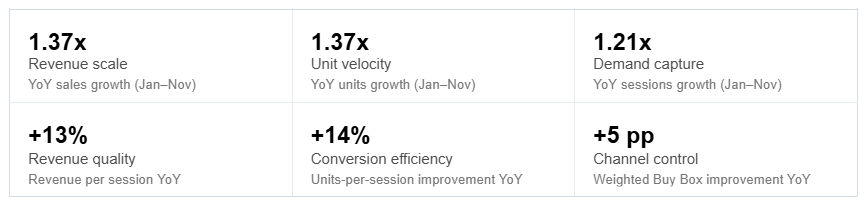
The results below are shown as YoY changes and indexed performance signals. This allows the case study to show the improvement without revealing confidential absolute numbers.
From a PE point of view, these signals show what can actually be underwritten: the channel increased in size while revenue quality and operating control also improved, even while pressure from third-party sellers continued.
| Operating metric (Jan-Nov YoY) | YoY signal (indexed) | What it indicates (PE lens) |
|---|---|---|
| Sales (Amazon) | +37% (≈1.37x) | Scale with improved monetization; growth is not purely traffic-led. |
| Units | +37% (≈1.37x) | Sustained velocity; indicates repeatable demand capture, not one-off spikes. |
| Sessions (traffic) | +21% (≈1.21x) | Top-of-funnel expanded; sales outpaced sessions, implying efficiency gains. |
| Revenue per session | +13% | Higher revenue productivity per visitor (operating leverage proxy). |
| Conversion efficiency (units / session) | +14% (≈ +1.3 pp) | Improved purchase propensity; better revenue quality for the same traffic base. |
| Weighted Buy Box | +5 pp | Reduced leakage and increased controllability; improves stability and forecast confidence. |
Note: YoY signal is presented as relative change and indexed multiples for publication.
Growth Decomposition
Using the formula Sales = Sessions × Conversion × Price, Polder’s YoY growth mainly came from two areas: more sessions and better conversion.
Pricing remained mostly stable. This means the growth did not depend on inflationary pricing or aggressive discounting.
Growing sessions while also improving conversion is a healthier growth pattern because it shows the business is building a scalable system instead of depending on a temporary increase in advertising spend.
Resilience Indicator (Late-Year Efficiency)
An important signal for investors is whether revenue can remain strong when traffic slows down.
Later in the year, Polder’s sessions declined YoY, but sales still increased. Better conversion efficiency and higher revenue per session helped support that growth.
This is a sign of stronger operating control. The business did not need traffic to keep increasing every month in order to grow revenue.
Advertising Outcomes (Governed Demand Capture)
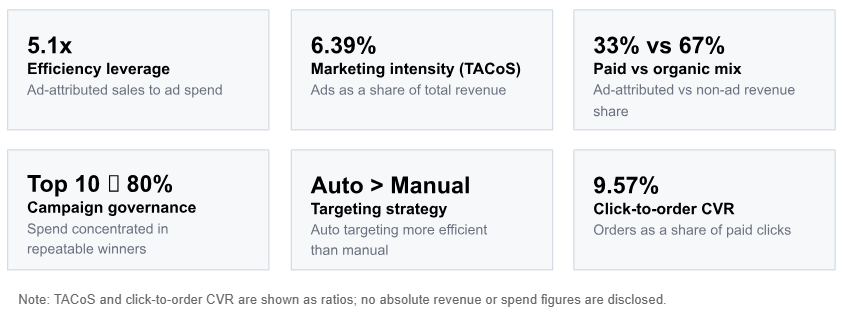
Advertising was managed as an acquisition portfolio with clear rules for efficiency and marketing intensity.
Instead of spending as much as possible simply to increase top-line sales, SalesDuo focused on repeatable unit economics and controlled spending levels.
This is the difference between “spend-led” growth and “governed demand capture.”
The program produced 5.1x sales-to-spend leverage on ad-attributed revenue while keeping marketing intensity disciplined.
Results were supported by strong click-to-order conversion and by putting more investment behind campaigns and products that repeatedly performed well.
Ethan Monitoring Layer (Pricing and Buy Box)
In mature Amazon businesses, the biggest problem is usually not a lack of ideas. The challenge is having enough speed, visibility, and control to act on problems quickly.
For Polder, the Ethan bot became a monitoring layer that improved response time in two areas that are important for PE underwriting: pricing stability and Buy Box capture.
Throughout the year, Polder repeatedly faced Buy Box pressure from third-party sellers. Instead of treating these events as random marketplace problems, SalesDuo turned them into measurable incidents that could be monitored and managed.
Pricing notifications: quickly identified pricing changes so the team could respond before the financial impact became larger.
Buy Box notifications: identified Buy Box losses and instability so the team could respond to third-party sellers and work to recover sales capture.
Governed response: each incident was assigned an owner and tracked until it was closed. This helped turn “Amazon chaos” into a process that could be reviewed and audited.
From a PE point of view, this makes the revenue stream less fragile by reducing uncontrolled losses, improving price realization, and making performance more predictable.
Risk Control and Recovery
Amazon performance is not only about advertising and product merchandising. Risk management is also important.
Two high-impact problems are listing suppressions on important products and incorrect fees that slowly reduce margins.
SalesDuo managed both areas using clear processes and fast action.
Top SKU reinstatements: Polder’s top-selling SKU was removed from sale twice within the last four months. SalesDuo managed the appeal process and got the product reinstated within two weeks both times.
When an important SKU is unavailable, the business loses revenue immediately. A long period without sales can also damage the product’s search ranking. Faster reinstatement helps protect business continuity and reduce revenue swings.
FBA fee reconciliation: SalesDuo also pursued reimbursement for FBA fee overcharges caused by a difference between the product’s actual dimensions and the dimensions Amazon FBA had recorded during FBA Cubiscan.
Correct fees are important in PE underwriting because they directly affect contribution margins. Incorrect fees create avoidable value leakage.
The reconciliation process corrected the mismatch and recovered value for the business.
Continuity and Weekly Coverage Cadence
Continuity is important because keeping products in stock protects search rankings and prevents sudden drops in revenue that can make PE forecasts less reliable.
SalesDuo created a weekly forward-coverage process for FBA inventory planning.
The recommendations were not fixed. They changed every week based on the latest sales rate and demand.
In the most recent weekly report shared with SalesDuo, the coverage review included more than 100 SKUs and generated replenishment recommendations across the product range. Priority was given to products responsible for most of the channel’s sales velocity.
Weekly cadence (not a one-time plan): inventory coverage and replenishment recommendations are recalculated every week based on current sell-through.
SKU prioritization: the strongest-performing products receive priority so the main revenue drivers stay protected.
Risk visibility: the process identifies short-term inventory risks, including products with low coverage or no coverage, so the team can act before revenue is affected.
Walmart Expansion (Selection + Advertising Pivot)
SalesDuo also helped Polder expand and diversify through Walmart.
The goal was not to simply “list everything.” Instead, Amazon performance data was used to decide which products had the strongest chance of succeeding on Walmart.
SalesDuo advised Polder to add Amazon’s top-performing products that were not already available on Walmart.
Once these products were live, the advertising strategy was adjusted to help them gain sales velocity.
From a PE point of view, this approach reduces execution risk. Instead of testing an unproven product range, the business starts with products that have already shown strong demand on Amazon and then uses controlled advertising to build traction.
Why This Matters for PE Portfolios
Why this matters for PE portfolios: The Polder engagement shows a repeatable model that can also be used across other consumer portfolio companies where Amazon is an important sales channel.
The approach does not depend on one-time tactics or individual heroics. It is based on governance, repeatable processes, and control.
Revenue quality: better conversion and monetization help generate more value from each visitor.
Controllability: Buy Box and pricing monitoring help reduce revenue leakage caused by third-party sellers.
Acquisition economics: advertising is managed with clear efficiency and spending guardrails, making growth easier to predict.
Risk control: fast reinstatement processes and fee reconciliation reduce hidden margin leakage and help prevent major revenue losses.
Execution cadence: weekly inventory and performance reviews create a regular operating system that investors can understand and trust.
The result is an Amazon channel that works less like an unpredictable marketing experiment and more like a controlled growth asset that is measurable, scalable, and auditable.
Treating Amazon as a controlled growth asset means coordinating strategy, ads, listings, and operations, the connected responsibilities our Amazon agency manages.
Want similar results for your brand? Book your 1:1 growth call today!
Frequently Asked Questions
How can brands turn Amazon into a controlled, scalable growth channel?
This Amazon growth strategy case study shows how brands can create controlled Amazon growth through Amazon account optimization, Amazon performance management, and data-driven Amazon management focused on Amazon profitability optimization.
SalesDuo builds predictable and scalable Amazon growth systems.
What drives sustainable Amazon growth without hurting margins?
Sustainable Amazon growth depends on Amazon advertising efficiency, Amazon ROAS improvement, and a clear Amazon cost control strategy that supports Amazon margin protection.
SalesDuo focuses on disciplined optimization instead of aggressive spending.
Why is long-term Amazon performance management critical for brands?
Amazon operational excellence requires Amazon performance management that supports an Amazon long-term growth strategy.
This means balancing advertising, operations, and margin protection instead of treating them as separate areas.
SalesDuo helps brands manage Amazon as a controlled growth asset.
About the Author
Rahul is an Associate Customer Success Manager driven by a strong interest in business management and leadership. He focuses on solving complex, analytical eCommerce challenges for clients. Beyond work, he actively pursues learning through reading, public speaking, global affairs, and professional development.