Amazon Advertising Revenue, Market Share & Growth: The 2026 Data Report
Amazon ads revenue reached $68.63 billion in 2025. In Q1 2026, Amazon Advertising Services Sales reached $17.24 billion, up approximately 22% year over year.
Revenue is reported under Advertising Services Sales and includes sponsored ads, display advertising, and video advertising sold to sellers, vendors, publishers, and brands.
For sellers, vendors, and D2C brands, this is more than a revenue update. It shows how fast Amazon Ads is becoming a full-funnel advertising platform built around retail media, shopper intent, Prime Video, DSP, measurement, and AI-powered tools.
This report covers Amazon advertising revenue by year, the latest quarterly results, Amazon’s position against Google and Meta, and what this growth means for brands planning their 2026 advertising strategy.
Key Amazon Advertising Revenue Stats at a Glance
| Metric | Latest Figure | Why It Matters | Source / Reporting Period |
|---|---|---|---|
| Amazon advertising revenue 2024 | $56.22 billion | Amazon crossed the $50B annual ad revenue mark | Marketplace Pulse, full-year 2024 |
| Amazon advertising revenue 2025 | $68.63 billion | Shows strong year-over-year growth | Marketplace Pulse, full-year 2025 |
| Latest reported quarter | Q1 2026: $17.24 billion | Confirms continued momentum after a record 2025 | Marketplace Pulse, Q1 2026 |
| Q1 2026 growth | 22%–24% YoY, depending on source/rounding | Shows Amazon Ads is still growing at a double-digit pace | Amazon commentary and Marketplace Pulse, Q1 2026 |
| Q3 2025 advertising services net sales | $17.7 billion | Confirmed strong growth before the Q4 holiday period | Business Insider, Q3 2025 earnings coverage |
| Q4 2025 advertising services net sales | ~$21.3 billion | Holiday demand pushed Amazon’s ad revenue higher | Derived from full-year 2025 minus Q1–Q3 2025, unless replaced with Amazon-reported Q4 figure |
| Main revenue drivers | Sponsored ads, display, video, DSP, Prime Video, retail media | Shows why Amazon Ads is moving beyond marketplace PPC | Amazon Ads product ecosystem and SalesDuo analysis |
How Much Revenue Does Amazon Advertising Make?
Amazon advertising revenue reached $68.63 billion in 2025. In Q1 2026, Amazon Advertising Services Sales reached $17.24 billion, driven by sponsored ads, display, video ads, DSP, Prime Video inventory, and retail media growth.
Amazon reports this revenue under Advertising Services Sales. This includes advertising services sold to sellers, vendors, publishers, authors, and other brands through sponsored, display, and video ads.
For Amazon sellers, this matters because ad revenue shows how competitive the marketplace has become. More brands are spending on Amazon because ads can connect directly to product discovery, shopper behavior, and sales.
Unlike many awareness-first platforms, Amazon Ads often reaches shoppers when they are already comparing products, reading reviews, checking prices, and getting ready to buy.
Amazon Advertising Revenue by Year: 2020–2026
| Year | Amazon Advertising Revenue | Growth Context |
|---|---|---|
| 2019 | $14.09 billion | Amazon Ads was still reported under “Other,” which primarily included advertising services at the time. |
| 2020 | $21.45 billion | Sponsored ads adoption accelerated as more retail shifted online during the pandemic period. |
| 2021 | $31.16 billion | Amazon publicly disclosed advertising as a major revenue business, crossing $31B annually. |
| 2022 | $37.74 billion | Retail media and sponsored ads continued gaining budget share despite a slower eCommerce year. |
| 2023 | $46.91 billion | Amazon Ads became a larger standalone growth engine, supported by sponsored ads, DSP, and retail media demand. |
| 2024 | $56.22 billion | Amazon crossed the $50B annual advertising revenue mark. |
| 2025 | $68.63 billion | Amazon’s ad business passed $68B annually. |
| Q1 2026 | $17.24 billion | Latest reported quarter shows continued double-digit growth. |
Amazon’s advertising business has grown from a marketplace ad channel into one of the world’s largest digital advertising businesses. The growth has come from Sponsored Products, Sponsored Brands, Sponsored Display, Amazon DSP, Prime Video ads, and broader retail media solutions.
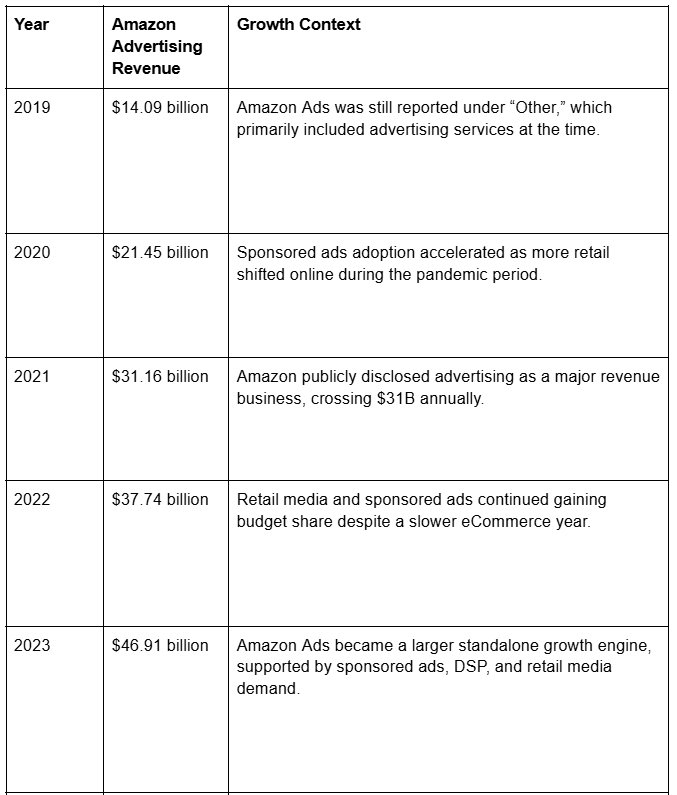
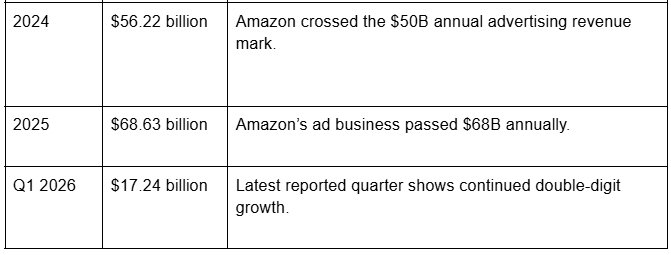
Amazon’s advertising revenue grew from about $14.09 billion in 2019 to $68.63 billion in 2025, making it one of Amazon’s fastest-growing business lines. The biggest shift came after Amazon began reporting advertising more directly as Advertising Services Sales, showing how quickly sponsored ads, display, video, DSP, and retail media became central to Amazon’s growth.
Amazon Advertising Revenue 2024
Amazon advertising revenue reached $56.22 billion in 2024. This made 2024 the first year Amazon’s ad business crossed the $50 billion mark.
That number matters because it showed Amazon Ads was no longer just a support channel for marketplace sellers. By 2024, advertising had become one of Amazon’s major growth businesses.
For brands, 2024 was a turning point. Amazon Ads became too large to treat as a small PPC line item. It became a major digital advertising platform competing for budgets that once went mainly to Google, Meta, and other media networks.
Amazon Advertising Revenue 2025
Amazon advertising revenue increased to $68.63 billion in 2025, up from $56.22 billion in 2024.
This growth came from several areas:
- More sellers competing for Sponsored Products visibility
- Higher adoption of Sponsored Brands and Sponsored Display
- More brands using Amazon DSP for full-funnel campaigns
- Prime Video and connected TV expanding Amazon’s reach
- Better measurement through Amazon Marketing Cloud
- Stronger retail media investment from enterprise advertisers
The 2025 number matters because Amazon Ads is no longer growing only from keyword bidding. It is growing because Amazon is building a larger advertising system around shopping data, streaming, audience targeting, AI tools, and off-Amazon reach.
Amazon Advertising Revenue 2026 So Far
In Q1 2026, Amazon Advertising Services Sales reached $17.24 billion based on Marketplace Pulse’s tracking of Amazon Advertising Services Sales. Amazon’s own Q1 commentary rounded the figure to about $17.2 billion and described growth as roughly 22% year over year.
For the latest reported figures, verify quarterly numbers using Amazon’s official quarterly results.
To keep the article consistent, this report uses $17.24 billion in data tables and uses 22% YoY as the main growth rate when referring to Amazon’s official commentary. Where Marketplace Pulse calculates 24% YoY, that difference is treated as a source-calculation difference and explained in the methodology section.
The main point is simple: Amazon Ads continued to grow strongly after a record 2025. For advertisers, this means Amazon Ads should not be treated as a basic PPC channel in 2026. Competition is increasing, inventory is expanding, and measurement is becoming more important.
Amazon Advertising Growth Rate & Trajectory
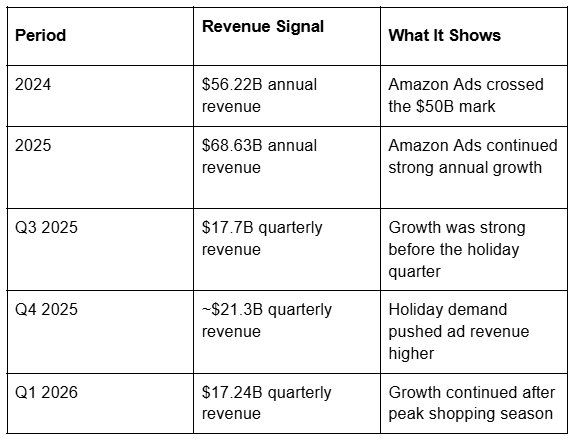
| Period | Revenue Signal | What It Shows |
|---|---|---|
| 2024 | $56.22B annual revenue | Amazon Ads crossed the $50B mark |
| 2025 | $68.63B annual revenue | Amazon Ads continued strong annual growth |
| Q3 2025 | $17.7B quarterly revenue | Growth was strong before the holiday quarter |
| Q4 2025 | ~$21.3B quarterly revenue | Holiday demand pushed ad revenue higher |
| Q1 2026 | $17.24B quarterly revenue | Growth continued after peak shopping season |
Amazon ads revenue is still growing at a strong double-digit pace. The biggest jump in recent years came from Amazon’s shift from marketplace PPC into a wider retail media and full-funnel advertising platform.
From 2024 to 2025, Amazon advertising revenue increased from $56.22 billion to $68.63 billion. In Q1 2026, Amazon Advertising Services Sales reached $17.24 billion, indicating continued growth after the record 2025 total.
This growth is important because it shows Amazon Ads is no longer expanding only through keyword-based Sponsored Products. Revenue is also being supported by Prime Video ads, Amazon DSP, Sponsored Display, Sponsored Brands Video, AI-powered tools, and better measurement through Amazon Marketing Cloud.
For brands, the growth trajectory means Amazon Ads will likely become more competitive, more expensive in crowded categories, and more dependent on strong creative, clean campaign structure, and margin-based measurement.
Latest Amazon Ads Revenue News: Q1 2026 Update
Amazon’s latest reported advertising results show its ad business is still growing fast. In Q1 2026, Amazon Advertising Services Sales reached $17.24 billion, up about 24% year over year according to Marketplace Pulse. Amazon’s own Q1 commentary rounded the figure to about $17.2 billion, with growth of roughly 22% year over year.
Amazon’s Q1 2026 growth was linked to:
- Full-funnel advertising options
- Streaming and Prime Video inventory
- Shopping signals and first-party shopper data
- AI-powered creative and campaign tools
- Broader advertiser adoption beyond marketplace sellers
For brands, the Q1 2026 update confirms one thing: Amazon advertising is becoming more competitive and more advanced.
Winning in 2026 will require a stronger campaign structure, better creative, smarter measurement, and clearer control of profitability.
Amazon Ads Revenue Q3 2025 News: Why It Matters
Amazon Ads revenue news for Q3 2025 mattered because it showed strong ad growth before the Q4 holiday season. In Q3 2025, Amazon advertising services net sales rose to about $17.7 billion, up 24% year over year.
That was an important signal because Q3 does not have the same holiday lift as Q4. Strong Q3 growth showed that advertisers were increasing Amazon budgets across normal retail cycles, not only during peak shopping events.
The Q3 2025 update also showed how Amazon’s ad business was changing. Prime Video, live sports, Amazon DSP, retail media, AI shopping tools, and better measurement were becoming larger parts of the advertising ecosystem.
For sellers and brand owners, Q3 2025 showed that competition on Amazon Ads is becoming more consistent year-round.
Brands can no longer prepare only for Prime Day, Black Friday, and Cyber Monday. They need an always-on Amazon Ads strategy that covers:
- Core keyword defense
- Category expansion
- Competitor targeting
- Retargeting
- New-to-brand acquisition
- Video creative
- Full-funnel measurement
The Q3 2025 number also helped set up Amazon’s stronger full-year 2025 results, with annual advertising revenue surpassing $68 billion.
Amazon Ads Market Position: Revenue, Retail Media, and Digital Ad Share
| Platform / Channel | Latest Research-Backed Position | Scope of Figure | Core Strength | Best Use Case for Brands |
|---|---|---|---|---|
| Amazon Ads | Amazon advertising revenue reached $68.63B in 2025. Growth is strongly tied to retail media, shopper data, marketplace ads, DSP, and video inventory. | Amazon Advertising Services Sales | Shopping intent and purchase data | Retail media, marketplace sales, DSP, and conversion-focused campaigns |
| Search advertising platforms | Market research estimates place the leading search ad channel among the largest shares of U.S. digital ad spending in 2025. | U.S. digital ad spending share | Search demand and video reach | Broad search demand, shopping campaigns, video, and discovery |
| Social advertising platforms | Market research estimates place the leading social ad channel among the largest shares of U.S. digital ad spending in 2025. | U.S. digital ad spending share | Social discovery and audience targeting | Awareness, demand creation, retargeting, and social commerce |
Amazon is now one of the most important companies in digital advertising. But it does not compete with Google and Meta in the same way.
Google is strongest in broad search intent. Meta is strongest in social discovery, audience targeting, and interest-based advertising. Amazon is strongest in commerce intent because shoppers are already searching, comparing, and buying products.
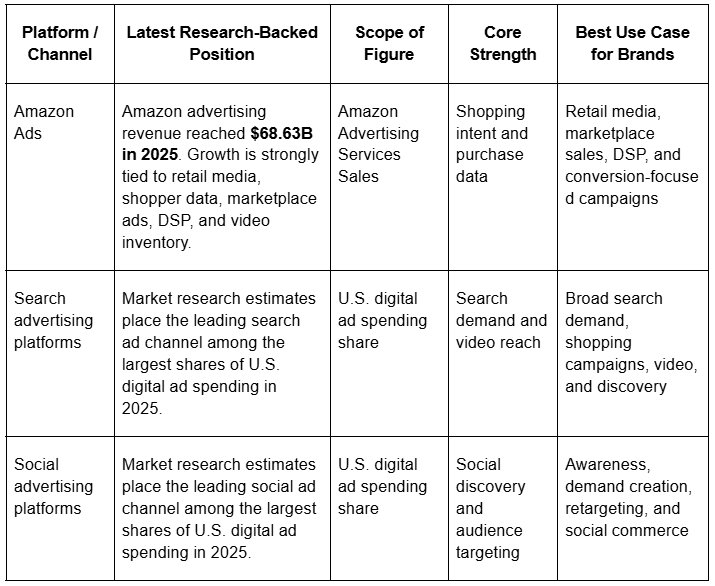
Amazon’s ad business is not measured in the same way as broader digital ad-share estimates. Amazon reports Advertising Services Sales, while many market-share estimates track U.S. digital ad spending, global net ad revenue, or retail media revenue. That distinction matters because Amazon’s strongest position is in commerce media, where ad exposure can be more directly connected to shopper behavior, detail-page views, retargeting, and purchase signals.
For brands, this makes Amazon Ads different from a pure awareness channel. It connects media spend to product discovery and retail outcomes, which is why Amazon has become one of the most important platforms in retail media.
Amazon’s biggest advantage is the link between ad exposure and shopping behavior.
A shopper may see a Sponsored Product, visit the product detail page, check reviews, view a Sponsored Brands video, be retargeted, and then purchase. Amazon can connect many of those actions inside its own ecosystem.
That is why brands increasingly view Amazon as more than a marketplace. It is now a retail media platform with purchase-level signals.
For sellers, this means Amazon Ads should not be measured only through clicks and ACOS. As the platform becomes more full-funnel, brands need to track:
- TACOS
- New-to-brand sales
- Organic rank lift
- Repeat purchase behavior
- Incremental sales
- Contribution margin
- Customer lifetime value
Amazon may still be smaller than Google and Meta in total digital advertising revenue, but it has become one of the most important platforms for commerce-driven advertising.
Why Amazon Advertising Revenue Is Growing So Fast
Amazon advertising revenue is growing because the platform sits close to the buying decision. Most ad platforms help brands find audiences. Amazon helps brands reach shoppers when they are already searching, comparing, and ready to buy.
That is why advertisers continue to allocate more budget to Amazon Ads.
Amazon Owns High-Intent Shopping Behavior
Amazon’s biggest advantage is purchase intent.
A shopper searching for “wireless earbuds,” “protein powder,” or “stainless steel water bottle” is often close to making a purchase. They are not only browsing content. They are comparing options.
That makes Amazon search results highly valuable. Brands are not just paying for impressions or traffic. They are paying for visibility at the point where shoppers are choosing between products.
This is why Amazon Ads is attractive to sellers, vendors, and D2C brands. It connects media spend to product discovery, consideration, and sales in a way many traditional channels cannot.
Sponsored Ads Still Drive the Core Business
Sponsored ads remain the foundation of Amazon’s advertising revenue.
Amazon defines Sponsored Products as cost-per-click ads that promote individual product listings on Amazon and select premium apps and websites.
Sponsored Products are still the most important ad format for many sellers because they appear directly in search results and product detail pages. They help brands defend branded keywords, reach category shoppers, and capture high-intent demand.
Sponsored Brands help brands tell a bigger story through headline search ads, Store traffic, and video placements. Sponsored Display supports retargeting and audience-based visibility across Amazon and selected off-Amazon placements.
Even as Amazon expands into Prime Video, DSP, and AI-powered tools, Sponsored Products remain central because they sit closest to the transaction.
For most sellers, the basics still matter:
- Clean campaign structure
- Keyword segmentation
- Negative keyword management
- ASIN targeting
- Bid control
- Placement optimization
- Listing conversion rate
- Review strength
- Pricing competitiveness
If Sponsored Products are taking most of your budget, structured Amazon PPC management can help reduce wasted spend and improve campaign control.
Prime Video and Connected TV Are Expanding Amazon Ads
Prime Video has changed the ceiling for Amazon Ads.
For years, Amazon Ads was seen mainly as a search and marketplace advertising platform. Prime Video, live sports, Fire TV, Twitch, and connected TV inventory have expanded Amazon's presence into upper- and mid-funnel media.
This gives Amazon a stronger full-funnel advertising story.
A brand can now use Amazon to:
- Build awareness through streaming inventory
- Retarget shoppers through display and DSP
- Capture demand through Sponsored Products
- Measure impact through Amazon Marketing Cloud
- Connect ad exposure to shopping behavior
For larger brands, this makes Amazon more competitive with traditional media platforms. For growing sellers, it means video creative and brand storytelling are becoming more important.
Amazon Ads is no longer only about winning the top sponsored slot. It is about building a complete path from awareness to conversion.
Amazon DSP Is Moving Amazon Beyond Search Ads
Amazon DSP helps brands reach shoppers across Amazon-owned and third-party placements by using Amazon’s audience and shopping behavior data.
This is one reason Amazon advertising revenue can keep growing. Search ads are powerful, but search inventory is limited by the number of shoppers actively searching at one time. DSP opens a broader audience layer.
With Amazon DSP, brands can reach shoppers based on signals such as:
- Category browsing behavior
- Product detail page views
- Past purchases
- Lifestyle and interest segments
- In-market behavior
- Retargeting pools
- Lookalike audience opportunities
For mature brands, DSP can support both acquisition and retention. It can help brands reach shoppers before they search, bring back shoppers who viewed but did not buy, and support launches with broader awareness.
However, DSP is not a shortcut. It works best when a brand already has a strong product-market fit, clear margins, enough traffic, and conversion-ready listings.
Amazon Marketing Cloud Is Improving Measurement
As Amazon Ads becomes more full-funnel, measurement becomes more complex.
A shopper may interact with several ads before making a purchase. They might first see a video ad, later click a Sponsored Brand ad, view a product detail page, leave, return through retargeting, and finally purchase through Sponsored Products.
If a brand only looks at last-click ACOS, it may misinterpret which campaigns contributed to the purchase journey.
Amazon Marketing Cloud helps advertisers study multi-touch journeys, audience behavior, path-to-purchase patterns, and campaign overlap. This is especially useful for brands using DSP, Sponsored Brands Video, Sponsored Display, and Prime Video ads.
For sellers, the takeaway is clear: as Amazon Ads becomes more advanced, measurement must improve as well.
Basic ACOS reporting is no longer enough for brands investing across multiple ad types.
AI Tools Are Reducing Campaign and Creative Friction
Amazon is also using AI to make advertising easier to build, manage, and scale.
AI-powered tools can help with campaign setup, audience development, creative generation, bidding, product recommendations, and performance analysis.
This matters because creative production has often been a bottleneck for smaller brands. As Amazon adds more video, streaming, and display inventory, brands need more assets than they needed for basic Sponsored Products campaigns.
AI tools can reduce friction, but they do not replace strategy.
Brands still need to know:
- Which audience they want to reach
- What product message matters
- Which campaigns are profitable
- How to measure incrementality
- When to scale
- When to reduce wasted spend
AI can help execution move faster. It cannot fix weak positioning, poor product-market fit, bad pricing, low reviews, or a listing that does not convert.
Amazon Advertising Revenue by Product and Format
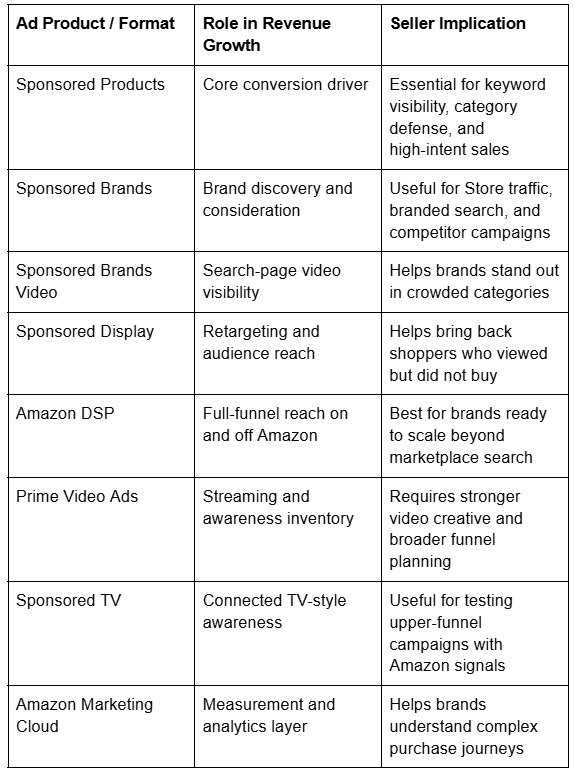
| Ad Product / Format | Role in Revenue Growth | Seller Implication |
|---|---|---|
| Sponsored Products | Core conversion driver | Essential for keyword visibility, category defense, and high-intent sales |
| Sponsored Brands | Brand discovery and consideration | Useful for Store traffic, branded search, and competitor campaigns |
| Sponsored Brands Video | Search-page video visibility | Helps brands stand out in crowded categories |
| Sponsored Display | Retargeting and audience reach | Helps bring back shoppers who viewed but did not buy |
| Amazon DSP | Full-funnel reach on and off Amazon | Best for brands ready to scale beyond marketplace search |
| Prime Video Ads | Streaming and awareness inventory | Requires stronger video creative and broader funnel planning |
| Sponsored TV | Connected TV-style awareness | Useful for testing upper-funnel campaigns with Amazon signals |
| Amazon Marketing Cloud | Measurement and analytics layer | Helps brands understand complex purchase journeys |
Amazon's advertising revenue does not come from a single ad type. It comes from a growing mix of marketplace ads, display, video, streaming, DSP, and measurement products.
To understand how each format works across the funnel, review SalesDuo’s guide to Amazon ad types
For most sellers, Sponsored Products will remain the main revenue-driving ad type. But the brands that grow most efficiently in 2026 will not rely on a single format.
A stronger Amazon Ads mix usually includes:
- Sponsored Products for conversion
- Sponsored Brands for brand visibility
- Sponsored Brands Video for differentiation
- Sponsored Display for retargeting
- DSP for full-funnel reach
- AMC for measurement and audience insights
The right mix depends on product category, margin, sales velocity, budget, maturity, and business goals.
A new seller should not jump into every format at once. A mature brand should not stay stuck in the basic keyword PPC forever.
What Amazon Ads Revenue Growth Means for Brands
Amazon’s advertising revenue growth tells brands one thing clearly: competition is rising.
More advertisers are spending on Amazon because the platform works. But as more brands enter the auction, weak campaign structures, poor listings, and generic creative become increasingly expensive problems.
More Revenue Means More Competition
As Amazon earns more advertising revenue, more brands are competing for the same high-value placements.
That can create pressure on:
- CPCs
- Keyword auctions
- Category visibility
- Sponsored placement costs
- Retargeting audiences
- Video inventory
- Prime Day and holiday budgets
If CPCs are rising but sales are not improving, review what Amazon ads cost before increasing budgets. Higher spend only works when the campaign structure, margins, and conversion rates can support it.
This does not mean brands should spend less on Amazon Ads. It means they need to spend more carefully.
A campaign that worked two years ago may not work the same way in 2026. Search results are more competitive. Shoppers have more options. Amazon’s ad formats are more advanced. Brands are also using better measurement tools.
Brands that perform best will be those that connect ad spend with the broader retail picture — including pricing, listings, reviews, margins, creative, and long-term sales growth.
ACOS Alone Is No Longer Enough
ACOS is still useful, but it is not sufficient on its own.
A low ACOS campaign may simply be capturing branded traffic that would have converted anyway. A higher ACOS campaign may help a product gain category visibility, improve ranking, or acquire new-to-brand customers.
Brands need to look beyond campaign-level ACOS and evaluate:
- TACOS
- Contribution margin
- New-to-brand sales
- Organic sales lift
- Repeat purchase rate
- Incremental revenue
- Customer lifetime value
- Product-level profitability
This is especially important as Amazon Ads becomes more full-funnel. Upper-funnel and mid-funnel campaigns may not always look efficient in last-click reporting, but they can still support long-term growth when measured correctly.
Creative Quality Now Affects Ad Efficiency
Creative quality now directly impacts ad efficiency.
As Amazon expands into video, DSP, Prime Video, Sponsored Brands Video, and Store-based campaigns, brands cannot rely only on keyword bids.
Better creative helps shoppers understand:
- What the product does
- Who it is for
- Why it is different
- How it solves a problem
- Why it is worth the price
- What makes it trustworthy
Creative also affects how well full-funnel campaigns perform. A strong video can introduce the product. A strong Store can educate the shopper. A strong product detail page can close the sale.
That means ad performance is now closely connected to content quality.
Full-Funnel Strategy Matters More Than Manual PPC Tweaks
Manual PPC management is still important, but it is no longer the whole strategy.
A full-funnel Amazon advertising strategy connects:
- Sponsored Products for demand capture
- Sponsored Brands for category and brand visibility
- Sponsored Display for retargeting
- DSP for audience reach
- Prime Video or Sponsored TV for awareness
- AMC for journey measurement
- Listing optimization for conversion
This is where many brands struggle. They increase budgets but do not fix the system around the ads.
More budget cannot fix:
- Weak images
- Poor reviews
- Bad pricing
- Low conversion rates
- Confusing titles
- Thin A+ Content
- Poor keyword targeting
- Overlapping campaigns
- No measurement framework
Amazon’s ad revenue growth creates opportunity, but it also rewards better operators.
The Future of Amazon Advertising: 2026 and Beyond
The future of Amazon advertising will be full-funnel, data-led, and more automated.
The same forces driving Amazon advertising revenue today will shape the next stage of growth: retail media, video, AI, first-party shopping data, and better measurement.
Amazon Ads Will Become More Full-Funnel
Amazon Ads is moving from a marketplace PPC platform to a full-funnel media ecosystem.
Sponsored Products still capture demand at the bottom of the funnel. But Amazon is expanding its reach in awareness and consideration through Prime Video, Sponsored TV, DSP, Twitch, Fire TV, and streaming partnerships.
This gives brands more ways to influence shoppers before the final search.
In 2026 and beyond, Amazon Ads planning will look more like media planning and less like simple keyword bidding.
Brands will need to ask:
- Which campaigns create demand?
- Which campaigns capture demand?
- Which campaigns retarget shoppers?
- Which campaigns protect brand terms?
- Which campaigns support launches?
- Which campaigns improve profitability?
The answer will rarely come from a single ad type.
Retail Media Budgets Will Keep Moving Toward Commerce Platforms
Retail media is growing because brands want advertising that more effectively drives sales.
Traditional digital ads often measure clicks, impressions, reach, and engagement. Retail media adds another layer: shopping behavior.
Amazon has a major advantage because it owns both the media and shopping environments. A shopper can see an ad, click a product, compare options, read reviews, and buy inside the same ecosystem.
That closed-loop environment is why more advertisers are shifting budget toward Amazon and other retail media networks.
For sellers, the implication is simple: Amazon Ads will continue to attract more professional advertisers, larger budgets, and more advanced measurement expectations.
AI Will Change Campaign Management and Creative Testing
AI will continue changing how Amazon campaigns are built, optimized, and measured.
Brands should expect more automation around:
- Bidding
- Budget allocation
- Audience creation
- Creative generation
- Keyword discovery
- Search term analysis
- Product recommendations
- Performance insights
But AI will not remove the need for strategy.
If every brand has access to similar automation, the real advantage will come from better inputs:
- Better product positioning
- Better listing content
- Better creative direction
- Better margin data
- Better campaign structure
- Better measurement decisions
AI can make advertising faster. It does not automatically make advertising more profitable.
Amazon’s Ad Business Will Move Beyond Amazon
Amazon’s advertising growth will increasingly come from places beyond the Amazon marketplace.
This includes:
- Prime Video
- Fire TV
- Twitch
- Live sports
- DSP inventory
- Publisher partnerships
- Retail Ad Service
- Off-Amazon audience targeting
This gives brands more reach, but it also creates more complexity.
The future of Amazon advertising will belong to brands that understand both sides of the platform: retail performance and media planning.
How Brands Should Prepare for Rising Amazon Ads Competition
Brands should prepare for rising Amazon Ads competition by improving the entire advertising system. That means better campaign structure, stronger listings, better creative, cleaner measurement, and tighter budget control.
Amazon's advertising revenue growth creates opportunity but also raises the bar.
Audit Wasted Spend Before Increasing Budgets
Before increasing ad spend, brands should check where money is leaking.
Look for:
- Search terms spending without sales
- Keywords with low conversion rates
- Duplicate targeting across campaigns
- Broad match campaigns with poor control
- High CPC placements with weak returns
- Auto campaigns that have not been mined properly
- Products with poor conversion rates
- Campaigns that are not aligned with margin
A budget increase should support campaigns that already show strong signals. It should not be used to hide weak structure.
Improve Listing Conversion Before Scaling Ads
Advertising sends traffic. Listings convert that traffic.
If a product detail page is weak, more ad spend usually means more wasted spend.
Before scaling campaigns, brands should review:
- Main image quality
- Secondary image clarity
- Product title accuracy
- Bullet point readability
- A+ Content quality
- Review count and rating
- Pricing competitiveness
- Coupon and promotion strategy
- Delivery promise
- Variation structure
A small improvement in conversion rate can make the same ad budget more profitable.
Build a Full-Funnel Ad Mix
A strong Amazon Ads strategy should match the customer journey.
For example:
- Use Sponsored Products to capture high-intent search demand.
- Use Sponsored Brands to build brand visibility.
- Use Sponsored Brands Video to make your product more noticeable when search results are filled with similar options.
- Use Sponsored Display to retarget shoppers.
- Use DSP to reach audiences on and off Amazon.
- Use Prime Video or Sponsored TV when video awareness makes sense.
- Use AMC to understand how campaigns work together.
For a deeper planning framework, read SalesDuo’s Amazon advertising strategy guide.
Not every brand needs every ad type. But every growing brand needs a funnel-based plan.
Use Better Measurement
Brands should not judge every campaign by the same metric.
A branded Sponsored Products campaign, a competitor targeting campaign, a DSP retargeting campaign, and a Prime Video campaign serve different purposes. They should not be measured the same way.
Use metrics based on the campaign goal.
For conversion campaigns, track:
- ACOS
- ROAS
- CPC
- Conversion rate
- Sales volume
For growth campaigns, track:
- TACOS
- New-to-brand sales
- Organic rank movement
- Incremental revenue
- Detail page views
- Audience growth
For profitability, track:
- Contribution margin
- Product-level profit
- Repeat purchase rate
- Customer lifetime value
Better measurement helps brands scale the right campaigns and reduce wasted spend faster.
Refresh Creative More Often
Creative fatigue is becoming a bigger issue as Amazon expands into video and display.
Brands should refresh:
- Sponsored Brands Video
- DSP banners
- Store pages
- A+ Content
- Product images
- Prime Video assets
- Seasonal campaign creative
Creative should not only look good. It should answer shopper questions, reduce hesitation, and support the product’s positioning.
The brands that win will test creative with the sa
me discipline they apply to bids and keywords.
Sources and Methodology
This report uses publicly available data from Amazon earnings releases, annual reports, SEC filings, advertising revenue data series, industry reports, and market research estimates.
Amazon reports advertising revenue under Advertising Services Sales, which includes sponsored ads, display advertising, and video advertising sold to sellers, vendors, publishers, authors, and other advertisers.
Figures may vary slightly across sources due to rounding, reporting periods, or calculation methods. For consistency, this report uses $17.24 billion for Q1 2026 in data tables, while Amazon’s commentary may round the figure to about $17.2 billion.
Market-share figures are separated by scope because Amazon Advertising Services Sales, U.S. digital ad spending share, global ad revenue estimates, and retail media revenue are different measurements.
Revenue figures are cross-checked against Amazon’s official annual reports and shareholder letters, quarterly results, and SEC filings wherever available.
Conclusion
Amazon advertising revenue has become one of the clearest signs of where digital commerce is heading.
With Amazon advertising revenue reaching $68.63 billion in 2025 and Q1 2026 showing continued double-digit growth, the message for brands is clear: Amazon Ads is becoming more competitive, more full-funnel, and more central to retail media planning.
For sellers, the opportunity is still strong. But the old approach of increasing bids, adding keywords, and checking ACOS is no longer enough.
Brands now need to integrate Amazon PPC, DSP, Prime Video, Sponsored Brands, creative, listings, measurement, and profitability into a single, clear growth system.
If your brand is spending more on Amazon Ads but not seeing stronger profitability, the issue may not be the budget alone. It may be campaign structure, creative quality, listing conversion, measurement, or full-funnel strategy.
Book a 1:1 growth call with SalesDuo.
FAQs About Amazon Advertising Revenue
How much revenue does Amazon advertising generate?
Amazon advertising revenue reached $68.63 billion in 2025. In Q1 2026, Amazon Advertising Services Sales reached $17.24 billion, showing continued double-digit growth after a record 2025.
What was Amazon advertising revenue in 2024?
Amazon advertising revenue was about $56.22 billion in 2024. This was the first year Amazon’s advertising business crossed the $50 billion annual revenue mark.
What was Amazon advertising revenue in 2025?
Amazon advertising revenue reached about $68.63 billion in 2025, up from $56.22 billion in 2024.
This growth was driven by Sponsored Products, Sponsored Brands, display advertising, video ads, DSP adoption, retail media, and Prime Video inventory.
What is Amazon Ads revenue in 2026 so far?
Amazon Ads revenue in Q1 2026 was about $17.2 billion to $17.24 billion, depending on source rounding.
The full-year 2026 figure is not available yet because Amazon has not reported all four quarters.
How fast is Amazon advertising revenue growing?
Amazon’s advertising business is growing at a strong double-digit pace. In Q1 2026, Amazon reported about 22% year-over-year growth in advertising revenue.
Third-party sources reported Q1 2026 Advertising Services Sales growth at about 24% year over year.
What is Amazon’s share of the digital advertising market?
Amazon has become one of the strongest forces in digital advertising, especially in retail media. Amazon advertising revenue reached $68.63B in 2025, but that figure refers to Advertising Services Sales, not U.S. market share.
Market-share estimates are often reported differently across sources. Some measure U.S. digital ad spending, while others measure global net ad revenue or retail media revenue. Amazon’s advantage is commerce media: it connects ads to shopper behavior, product discovery, detail-page views, retargeting, and purchase signals
How does Amazon ad revenue compare with Google and Meta?
Google is strongest in broad search and YouTube advertising. Meta is strongest in social discovery and audience-based advertising. Amazon is strongest in commerce media because its ads are connected to shopping behavior, product discovery, and purchase decisions.
Amazon may not be larger than Google or Meta in total ad revenue, but it has a unique advantage in retail media because it can connect ad exposure to product-level sales.
What were Amazon’s latest quarterly ad results?
Amazon’s most recently reported quarter is Q1 2026, when Amazon Advertising Services Sales
reached $17.24 billion, up approximately 22% year over year. Q4 2025 was the
previous quarter, when Amazon reported approximately $21.3 billion in advertising
revenue, boosted by Black Friday, Cyber Monday, and holiday shopping demand.
What is driving Amazon advertising revenue growth?
Amazon advertising revenue growth is being driven by Sponsored Products, Sponsored Brands, Sponsored Display, Amazon DSP, Prime Video ads, connected TV, retail media demand, first-party shopper data, AI-powered tools, and better measurement through Amazon Marketing Cloud.
What does Amazon Ads revenue growth mean for sellers?
For sellers, Amazon Ads revenue growth means more opportunity and more competition.
As more advertisers spend on Amazon, brands need a stronger campaign structure, better listings, better creative, better budget control, and more advanced measurement.
Sellers can no longer rely only on manual PPC tweaks. They need a full-funnel Amazon advertising strategy that connects ads, content, conversion, margin, and long-term growth.
What is the future outlook for Amazon advertising?
The future of Amazon advertising is full-funnel, data-led, and increasingly powered by AI.
Amazon will continue expanding beyond Sponsored Products into Prime Video, DSP, Sponsored TV, connected TV, retail media services, and AI-powered creative and campaign tools.
For brands, this means Amazon Ads will become more powerful, but also more complex. The winners will be brands that combine retail fundamentals with advanced advertising strategy.
About the Author
Badal Tharayil is a master of customer success, turning first impressions into lasting partnerships. Known for proactive communication and flawless onboarding, he’s the bridge between client satisfaction and operational excellence. Outside work, Badal loves exploring cinema, expressing himself on the dance floor, and staying energized through fitness pursuits.