5 Best Amazon Shortage Claim Agencies to Recover Your Lost Revenue

For U.S. Amazon Vendor Central teams, choosing the right Amazon shortage claim agency isn't just about picking the company that promises the highest recovery amount. The better choice is a partner whose working process, evidence handling, integrations, financial controls, and results match your business needs.
This comparison looks at five current options. These include managed recovery services, software-based recovery platforms, and shortage-prevention tools. The goal is to help finance, operations, and ecommerce teams build a practical shortlist.
TL;DR - How to choose among the five options
- SalesDuo is a managed agency + operations/EDI option for brands that want real people handling disputes while also connecting the work with Vendor Central operations.
- Reason Automation and ChannelEngine are mainly software/data-led solutions, but the level of automation and expert support differs between them.
- KhooCommerce mainly focuses on preventing shortage claims and managing Amazon Vendor orders. Based on its current public positioning, it is not a traditional claims-recovery agency.
- Wake Commerce offers managed recovery through ProfitGuard. It also shares public pricing and case-study results, but U.S. brands should confirm whether those details apply to the U.S. market before signing a contract.
Disclosure: SalesDuo publishes this comparison and is also included as one of the providers. The profiles below use the same public-evidence standards for SalesDuo and its competitors. Each profile also includes an important limitation or point that buyers should verify before signing.
What Are Shortage Claims?
In this context, a shortage claim is a payment deduction in Vendor Central/1P that occurs when Amazon records receiving fewer units than the vendor invoiced or expected to send against a purchase order.
This is often called a purchase quantity variance, or PQV, shortage.
It is different from Seller Central/FBA reimbursements. It also differs from chargebacks, although the same finance and operations teams may handle all of these issues.
For a more detailed explanation of shortage claim causes, documents, and prevention methods, read SalesDuo’s Amazon Vendor Central shortage claims guide.
Quick comparison: Amazon shortage-recovery providers
| Provider | Delivery model | Best fit | Shortage-specific public scope | Automation/data | Human dispute support | Prevention/root cause | Pricing visibility | Proof available | Key limitation to verify | Last checked |
|---|---|---|---|---|---|---|---|---|---|---|
| SalesDuo | Managed agency + EDI/operations | Brands wanting connected recovery + operations | Shortage claims and chargebacks; current SOW should confirm exact ownership | EDI/operations automation publicly described | Public case study describes manual dispute handling | EDI/process work can address upstream causes | Custom / verify proposal | WOW case study: $475K across shortage claims + chargebacks (2020-2022); 66% recovery for that account | Reconfirm current SOW, automation boundaries, and reconciled proof before publication | 31 Aug 2026 |
| Reason Automation | Software/data + expert support | Vendor finance and data teams | Publicly lists Shortage Claims and Audit & Recovery | BASIS analytics + data infrastructure | Expert support is public; exact dispute-filing ownership needs proposal verification | Broader finance/data analysis may surface root causes | Pricing page exists; shortage-specific fee basis to verify | Current product/support pages; no shortage-specific case study relied on here | Verify who files/follows disputes, fee basis, and implementation scope | 31 Aug 2026 |
| KhooCommerce | Prevention / EDI order-management software | Teams trying to reduce recurring shortage causes | Current site emphasizes reducing/preventing shortages, not recovering historical claims. | PO, ASN, invoicing, EDI, LPR/SSCC workflows | Support is public; shortage dispute execution is not clearly positioned | Strong prevention positioning around PO/ASN/labels/LPR | Contact sales / not public on checked page | Customer testimonials + public prevention claim | Do not assume it will audit and dispute historical shortages; confirm service scope | 31 Aug 2026 |
| Wake Commerce | Managed recovery consultancy + ProfitGuard | Vendors wanting done-for-you audit and dispute work | ProfitGuard publicly covers shortage claims and other Vendor deductions | Dashboard/service positioning; explicitly human-led on public page | Ex-Amazon FinOps specialists; managed disputes and escalations | Profit-recovery content also covers prevention/root causes | Public UK page states 15% of recovered funds; verify U.S. terms | General Mills case study: £377,048.05 of £898,000 recovered (~42%) | UK evidence/terms may not map directly to U.S.; verify marketplace rules and SOW | 31 Aug 2026 |
| ChannelEngine | Software-led automated recovery | Teams prioritizing automated identification and dispute submission | Invoice shortages + price discrepancies in Vendor module | Automated detection, submission, tracking, reporting | Customer success/support exists; core recovery is automation-led | Recovery-focused; root-cause prevention is not the main public proposition | No upfrontcost/payy on recovery; exact standard fee to verify | Provider-published apparel case study: $100K recovered; 90% of disputed shortages | U.S. help content differs from generic lookback claims; verify current U.S. eligibility and contract | 31 Aug 2026 |
Top 5 Amazon Agencies for Shortage Claims for 2026
The five companies below do not all provide the same type of service. That is important.
People searching for an Amazon shortage claim agency may also be comparing managed recovery companies, software platforms, and shortage-prevention tools.
Because of this, the useful question is not simply, “Which company says it is the best?”
The better question is, “Which service model covers the work my business actually needs?”
Evidence standard used in this comparison:
- Public marketing claim - This helps explain how a provider positions its service, but it is weak proof of actual results.
- Dated case study - This is stronger because you can review the account, time period, starting amount, and final result.
- Client reference - This is stronger when you can directly ask the client about the provider’s work, workload, and problem cases.
- Account-level sample or report - This is even stronger because it shows how the provider classifies eligible, disputed, denied, and recovered amounts.
- Independently validated result - This is the strongest evidence when the method and result can be checked outside the provider’s own marketing.
1. SalesDuo

SalesDuo is best suited for Vendor Central brands that want shortage recovery connected to broader PO, EDI, chargeback, and operations work, rather than treating shortage claims as a separate task.
Its current public service page describes SalesDuo as an ex-Amazon-led team that handles shortage claims and chargebacks while also providing an EDI system.
Delivery model and public scope. SalesDuo works as a managed-service/agency provider with technology supporting the operational process.
An important point in its public information is that EDI can automate parts of PO processing, but some dispute work may still need to be handled manually.
This matters when a shortage dispute depends on complicated PODs, BOLs, carton labels, shipment history, or other evidence that cannot simply be handled through an automatic submission rule.
Public proof. SalesDuo's WOW Water Sports case study reports $475,000 recovered across shortage claims and chargebacks between 2020 and 2022. This comparison does not use a recovery-rate percentage as a cross-provider benchmark because the public case study does not define the eligible-claim denominator in enough detail for a like-for-like comparison.
The older $500,000 shorthand and 20–25% “industry” benchmark are not used here because they are not sufficiently supported for this comparison.
Best fit and limitation. SalesDuo is most useful when a company wants one partner to handle recovery, EDI/process accuracy, and operational work together.
Before signing, confirm the current SOW, supported marketplaces, evidence responsibilities, automation limits, security and account-access setup, pricing method, reporting/export rights, and which tasks still require manual work.
2. Reason Automation
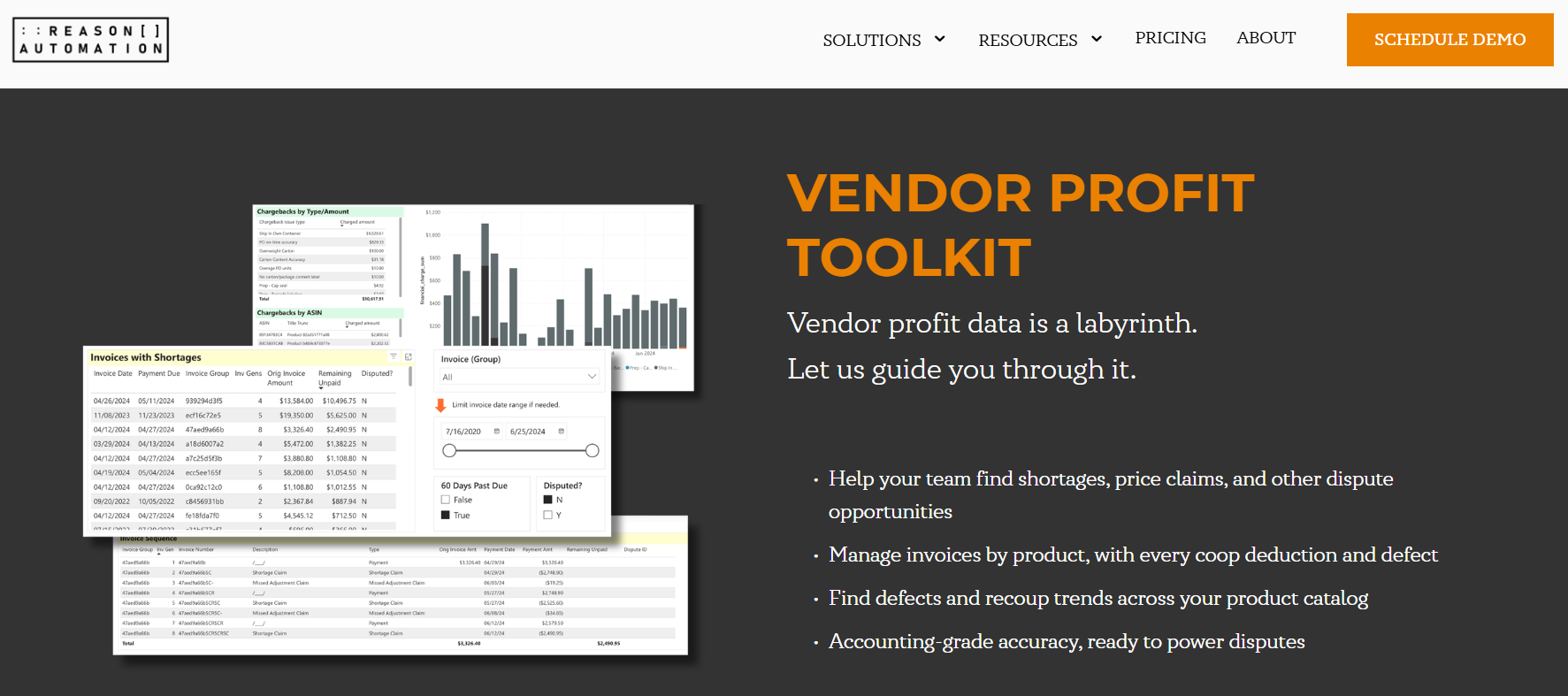
Reason Automation is a software/data + expert-support solution built around Amazon financial data, infrastructure, and analytics.
Its current Amazon Vendor recovery page publicly lists Shortage Claims, Audit & Recovery, Co-op Auditing, Chargebacks, finance/profitability tools, BASIS Analytics, data infrastructure, and expert support.
Best fit. This type of service can be especially useful for Vendor finance, analytics, and ecommerce teams that want better data to find lost money, match Amazon financial activity, and make recovery decisions.
Reason also publishes Vendor Central API connection guidance. This matters because it shows the platform is designed to bring in Vendor data directly, rather than relying only on manual spreadsheets.
Limitation to verify. Its public information confirms shortage-claim and recovery capabilities. However, buyers should still ask exactly who is responsible for preparing claims, submitting them, following up on re-disputes, and collecting supporting documents.
Also confirm pricing, historical audit coverage, implementation work, supported marketplaces, and whether expert support includes hands-on dispute management or is mainly analysis and advice.
3. KhooCommerce
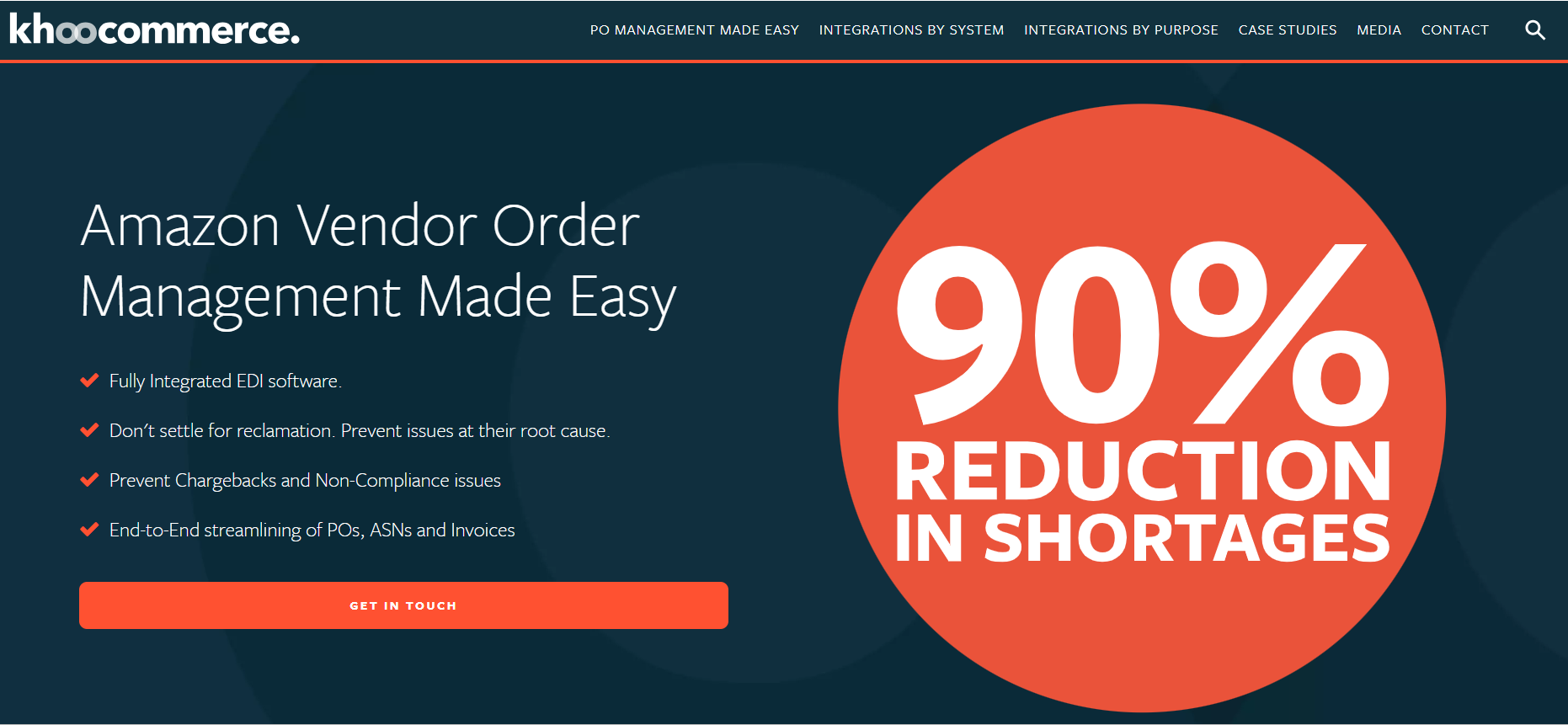
KhooCommerce is better viewed as a prevention and Amazon Vendor order-management platform instead of a traditional shortage-recovery agency.
Its current public website focuses on EDI, bulk PO processing, ASN creation, invoicing, ERP integration, LPR/SSCC-compliant labeling, and reducing shortage claims by fixing their root causes.
Best fit. KhooCommerce makes the most sense when shortage problems keep happening because of PO handling, shipment data, labels, ASNs, warehouse processes, or EDI accuracy.
In this situation, the goal is to reduce future shortages.
That is different from a company that needs someone to review a large backlog of old shortage deductions and submit detailed disputes to recover the money.
Proof and limitation. KhooCommerce publicly says customers can see up to 90% fewer shortage claims after using its system.
However, this is a provider marketing claim and should not be treated as the result every customer will receive.
Its website also shares customer testimonials about improved process efficiency.
Before using KhooCommerce as a recovery provider, confirm whether it actually audits historical shortage claims, submits disputes, handles re-disputes, collects carrier evidence, or mainly focuses on prevention and Vendor order processing.
4. Wake Commerce

Wake Commerce ProfitGuard is a managed, human-led Amazon Vendor profit-recovery service.
Its current public page says the team audits, disputes, and recovers shortage claims and other Vendor deductions.
The company also says ex-Amazon FinOps specialists handle the work and that it uses a pay-after-recovery pricing model.
Public proof. Wake’s December 2025 General Mills case study reports that it recovered £377,048.05 from £898,000 in shortage claims, which is about 42%, for a UK Vendor Central account.
The case study describes the team auditing claims, matching evidence, choosing which disputes to submit, and repeatedly escalating claims after initial rejections.
This provides useful proof that its process involves manual, case-by-case work rather than a fully automated system.
Pricing and limitations. The current UK ProfitGuard page publicly says Wake charges 15% of successfully recovered funds.
However, this comparison focuses on the United States.
Do not assume Wake's published UK pricing, audit window, or service terms apply unchanged to a U.S. Vendor Central account.
Confirm U.S. marketplace support, current Amazon eligibility periods, evidence responsibilities, exclusions, data access, and exactly how the success fee is calculated in the written SOW.
5. ChannelEngine
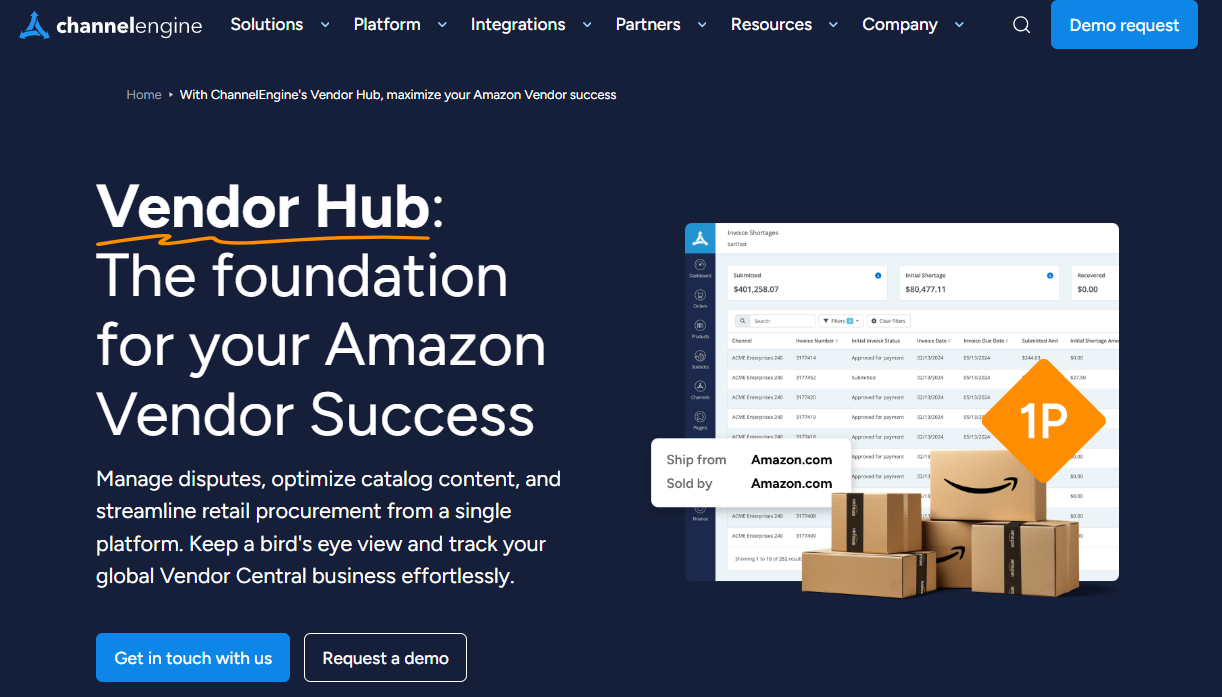
ChannelEngine Recovery Management is a software-led Amazon Vendor recovery tool.
It can identify invoice shortages and price differences, submit disputes, track recoveries, and provide reports through its Vendor module.
Its current documentation also describes automated schedules and automatic re-dispute/support-case handling.
Best fit. ChannelEngine is best suited for teams that want shortage recovery to run mainly through configurable software rather than relying on a fully managed human service.
Its current product page presents the service as automated recovery with no upfront fee and payment based on successful recoveries.
However, buyers should still confirm the exact standard fee in the contract.
Proof and limitation. ChannelEngine publishes a premium apparel case study reporting $100,000 recovered and a 90% claim success rate. Treat this as one provider-published account result, not a standard outcome for every Vendor Central brand.
ChannelEngine currently states that its Recovery Management solution can identify and recover eligible Amazon Vendor shortages and pricing claims going back up to five years. Because actual eligibility can depend on the claim, marketplace, Amazon's current rules, and the commercial agreement, confirm the usable historical window in your proposal and Vendor Central account before signing.
How to Select the Right Agency to Help You with Shortage Claims
Start by focusing on the real problem in your business instead of comparing long provider feature lists.
A brand with a large backlog of old shortage claims has very different needs from a company whose main problem is repeated ASN, labeling, or receiving mistakes.
Compare every provider using the same standards and ask for proof behind every important claim.
1P Vendor Central depth: Make sure the provider has real experience working with Vendor Central financial and operational data. Do not assume experience with Seller Central/FBA reimbursements is the same thing.
Recovery scope: Clearly define whether the provider finds deductions, audits past claims, gathers documents, files disputes, re-disputes denied claims, follows support cases, matches recovered payments, and closes the reporting process.
Evidence workflow: Ask who is responsible for PODs, BOLs, carton/pallet labels, carrier documents, ASNs, invoices, and internal warehouse records. Also ask what happens when some evidence is missing.
Integrations and data layer: Understand how the provider receives PO, invoice, shipment, payment, EDI/API, ERP, or BI information and how data problems are matched and corrected.
Automation versus human review: Find out exactly which tasks are automated and which ones are reviewed by a person. Difficult claims may need a written explanation, carefully selected evidence, or manual escalation.
Recovery versus prevention: Keep money recovery and shortage prevention separate. A provider may recover old deductions, prevent future claims, or offer both services.
Reporting and data ownership: Ask for claim-level statuses and clear definitions of eligible, disputed, denied, and recovered amounts. Also confirm export rights, audit records, and access to your data after the contract ends.
Security and access: Confirm Vendor Central permissions, API access, credential handling, data retention, subcontractor use, and the steps used to remove access when the relationship ends.
Economics: Compare the fee structure, implementation/data costs, minimum charges, exclusions, internal labor requirements, and whether the provider’s fee is based on gross recovered cash or something else.
Proof quality: Give more weight to dated and relevant account results than to general success-rate claims. Ask for the time period, starting amount, marketplace, claim type, and exact definition of “recovered.”
Exit and handoff: Make sure there is a written process for exporting your data, transferring open claims, removing access, and saving dispute history if you stop working with the provider.
If you are also deciding whether you need a shortage specialist or a full Vendor Central partner, compare the scope with SalesDuo’s Vendor Central management services framework.
If your shortages are mainly caused by PO, ASN, or invoice data problems, the Amazon EDI for Vendor Central guide explains the prevention side in more detail.
Partner-fit scorecard
| Criterion | Suggested weight | What to verify | Red flag |
|---|---|---|---|
| 1P / Vendor Central depth | 15% | Current SOW, references, claim types | Mostly FBA/Seller reimbursement language |
| End-to-end recovery scope | 15% | Audit -> evidence -> dispute -> follow-up -> reconciliation | Only identifies claims but leaves execution unclear |
| Evidence handling | 10% | Ownership of POD/BOL/labels/ASN/invoice evidence | No written evidence responsibility |
| Automation + human review | 10% | Which steps are automated; exception path | “AI-powered” with no workflow detail |
| Prevention/root cause | 10% | EDI, catalog, ASN, warehouse, or process remediation | Recovery only when recurring causes are material |
| Reporting + data ownership | 10% | Claim-level audit trail and export | No export or unclear data definitions |
| Security/access | 10% | Permissions, retention, revocation | Requests broader access than needed |
| Economics | 10% | Fee denominator, exclusions, setup/data costs | Unclear success-fee calculation |
| Proof quality | 10% | Dated case, denominator, period, marketplace | Generic success rate without scope |
Use net expected value, not gross recovery claims
A simple buyer-side formula is:
Net expected recovery value = (Eligible disputed value × Expected recovery rate) − Provider fees − Internal labor cost − Implementation/data costs.
Calculate prevention value separately. This helps avoid counting the same recovered or avoided money twice.
Here is an example only.
Suppose a company has $100,000 in shortage claims that are actually eligible for recovery.
For planning purposes, it assumes a 60% recovery rate, pays the provider a 15% fee on successfully recovered money, and expects $5,000 in internal and implementation costs.
The estimated net value would be $46,000:
$60,000 recovered − $9,000 provider fee − $5,000 internal/implementation cost = $46,000 net expected recovery value.
These are only example numbers. Replace every assumption with the real numbers from each provider’s proposal before making a decision.
Agency vs software vs managed recovery vs in-house
| Model | Best when | Main advantage | Main tradeoff | Verify before choosing |
|---|---|---|---|---|
| Agency / managed operations | Shortage recovery is tied to broader Vendor operations | One partner can connect claims, EDI, process, and account context | Can be broader and more expensive than a narrow tool | Exact SOW ownership, staffing, reporting, fees |
| Managed recovery specialist | You have material deductions and want done-for-you audit/disputes | Human evidence review and persistence on complex cases | May focus on recovery more than upstream prevention | Marketplace rules, success-fee basis, lookback, evidence ownership |
| Software-led recovery | High volume and standardized data make automation valuable | Scalable detection, submission, tracking, reporting | Automation may need exception handling for complex evidence | Automation rules, safeguards, human escalation, data access |
| In-house | You have capable finance/ops staff and want maximum control | Direct control of evidence, access, data, and priorities | Requires bandwidth, process knowledge, and consistent follow-up | Staffing cost, controls, documentation, continuity |
Questions to ask before signing
- Which Amazon marketplaces and Vendor codes are included in the SOW?
- Which deduction types are covered, and are shortage claims kept separate from price claims, chargebacks, co-op deductions, returns, and open statements?
- How far back will you audit, and what current Amazon rules limit older recovery claims in the U.S.?
- Who collects and checks PODs, BOLs, carton/pallet labels, ASNs, invoices, carrier records, and warehouse documents?
- Which parts of the process are automated, which parts are manually reviewed, and when does escalation happen?
- How do you define eligible value, disputed value, denied value, recovered value, and recovery rate?
- How is the fee calculated, what is excluded, and are there implementation, data, minimum, or termination costs?
- What Vendor Central/API permissions are needed, how long is data stored, and how can we remove access?
- Can we export claim-level history, reports, evidence, and claim-status information whenever needed?
- What happens to open disputes and supporting documents if we end the agreement?
After you compare the providers and clearly understand what each one will handle, SalesDuo’s shortage claims and chargebacks support is the next step for teams looking for managed execution.
Keep chargeback-provider research separate from shortage claims.
If chargebacks are your main problem, compare Amazon chargeback agencies instead.
Parting Thoughts
The right shortage-recovery partner should match how your Vendor Central operation works and clearly document which parts of recovery and prevention it owns.
For a U.S. Vendor Central team, that means looking at your existing shortage backlog, available evidence, data systems, internal staff, risk controls, and need to prevent future shortages.
Do not choose a provider only because it advertises a high recovery percentage.
If your shortlist points toward an integrated managed model, book a 1:1 Growth Call and bring examples of your current shortage deductions, dispute history, and the problems your finance and operations teams are dealing with.
The goal is to decide whether managed recovery, EDI/process improvements, software, or an in-house model is best for your business, instead of assuming the same solution works for every account.
Frequently Asked Questions About Amazon Shortage Claim Agency
What does an Amazon shortage claim agency do?
Depending on the provider, an Amazon shortage claim agency may find shortage deductions, review past transactions, collect supporting evidence, submit disputes, re-dispute rejected claims, track recovered money, report results, and help prevent the same problems from happening again.
The exact service can vary widely from one provider to another. Always ask for a written SOW that clearly explains which parts of the process the provider will handle.
Should I use an agency or shortage-claim recovery software?
Software can make sense when you have a large number of claims, your data is organized, and automated detection, submission, and tracking can handle most of the work.
Your internal team must still be able to manage unusual or complicated cases.
A managed provider may be better when collecting evidence, making decisions, escalating claims, or coordinating between different teams would take too much internal time.
Many brands use a mix of both approaches.
How should I compare Amazon shortage recovery providers?
Compare their 1P Vendor Central experience, historical audit coverage, evidence responsibilities, integrations, automation vs. human review, shortage-prevention capabilities, reporting and data rights, security, pricing, quality of proof, and offboarding process.
Use the same standards for every provider, including SalesDuo.
What evidence is needed to dispute Amazon Vendor Central shortage claims?
The exact evidence depends on the shipment, shortage claim, and Amazon’s current requirements.
Common documents may include carrier proof of delivery, signed bills of lading, carton or pallet labels, shipment or ASN records, invoices, and internal shipping records.
Always check the current U.S. Vendor Central requirements in the account before submitting a claim, rather than relying on an old public checklist.
Can a provider prevent shortage claims, not just recover them?
Yes, if the service includes shortage prevention.
Prevention work may include improving catalog and barcode accuracy, case-pack data, ASN/EDI quality, labels, warehouse processes, shipment matching, and other operational controls.
Measure recovery and prevention separately. This avoids confusing recovered money with future deductions that were prevented.
How far back can a shortage recovery provider audit claims?
No single safe answer applies to every provider or account.
Two things matter: the historical period the provider agrees to audit and Amazon’s current marketplace-specific eligibility rules.
Public information can sometimes conflict.
Ask the provider to clearly document the U.S. eligibility period it plans to use and confirm that information against your current Vendor Central account before signing a contract or submitting claims.
How are shortage claim recovery services priced?
Common pricing models include custom retainers, software subscriptions, setup or data fees, or a percentage of successfully recovered money.
The most important detail is understanding exactly what the fee is calculated on.
Make sure the agreement clearly defines what counts as recovered, which claim types are included, when the provider earns its fee, and what happens to credits or payments that were already being processed.
Are Amazon shortage claims the same as FBA reimbursements?
No.
This page covers 1P Amazon Vendor Central shortage deductions related to purchase orders, invoicing, and receiving.
Seller Central/FBA reimbursements are a separate 3P process.
For that topic, read SalesDuo’s guide to FBA reimbursement claims.
For a wider explanation of how shortage claims connect with purchase orders, EDI, direct fulfillment, chargebacks, and finance processes, read the Vendor Central operations guide.
About the Author
Meet Paulami Karmakar, an Amazon Content Expert, who specializes in strategizing and crafting powerful SEO content that enhances product visibility, enriching customer experience, and boosting sales on Amazon and Walmart across continents. With a passion for innovation and a commitment to excellence, Paulami consistently creates customized strategies that achieve measurable success. Outside of her work, she finds joy in painting, handcrafts, yoga, and music.