Amazon Marketing Services (AMS): What It Means Today and What Replaced It

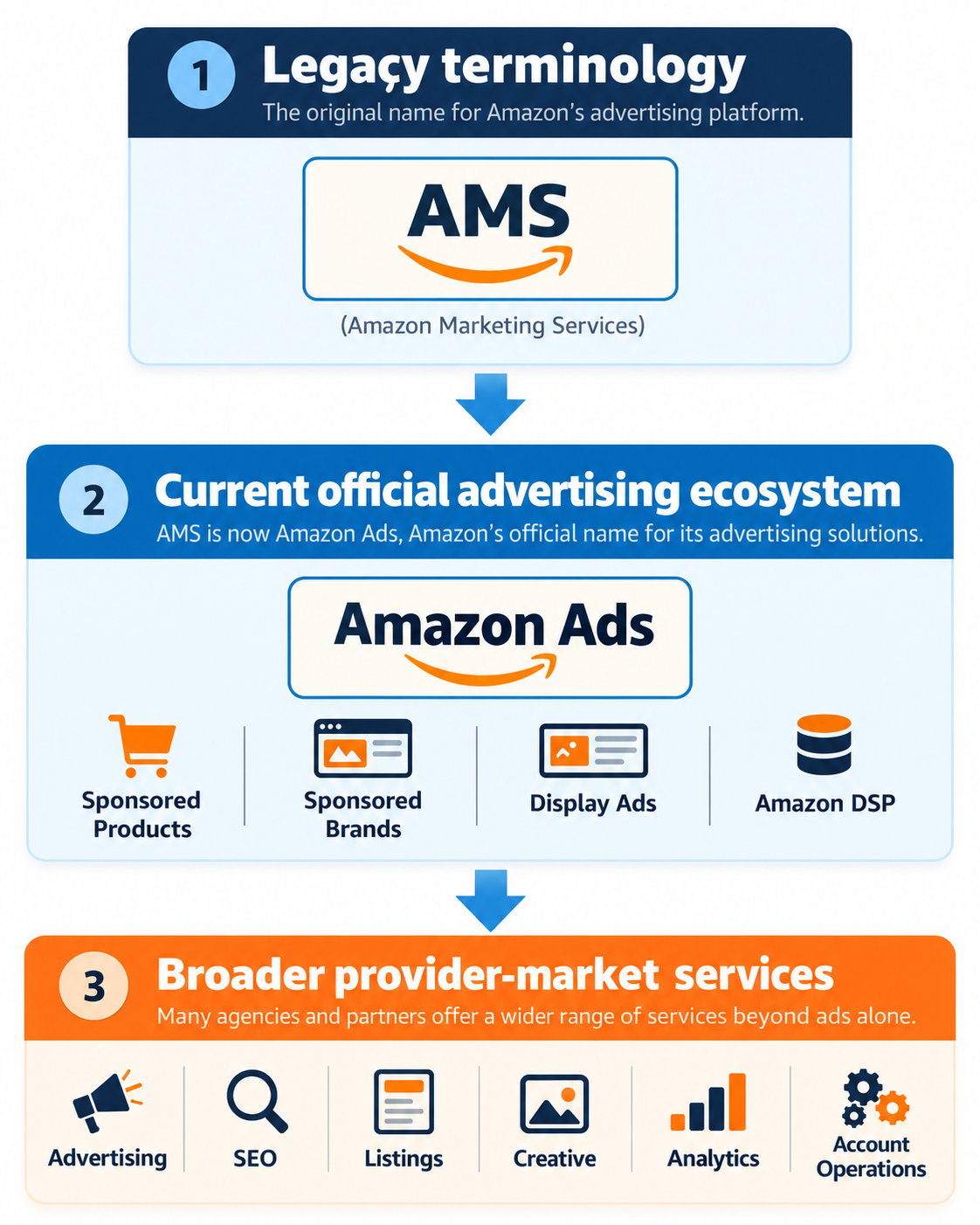
Amazon Marketing Services (AMS) is an older term for Amazon’s advertising tools. Today, Amazon calls its advertising platform Amazon Ads. It includes products such as Sponsored Products, Sponsored Brands, display ads, and Amazon DSP.
Agencies may still use the phrase “Amazon marketing services” more broadly. Their services can include paid advertising, Amazon SEO, listing improvements, creative work, analytics, and account support.
That difference matters. AMS, Amazon Ads, PPC management, and full-service Amazon marketing are not the same thing. You will be charged for services you do not require if you consider them to be the same service.
This article explains how the old AMS term maps to Amazon’s current advertising products. It also shows what falls inside and outside Amazon Ads so you can decide whether you need an advertising specialist, a listing or SEO specialist, or a broader Amazon marketing partner.
| Term | What it means here | How to use the term |
|---|---|---|
| Amazon Marketing Services (AMS) | Older terminology linked to Amazon’s advertising tools | Useful when reading older articles, reports, or agency materials |
| Amazon Ads | Amazon’s current advertising platform and brand | Use for current product names, campaigns, documentation, and measurement |
| Display ads | Amazon’s current display advertising offering, including what was previously called Sponsored Display | Use for current display campaign language; existing Sponsored Display campaigns can continue |
| Amazon marketing services | A broad agency term that may include ads, SEO, listings, creative, analytics, and operations | Use when comparing outside support, not as the official name of Amazon’s ad platform |
| Amazon marketing agency | A provider that manages one or more Amazon workstreams for brands | Use when you are ready to compare or hire an outside partner |
What Amazon Marketing Services Means in 2026
The easiest way to understand AMS is to separate its old meaning from how agencies use the phrase today.
AMS referred to Amazon’s advertising tools before Amazon brought its advertising brands together. Current Amazon documentation uses Amazon Ads and specific advertising product names instead of AMS as the platform name.
Legacy AMS vs Amazon Ads
If you see “AMS” in an older article, proposal, or dashboard, it usually refers to Amazon advertising.
For current work, use Amazon Ads product terminology. Amazon’s advertising products and names keep changing, so using the current terms helps avoid confusion.
The main point is simple: AMS is an older reference, while Amazon Ads is the current advertising platform.
An agency that still uses AMS may simply be using a familiar term. But you should still check which current Amazon Ads products it manages and whether its service goes beyond paid advertising.
Why agencies still use “Amazon marketing services”
Agencies often use “Amazon marketing services” to describe more than advertising.
One provider may use the phrase for Sponsored Ads management only. Another may include SEO, listing copy, creative work, Brand Stores, analytics, catalog support, and account operations.
That broader meaning is not the official name of an Amazon product suite. It is simply a label agencies use to describe their services.
This is why the actual scope matters more than the name on the proposal. Start by identifying the problem you need to solve, then confirm which team or provider will own it.
When comparing providers, do not assume two agencies offering “Amazon marketing services” are selling the same scope. Compare the actual deliverables, ownership, reporting, and exclusions instead.
What Belongs to Amazon Ads Today
Amazon Ads includes several advertising and ad-tech products. Each one solves a different problem.
A brand that needs help with Sponsored Products may not need the same budget, tools, or skills as a brand running programmatic media through Amazon DSP.
| Product/asset | Current role | Typical use | Important boundary |
|---|---|---|---|
| Sponsored Products | CPC ads for individual product listings on Amazon and select premium apps or websites | Product discovery and sales through keyword or product targeting | Paid advertising does not fix weak product detail pages |
| Sponsored Brands | Sponsored Brands help brands reach shoppers through formats such as video and multi-product creative across eligible Amazon placements. Depending on the campaign setup, they can direct shoppers to a Brand Store or product detail page | Brand discovery and traffic to Brand Stores or product pages | Paid-media availability and placements depend on the current Amazon Ads setup |
| Display ads | Amazon’s current display offering; Sponsored Display now sits within this broader experience | Reach audiences across Amazon properties and premium open-internet placements | New campaigns use the current display workflow; existing Sponsored Display campaigns can continue |
| Amazon DSP | Amazon's demand-side platform for programmatic media buying across Amazon properties and third-party supply. It can be used to run display and other programmatic formats | Display, video, audio, streaming TV, and other programmatic media | DSP works differently from basic Sponsored Ads and should not be treated as another PPC campaign |
| Brand Stores | Free branded destinations on Amazon | Product education, brand storytelling, cross-sell, and landing pages for ad traffic | A Brand Store is not a paid ad format |
Sponsored Products
Sponsored Products are cost-per-click ads for individual product listings.
Amazon says these ads can appear in the Amazon store and on select premium apps and websites. Advertisers control their bids and budgets. When a shopper clicks the ad, they go to the promoted product detail page.
If your main problems are campaign structure, targeting, bids, or wasted paid-search spend, Amazon PPC management may be a better fit than a broad marketing service.
Sponsored Brands
Sponsored Brands help shoppers discover brands through video, image, or collection-based ads.
Amazon’s current documentation shows placements such as top of search, shopping results, and product pages. These ads often send traffic to a Brand Store or product detail page.
Sponsored Brands are part of paid media. The Store or product page still needs to do its job after the shopper clicks. Improving that page is a separate task from running the ad.
Display Ads (Formerly Sponsored Display)
Amazon has moved Sponsored Display into its broader Display offering. Existing Sponsored Display campaigns can continue running in Campaign Manager, while new display campaigns use the current Display workflow.
Display ads can reach shoppers across Amazon properties and premium sites on the open internet. This is broader than the older idea of Sponsored Display as a separate ad product.
If your plan includes retargeting, audience targeting, or display ads across several placements, confirm which current display setup and buying method your team or agency plans to use.
Amazon DSP
Amazon DSP is Amazon’s demand-side platform for programmatic media buying.
Brands that sell on Amazon and advertisers that don't can both use it. DSP can reach audiences across Amazon properties and third-party inventory.
DSP usually requires more planning around audiences, creative, media buying, and measurement than basic Sponsored Ads.
If paid media is your main need, an Amazon Advertising agency may be a better fit than turning a basic AMS discussion into a full DSP project.
Brand Stores and the Ad Journey
Brand Stores are free branded destinations on Amazon.
Amazon says brands can create and maintain a Store without paying for advertising. Still, Stores can support advertising because Sponsored Brands and display campaigns may send shoppers there.
A Brand Store is part of the wider shopping experience, but it is not a paid ad format.
The ad gets the shopper to the Store. The Store then needs to help that shopper understand the brand, products, and options.
Amazon Ads vs Broader Amazon Marketing Services
Amazon Ads is a specified ad platform. Greater Amazon marketing services could also encompass advertising, organic search, listing conversion, creative execution, analytics, and account management.
The exact package varies by provider, so the service name alone does not tell you what you are buying.
| Workstream | What it can include | When it becomes the main problem |
|---|---|---|
| Paid advertising | Sponsored Products, Sponsored Brands, display ads, DSP, campaign measurement, bids, and budgets | Traffic costs are high, campaign structure is weak, targeting is poor, or paid growth has slowed |
| Organic visibility and conversion | Keyword research, titles, bullets, descriptions, Amazon SEO, listing creative, A+ Content, and conversion work | Products are hard to find organically, listing relevance is weak, or traffic reaches pages that do not convert well |
| Brand experience | Brand Store structure, merchandising, creative consistency, product education, and cross-sell paths | Shoppers reach the brand, but the buying experience feels disconnected or unclear |
| Analytics and reporting | Ad efficiency, total sales, organic share, contribution economics, search trends, and reporting | Teams struggle to connect ad decisions with wider Amazon performance |
| Account and operations | Catalog health, inventory, forecasting, pricing, promotions, marketplace issues, and expansion | Inventory, catalog, or operational problems are holding back growth |
For organic visibility, see Amazon SEO services.
For product-page content and conversion work, see Amazon listing optimization.
If your main problems are operational, Amazon account management may be the better fit.
Which Kind of Amazon Support Do You Actually Need?
Start with your main problem, not the provider’s label.
A specialist can work well when one area clearly owns the problem. Broader support can make more sense when several teams and workstreams affect the same result.
| Your main problem | Likely support layer | Why | Best next SalesDuo owner |
|---|---|---|---|
| High ACoS, weak campaigns, poor targeting, budget or bid problems | Advertising / PPC specialist | The main problem is paid-media execution | Amazon Advertising or Amazon PPC |
| Weak organic visibility or keyword relevance | Amazon SEO specialist | The main problem is organic discovery | Amazon SEO services |
| Traffic arrives, but product pages perform poorly | Listing/conversion specialist | The problem is copy, creative, A+ Content, relevance, or conversion readiness | Amazon listing optimization |
| Ads, SEO, content, analytics, catalog, and operations all need coordination | Full-service Amazon marketing partner | Several teams affect the same growth result | Full-service Amazon marketing agency |
| Catalog, inventory, Seller/Vendor Central, or marketplace execution takes most of the work | Account management/operations partner | The main problem is operational ownership | Amazon account management |
| You know the service category but need to compare providers | Agency evaluation/comparison | You are choosing a vendor rather than learning the terminology | Agency review or comparison |
A useful way to make this decision is to look at how many workstreams contribute to the problem. If advertising performance is the only major issue, a PPC or advertising specialist may be enough. If traffic is reaching Amazon but product pages are not converting, listing and creative work may need attention before increasing ad spend.
More general support is more effective when the issues are related. Such as, an ad team may drive traffic while inventory, poor sales, catalog issues, or weak product pages hinder conversion. In that case, focusing on campaigns alone may not resolve the bottleneck.
The same can be said for ownership. If your team can handle catalog, inventory, listings, and reporting, you may only need advertising support from a specialist. For a multi-team environment with no clear owner of these responsibilities, a more full-service Amazon marketing or account-management partner might make more sense.
Start with the bottleneck, identify which workstreams affect it, and then choose the narrowest level of support that can realistically solve the problem.
For more help comparing providers, see how to choose an Amazon agency.
If you are ready to build a shortlist, compare Amazon marketing agencies.
How to Measure Amazon Marketing Performance Without Mixing Different Metrics
Use the right metric for the question you are trying to answer.
Ad efficiency and whole-account performance are connected, but they are not the same thing.
A campaign can have a strong ROAS while the business still struggles with low margins, poor inventory, weak organic sales, or low conversion elsewhere.
Amazon Ads explains ACoS and ROAS as two ways to measure ad efficiency.
ACoS is ad spend divided by ad-attributed revenue.
ROAS is ad-attributed revenue divided by ad spend.
Amazon also says no single ACoS number is “good” for every advertiser because the right result depends on context.
| Metric | What it answers | Use it for | Do not assume |
|---|---|---|---|
| ACoS | What share of ad-attributed revenue went to ad spend? | Campaign efficiency and break-even analysis | Lower ACoS is always better |
| ROAS | How much ad-attributed revenue came from each ad dollar? | Revenue efficiency | High ROAS always means high profit |
| CTR / conversion rate | Are shoppers clicking and buying after the click? | Checking targeting, creative, and post-click performance | Weak conversion is always an ad problem |
| TACoS | What share of total Amazon sales went to advertising? | Looking at paid-media intensity across the account | TACoS alone proves organic growth or profit |
| Contribution margin / total sales / organic share | Is the Amazon business becoming healthier? | Whole-account decisions | Ad metrics can replace profitability or operational analysis |
Illustrative Metric Example
Assume a brand spends $10,000 on ads, generates $50,000 in ad-attributed revenue, and records $100,000 in total Amazon sales during the same period.
ACoS would be 20%:
$10,000 ÷ $50,000 = 20%
ROAS would be 5.0x:
$50,000 ÷ $10,000 = 5.0x
TACoS would be 10%:
$10,000 ÷ $100,000 = 10%
These numbers only show how the metrics differ. They are not suggested targets or SalesDuo client results.
Real decisions also depend on margin, product stage, competition, inventory, campaign goals, and the costs included in your contribution-profit calculation.
Use ad metrics to answer advertising questions. Use broader business metrics to judge whether the Amazon business is becoming more profitable and stable.
When a Full-Service Amazon Marketing Agency Makes Sense
End-to-end support sometimes adds up when the issue spans multiple teams.
That’s often when paid, organic, listing conversion, inventory, catalog health, reporting, etc. impact the same growth aspiration. There, different specialists can each achieve marginal gains in their own field without anyone owning the overall account result. A generalist partner can manage and orchestrate those two workstreams, but a specialist partner is best when the issue is clearly confined to one area.
For example, ads may be working well, but weak listings, low inventory, catalog issues, or scattered reporting may still limit growth. Fixing only the ad campaigns may not solve the larger business problem.
A specialist may be enough when one area clearly needs help.
If campaign structure and bids are the main problems, an advertising or PPC specialist may be the better choice.
If organic search or product-page conversion is the main issue, SEO or listing support may be more practical than paying for broad account management.
If your needs cover advertising, SEO, listings, analytics, and wider execution, consider a full-service Amazon marketing agency.
The goal is not to buy the biggest service package. It is to own the problems limiting growth clearly.
Book Your 1:1 Growth Call with SalesDuo. Use the call to identify your main bottlenecks and decide whether you need specialist support or a broader service before increasing spend or hiring another provider.
Frequently Asked Questions about Amazon Marketing Services
What is Amazon Marketing Services (AMS)?
AMS is an older term linked to Amazon’s advertising tools.
Today, Amazon Ads is the current advertising platform. Agencies may still use “Amazon marketing services” more broadly to describe advertising, SEO, listings, creative, analytics, or account operations.
Is Amazon Marketing Services the same as Amazon Ads?
Not exactly.
AMS is an older name linked to Amazon advertising. Amazon Ads is the current official advertising brand and product platform.
Agencies may also use “Amazon marketing services” as a wider service label.
Does Amazon still use the term AMS?
Current Amazon advertising documentation uses Amazon Ads and current product names instead of AMS as the official platform label.
You may still see AMS in older articles, reports, search queries, dashboards, and agency content.
What happened to Sponsored Display?
Amazon Ads says Sponsored Display is now known as display ads and is part of a wider display offering.
Existing Sponsored Display campaigns can continue running. New display campaigns use the current Display workflow.
What is included in Amazon marketing services from an agency?
It depends on the provider.
Services may include Sponsored Ads, DSP, SEO, listing improvements, creative, Brand Stores, analytics, catalog work, or account operations.
Ask for the exact deliverables and owner for each area, rather than assuming “Amazon marketing services” means full service.
Is Amazon PPC the same as Amazon marketing services?
No.
Amazon PPC is one part of the wider Amazon marketing mix.
If your main need is Sponsored Products or Sponsored Brands management, a PPC specialist may be enough.
Broader Amazon marketing support may also cover SEO, listings, creative, analytics, and operations.
Do I need an Amazon marketing agency or only an advertising/PPC specialist?
Choose based on how broad the problem is.
Use an advertising or PPC specialist when paid media is the main issue.
Consider a broader agency when advertising, SEO, listings, analytics, catalog work, inventory, and operations need to work together.
Which metrics should I use to evaluate Amazon advertising performance?
Use ACoS, ROAS, CTR, conversion rate, spend, and ad-attributed sales for advertising questions.
For whole-account performance, also look at total sales, organic share, contribution margin, inventory, and possibly TACoS.
Avoid using one universal “good” target without looking at the business context.
About the Author
Navleen Kour is a seasoned professional dedicated to helping brands succeed on Amazon. Known for her strategic thinking and problem-solving skills, she excels at creating scalable solutions that drive growth. Outside of work, she enjoys exploring new ideas and diving into insightful reads.