Amazon Email Marketing for Sellers: Compliant Strategies That Work in 2026
Amazon email marketing in 2026 mainly means emailing people who chose to join your brand’s list outside Amazon. You can use that audience to support product discovery, repeat purchases, launches, and other Amazon sales goals.
Amazon marketplace buyers are different. Buyer-Seller Messaging is not a promotional email list, and Amazon’s Manage Your Customer Engagement (MYCE) tool is no longer available.
The basic approach is simple: keep Amazon-controlled communication separate from your owned email list, send campaigns only to subscribers who gave permission, and track Amazon traffic with Amazon Attribution when your account is eligible.
Quick answer: What can an Amazon seller do with email?
| Question | Quick answer |
|---|---|
| Can I use Buyer-Seller Messaging for promotions? | No. Use it only for permitted order-related or customer-service communication under Amazon rules. |
| Can I email a list my brand built outside Amazon? | Yes, if you collected the list lawfully, received the right permission, and follow applicable email laws. |
| Is MYCE still active? | No. Amazon says MYCE stopped sending campaigns on February 16, 2024. |
| Can I measure email traffic sent to Amazon? | Yes, where eligible, using Amazon Attribution along with your email-platform and profitability metrics. |
| Should review requests run through promotional email flows? | No. Keep Amazon review requests separate from promotional email automation. |
Can Amazon sellers email Amazon customers?
Amazon sellers can contact marketplace buyers for approved order and customer-service reasons. However, Buyer-Seller Messaging should not be used as a marketing channel.
Amazon’s current rules say the tool is meant for completing orders or answering customer-service questions, not for marketing or promotions. Check Amazon’s communication guidance before creating or changing any buyer-message workflow.
This means an Amazon order does not automatically make the buyer part of your brand’s email list. The masked or encrypted addresses inside Amazon’s messaging system are not a reusable marketing database. Sellers should not export, scrape, buy, or reuse Amazon buyer contact data for promotions.
A brand-owned email list is a different beast. People sign up for your email list through your website, an event, a social campaign, a content program, or another brand-owned source outside of Amazon. You can market to these subscribers according to the consent and email rules relevant to them.
The better question is not, “How can I email Amazon buyers?” It is, “How can I build an owned audience that supports my Amazon business?”
What changed after Manage Your Customer Engagement ended?
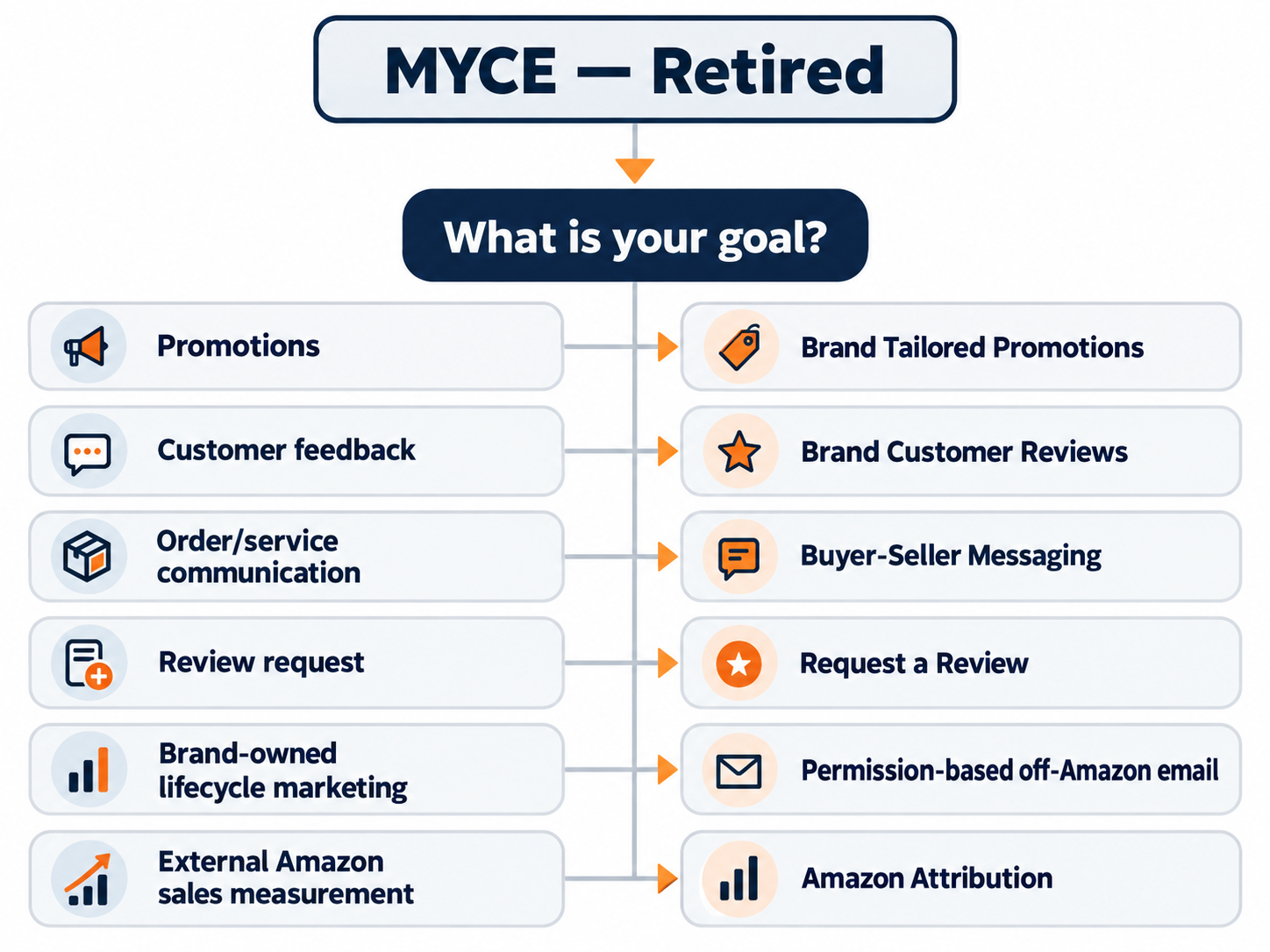
Amazon no longer offers Manage Your Customer Engagement. Amazon says MYCE stopped sending campaigns on February 16, 2024. Historical campaign metrics were available only through April 30, 2024.
This matters because some older Amazon email guides still describe MYCE as an active tool. For more details, see SalesDuo’s MYCE retirement and alternatives guide.
There is no direct replacement for MYCE. Amazon pointed sellers toward tools such as Brand Tailored Promotions and Brand Customer Reviews for certain engagement goals, but these tools do not recreate the old MYCE email system.
Brands now need to choose the right channel for each goal. That may be an Amazon-native promotion, an approved customer-service message, a review-request workflow, paid media, or an off-Amazon email campaign sent to people who opted in.
A useful rule is to ask two questions before building a campaign: Who owns the audience, and what is this channel allowed to do?
The four channels Amazon sellers should keep separate
Use this table before setting up any Amazon email automation.
| Channel | Audience | Primary purpose | Who controls the audience/data? | Measurement |
|---|---|---|---|---|
| Buyer-Seller Messaging | Amazon marketplace buyer | Order completion or customer service | Amazon | Order or service resolution |
| Request a Review | Eligible Amazon order | Amazon-standardized review or feedback request | Amazon | Review and feedback trends |
| Amazon-native retention/promotions | Eligible Amazon-defined audience | Platform-controlled promotions, retention, or feedback | Amazon | Tool-specific Amazon reporting |
| Owned email list | Subscriber who opted in outside Amazon | Welcome, education, launches, replenishment, win-back, and cross-channel campaigns | Brand | Email-platform metrics, Amazon Attribution where eligible, and contribution economics |
For broader repeat-purchase planning, see the Amazon customer retention strategy. For audience-based discounts inside Amazon, use the Amazon Brand Tailored Promotions guide.
How to build an email list for an Amazon brand
The safest Amazon seller email list is one your brand builds outside Amazon. The goal is not to recover buyer email addresses from the marketplace. Instead, give people a clear reason to subscribe directly to your brand.
- Use website sign-up forms that clearly explain what subscribers will receive.
- Offer useful content, education, launch updates, or other lawful incentives that fit the brand relationship.
- Use social media, creators, paid media, events, or communities to send interested people to an opt-in page.
- Use existing DTC customer relationships only when your consent and marketing permissions allow it.
- Track list source, consent status, location, suppression status, and other details needed to respect subscriber choices.
In the US, commercial emails must follow the CAN-SPAM Act. The FTC says you need to use accurate headers, honest subject lines, clearly mark messages as ads, include a real postal address, offer an easy way to unsubscribe, handle opt-out requests quickly, and make sure any vendors you use also follow these rules.
Review the FTC CAN-SPAM compliance guide. If you email people outside the US, check the rules that apply in those markets.
Two different rule sets apply: Amazon's communication policies control how sellers communicate with marketplace buyers through Amazon. Email laws such as CAN-SPAM apply to commercial email sent to your brand's own audience. Following one does not replace the need to follow the other.
Don’t purchase or scrape email lists. In addition to the issues of consent and deliverability, such lists erode the primary value of owned email: a direct line to people who opted to receive communications from your brand.
For a wider acquisition strategy, explore our guide for drive external traffic to Amazon.
Email flows that make sense for Amazon sellers
Lifecycle email can work well when recipients are on your brand’s own list, and each campaign has a clear goal.
The Amazon-specific part is deciding what data you can use, where the email should send shoppers, and how you will measure results.
| Flow | Audience or trigger | Goal | Typical destination | Useful KPI |
|---|---|---|---|---|
| Welcome / education | New subscriber | Explain products, use cases, and brand value | Brand site, Amazon Store, or product page | Clicks, engagement, unsubscribes, tracked Amazon actions |
| Launch/product update | Engaged subscribers with relevant interests | Introduce a new product or update | Amazon Store or product detail page | Click-through rate, detail-page views, purchases, sales |
| Replenishment/repeat purchase | Subscribers whose first-party relationship supports the timing | Remind customers when another purchase may be due | Relevant Amazon product page or brand destination | Clicks, attributed purchases, contribution |
| Win-back / reactivation | Subscribers with falling engagement | Reconnect with useful content, offers, or product news | Destination that matches the campaign goal | Reactivation clicks, unsubscribes, complaints, attributed sales |
| Cross-channel campaign | Subscribers also reached through other media | Coordinate message, offer, creative, and destination | Amazon Store or product page with tracking | Channel clicks, Attribution results, contribution |
Only segment using data you lawfully have. This may include product interest, email activity, content engagement, or purchase history from your own DTC store.
Do not build segments that assume access to Amazon cart activity or identifiable Amazon repeat-buyer data unless a current Amazon-native tool provides that audience inside Amazon’s own system.
Keep A/B tests simple. Test one meaningful change at a time, such as the subject line, creative, call to action, destination, or send time. Choose the winning version based on the campaign goal, not just open rate.
How to drive email traffic to Amazon and measure it
Email is more useful when you can connect a campaign to Amazon results.
Start with the destination. A product detail page may work well when the email focuses on one product and the shopper already has strong buying intent. An Amazon Store can work better for discovery, launches, bundles, or campaigns where people may want to browse.
Where eligible, Amazon Attribution can help measure how outside channels, including email, contribute to Amazon shopping activity.
Amazon says eligible advertisers can create tracking tags for different tactics and measure results such as clicks, detail-page views, add-to-carts, purchases, units sold, and product sales.
Use separate tags for different campaigns or useful audience segments. If every email uses the same tag, it becomes much harder to understand what worked.
Attribution is not the same as proving incremental sales. An attributed purchase means Amazon connected the sale to a tracked interaction under its reporting method. It does not prove the customer would not have purchased without the email.
Email-to-Amazon measurement map
| Stage | Data to review | What it tells you |
|---|---|---|
| 1. Email platform | Delivered emails, clicks, unsubscribes, complaints | Did people receive the message and respond? |
| 2. Tracking | Campaign-specific Amazon Attribution tag where eligible | Which campaign or segment sent the tracked Amazon visit? |
| 3. Amazon shopping actions | Detail-page views, add-to-carts, purchases, units, and product sales where available | Did the traffic move through the shopping process? |
| 4. Economics | COGS, Amazon fees, fulfillment, discounts, creative, email, and agency costs | Did the campaign produce positive contribution after costs? |
Use a consistent naming system for your tracking tags so reports remain easy to compare over time.
Review requests and post-purchase communication
Do not treat review requests as another promotional email campaign.
Amazon has its own Request a Review workflow and separate rules for buyer communication and reviews. Keep these activities separate from your brand’s owned-list email marketing.
Do not offer rewards for reviews, ask only happy customers to leave reviews, request that negative reviews be changed or removed, or hide a review request inside promotional messaging.
If your team uses a tool that starts Amazon-approved review requests, confirm the latest timing, interface, and messaging rules in Seller Central before using it.
A subscriber on your owned list may also buy from you on Amazon. That does not change Amazon’s review rules. Keep promotional email focused on the subscriber relationship and use Amazon-approved methods for marketplace review requests.
How to evaluate Amazon email marketing performance and economics
Don’t rely on open rates to measure how well your email program is working. Use a broader scorecard that links email engagement to customer purchases on Amazon and the revenue it helps generate.
- Delivery and clicks: Did the message reach subscribers and bring qualified traffic?
- Unsubscribes and complaints: Is your sending frequency still appropriate, and are subscribers responding positively to the program?
- Amazon Attribution reports: Where available, view detail-page views, add-to-carts, purchases, units, and product sales.
- Conversion quality: You should only compare tracked purchases to tracked clicks if the reporting windows and definitions are aligned.
- Contribution: Deducts the variable costs needed to produce and deliver the attributed sales.
A simple planning formula is:
Email-driven contribution = attributed net sales - COGS - Amazon fees - fulfillment or shipping costs - discounts - email, creative, and agency costs
Contribution per delivered recipient = email-driven contribution / delivered recipients
These are planning formulas, not standards of performance.
For instance: if a campaign drives $8,000 in attributable net sales and total variable costs equal $6,200, the sample contribution is $1,800. If 20,000 e-mails were sent out, contribution per delivered recipient is $0.09.
The point is not the example number. Your own costs and margins should decide whether a campaign is worth scaling.
Common Amazon email marketing mistakes
- Treating MYCE as an active 2026 email channel.
- Using Buyer-Seller Messaging for promotions.
- Treating masked Amazon buyer addresses as an owned email list.
- Buying or scraping contact information without a clear legal and consent basis.
- Mixing review requests with promotional email campaigns.
- Using the same Amazon Attribution tag for every email.
- Sending traffic to listings with poor inventory, pricing, content, or conversion readiness.
- Measuring success only through open rates instead of clicks, Amazon results, unsubscribes, complaints, and contribution.
For a wider strategy that connects email with SEO, advertising, creative, and outside traffic, see the Amazon digital marketing strategy guide or the cross-channel Amazon marketing guide.
30-day implementation checklist
Week 1: Audit your channels, rules, and destinations
- Include your buyer messages, review requests, promotions, and any owned-email automations.
- Specify audience ownership and the purview of each channel.
- Delete any workflow that treats Amazon buyer contact information as a promotional list.
- Review your inventory, pricing, content, and conversion readiness on your Amazon Store and product main page.
Week 2: Clean your list and tracking setup
- Record where each contact came from and suppress people who should not receive marketing.
- Confirm sender details, address, opt-out options, and other legal requirements.
- Create a clear naming system and Amazon Attribution tags where eligible.
- Choose the small group of KPIs that will decide whether the campaign worked.
Week 3: Launch one useful flow
Start with a single campaign with a defined audience and objective. It might be a welcome series, a product launch for interested subscribers, or a replenishment notification for a repeat-purchase product.
Don’t turn on every automation you can think of at once. Start with something simple enough to measure clearly.
Week 4: Review results and costs
Compare email metrics, Amazon Attribution data where available, listing performance, unsubscribes, and contribution.
Continue or expand flows that remain useful after costs and send shoppers to strong Amazon destinations. Record what changed so you have a clear starting point for the next test.
When to get help with Amazon email marketing
Email becomes more complex when it ties in with Amazon listings, paid ads, tracking, customer retention, and marketplace operations. When this happens, brands often need a bigger Amazon strategy instead of running separate campaigns on their own.
If your team needs help connecting owned email with listings, advertising, measurement, and retention, explore SalesDuo’s Amazon marketing agency services.
Build the channel around audience ownership, not a workaround
A robust Amazon email marketing doesn't try to convert marketplace buyers into a crumbles mailing list. It creates a true owned audience, segregates Amazon-controlled communications, and leverages transparent metrics to identify the campaigns that generate valuable Amazon demand.
For help connecting email, listings, advertising, analytics, and retention, explore SalesDuo’s Amazon marketing agency services and Book Your 1:1 Growth Call with SalesDuo.
Frequently Asked Questions about Amazon Email Marketing
Can Amazon sellers send marketing emails to Amazon buyers?
Not through Buyer-Seller Messaging. Amazon limits buyer communication to approved order and customer-service purposes. Marketing emails should go to a separate audience that your brand lawfully collected outside Amazon.
Is Amazon Manage Your Customer Engagement still available?
No. Amazon says MYCE stopped sending campaigns on February 16, 2024. Sellers now need to choose current tools based on what they want to achieve.
How can Amazon sellers build an email list?
Build your list outside Amazon through website sign-ups, content, communities, social media, creators, events, or DTC programs. Keep records of consent and list sources, and do not collect Amazon marketplace buyer contact information for marketing.
Can I use Klaviyo, Mailchimp, or another ESP to drive sales on Amazon?
Yes, if you are emailing your own consented subscriber list. The email platform itself does not give you permission to market to Amazon buyers. Choose the right Amazon destination and use Amazon Attribution where eligible.
How do I track sales from email campaigns on Amazon?
Use Amazon Attribution where your account is eligible and create separate tags for useful campaigns or tactics. Combine that data with email metrics and contribution calculations. Attribution shows credited conversions, but it does not prove the sale was incremental.
Can I automate Amazon review requests by email?
Keep review requests separate from promotional email. Use Amazon-approved review tools and follow current Seller Central rules. Do not reward reviews, filter requests based on customer sentiment, or ask buyers to change negative reviews.
What is the difference between Amazon email marketing and Amazon SES?
Amazon SES is an AWS email-delivery service. It does not give sellers access to Amazon marketplace buyer email addresses.
Amazon email marketing for sellers is about building a lawful audience, creating useful campaigns, choosing the right Amazon destination, and measuring results.
What is the best email strategy for an Amazon seller in 2026?
Build a permission-based audience outside Amazon. Use email flows that match real subscriber needs, keep Amazon-native tools focused on their intended jobs, and track Amazon traffic with Attribution where eligible, along with contribution metrics.
About the Author
Shiny Silvaraju is an energetic young professional who’s passionate about solving real-world business problems. As an Amazon ads expert, she’s making her mark by turning challenges into exciting opportunities. Beyond her hustle, Shiny loves brainstorming creative ideas and getting lost in inspiring books.