
Amazon Vendor Chargeback Recovery Services: 2026 Comparison

For Amazon 1P brands, recouping chargebacks is just the tip of the iceberg. The bigger question is whether you want someone to challenge historically deducted amounts, software to continually spot them, or an operations partner who can also remediate the processes leading to the losses.
After this comparison, you'll be able to determine which provider model fits your problem, what evidence to require, which providers are worth a shortlist, and what questions to ask before giving access to Vendor Central or financial data.
That distinction matters because Amazon uses the word “chargeback” in different contexts. Amazon’s public Seller guidance defines a chargeback as a customer payment dispute handled through the cardholder’s bank. Vendor Central teams, however, also use the term for operational deductions connected to purchase orders, shipment data, labeling, receiving, ASN accuracy, and other compliance issues.
This comparison is about the second category: Amazon Vendor Central operational chargebacks and deductions. For a deeper explanation of chargeback types and disputes, see Amazon Vendor Central chargebacks.
SalesDuo publishes this comparison and also provides Vendor Central chargeback, shortage-claim, and EDI services. Every provider below is therefore assessed using the same public-evidence criteria rather than an internal ranking score.
Quick answer: Which type of chargeback provider do you need?
No single provider model fits every Vendor Central operation.
| Your main problem | Likely fit | What to verify first |
|---|---|---|
| Historical deductions are going undisputed | Recovery/audit specialist | Eligible scope, lookback, contingency fee, exclusions |
| Chargebacks keep returning despite recovery | Full-service Vendor Central agency | EDI/ASN/PO ownership, prevention scope, reporting |
| Your team can manage disputes but lacks visibility | Software or managed platform | Integrations, automation controls, support, data export |
| Shortages, chargebacks, and process errors overlap | Audit-first or full-service provider | Diagnostic depth, recovery scope, remediation responsibility |
| Deduction volume is low, and documentation is organized | In-house | Team capacity, deadlines, evidence quality |
A recovery professional can be effective if the underlying operating process is sound. A full-service provider is more useful when recurring chargebacks are tied to PO processing, invoices, EDI, receiving, or shipment documentation. Software is ideal when you need visibility and automation but don't want to outsource the whole process.
How we evaluated Amazon Vendor chargeback recovery services
We reviewed and re-verified public provider information on September 4, 2026.
For a provider to be included in this comparison, they had to have publicly available evidence of working with Amazon 1P/Vendor Central shortage claims, chargebacks, reimbursements, or similar operational auditing. Providers that only worked with generic ecommerce credit-card chargebacks were not considered equivalent.
Each provider was reviewed across the same areas:
- Amazon Vendor Central specialization
- deductions or claims covered
- dispute and recovery support
- prevention or root-cause work
- service delivery model
- public pricing visibility
- published proof
- reporting and operational controls
- data or account access requirements
- likely fit and limitations
Amazon Vendor chargeback recovery services compared
| Provider | Model | Vendor Central specialization | Recovery scope | Prevention/root-cause support | Pricing visibility | Public proof | Data/access requirements | Best fit / constraint |
|---|---|---|---|---|---|---|---|---|
| SalesDuo | Full-service Vendor Central operations | Amazon 1P/Vendor Central | Chargebacks, shortages, EDI and PO operations | Yes, EDI/ASN/PO workflow remediation | Custom/not publicly listed | Historical proof: WOW Water Sports: $475K recovered between 2020 and 2022; 66% case-specific rate is not used as an industry benchmark | Not publicly disclosed | Recovery plus prevention; verify whether recovery-only scope is available |
| RefundPros | Recovery specialist | Amazon 1P Vendor auditing | Shortages, chargebacks, co-op deductions | Recovery-focused; broader operations ownership is limited | 15% commission on recovered reimbursements; no setup fee; rate negotiable by annual sales | Current first-party Vendor audit/service pages | Secure Vendor Central access; provider handles auditing, documentation, filing, and tracking | Historical recovery; limited broader EDI/supply-chain ownership |
| TrueOps | Recovery specialist | Amazon 1P Vendor auditing | Chargeback fees, shortages, accruals | Not publicly detailed | 10% commission on successful 1P claims under current special launch pricing | Current first-party services page | Not publicly disclosed | Hands-off recovery; root-cause/EDI scope is unclear |
| beBOLD Digital | Managed recovery / full-service agency | Amazon Vendor recovery plus broader agency services | Overbillings, deductions, chargeback recovery, financial operations, dispute management | Public materials mention course correction; exact EDI/supply-chain ownership should be verified | Percentage of recovered funds; exact rate not public | Public case study reports $325K in Vendor chargebacks recovered | Not publicly disclosed | Recovery plus broader agency support; verify manual review and operational-remediation scope |
| Cogent2 | Audit/operations consultancy | Amazon Vendor Central audit and operational risk | Chargeback analysis, shortages, PO/invoice discrepancies | Strong ASN, PO, invoice, EDI/API, data-governance, ERP/WMS process remediation | Not publicly disclosed | Current first-party audit methodology | Not publicly disclosed | Root-cause diagnosis/remediation; success-fee recovery fit should be confirmed |
| Xneeti | Software/payout intelligence | Vendor Central payout reconciliation | Financial-event reconciliation and deduction-error detection; not a recovery service | Continuous visibility and detection; dispute execution remains in-house | Verify current terms | Current first-party Vendor reimbursement analysis | Integration/access details should be verified | In-house teams needing continuous visibility; recovery execution remains the team’s responsibility. |
Note on provider data: Not all vendors publicly reveal full details of their service engagement, such as requirements for account access, reporting cadence, security implications, contract terms, or offboarding procedures. Information not available from a current first-party source should be considered “Not publicly disclosed” rather than inferred. Buyers are advised to confirm these details themselves before granting access to Vendor Central, financial, ERP, or shipment data.
SalesDuo
SalesDuo is not a current chargeback recovery provider. Since September 2025, its focus has shifted to broader Vendor Central operations, including EDI, shortage claims, purchase-order processing, ASN creation, invoicing, and operational tracking. Due to Amazon reducing the chargeback approval rate, we also stopped pursuing chargeback recovery services.
This can matter when deductions keep recurring because the underlying problem sits upstream in PO, warehouse, invoice, ASN, or EDI workflows rather than in the dispute process itself.
SalesDuo also has first-party recovery evidence. Its WOW Water Sports case study states that the team handled shortage and chargeback disputes as part of its finance and operations program and recovered $475,000 between 2020 and 2022.
The same older case study reports a 66% recovery rate. Still, this comparison doesn't use that figure as an industry benchmark because the public page doesn't provide a sufficiently detailed denominator to compare it with other providers.
Best fit: established Vendor Central brands where recovery, shortage management, EDI, PO execution, and operational prevention overlap.
Constraint to verify: whether your engagement can be limited to the recovery work you need or is better suited to broader operational management.
RefundPros
RefundPros has one of the clearest recovery-specialist propositions.
This Vendor audit page states that it audits Vendor Central for shipment shortages, chargebacks, and co-op charges. The process involves automated analysis of POs, invoices, shipment confirmations, remittance reports, deduction codes, and specialist review and dispute submission.
Pricing is unusually transparent. RefundPros currently states:
- no setup fee;
- performance-based pricing;
- a typical 15% commission on recovered reimbursements;
- rates may be negotiable based on annual sales.
It also says vendors grant Vendor Central access while RefundPros handles auditing, documentation, filing, and tracking.
RefundPros says it can typically review 6–12 months depending on the deduction and Amazon policy, while some claim types have been recovered further back. Treat that as RefundPros’ stated service capability, not a universal Amazon dispute-window rule.
Best fit: Brands mainly focused on historical recovery and that prefer a contingency-based expert.
Constraint: public positioning emphasizes recovery more than broad EDI, supply-chain, or Vendor Central operational ownership.
TrueOps
TrueOps offers another focused recovery model.
Its current services page says the 1P Vendor product audits chargeback fees, shortages, and accruals. 10% commission on successful 1P claims under current special-launch pricing; TrueOps says a platform minimum may apply in low-recovery months. Confirm current 1P terms before signing.
TrueOps’ help documentation further says it charges only for successful recoveries resulting directly from its work, with reimbursements paid to the brand through Amazon. The dashboard can report information such as reimbursement amount, case ID, reimbursement ID, type, and processing date.
That gives prospective buyers useful clarity around recovery attribution.
Best fit: teams in need of a relatively hands-off 1P auditing and reimbursement service.
Constraint: its public service page provides less detail on root-cause remediation, EDI correction, and broader Vendor operations than full-service alternatives.
beBOLD Digital
beBOLD combines recovery technology with broader Amazon agency services.
Its Vendor recovery page describes automated analysis of Amazon accounting data to identify overbillings and deductions, followed by recoupment. It offers a free account analysis and says clients pay a percentage of recovered funds rather than an upfront fee.
beBOLD also has public evidence of first-party recovery. A current case study reports $325,000 in Vendor chargebacks recovered for one brand.
The provider additionally offers wider marketplace services, which distinguishes it from reimbursement-only specialists.
Some statistics on beBOLD’s public recovery page, such as percentages of “hidden” deductions, lack enough published methodological detail for cross-provider comparison, so they should not be treated as industry benchmarks here.
Best fit: brands interested in recovery alongside a broader Amazon agency relationship.
Constraint: ask how much prevention and operational remediation the recovery engagement includes, rather than assuming full-service agency capability automatically means EDI or supply-chain ownership.
Cogent2
Cogent2 approaches the issue differently.
Its Vendor Central audit service starts with chargeback trend analysis but then moves upstream into:
- ASN compliance;
- PO confirmation;
- invoice integrity;
- data governance;
- EDI/API workflows;
- ERP and WMS connections;
- reconciliation;
- ongoing process monitoring.
Cogent2 explicitly describes chargebacks and PO discrepancies as symptoms whose root cause may lie elsewhere in the operation.
Their integration work expands to EDI mapping accuracy, ASN generation consistency, invoice submission automation, PO acknowledgment timeliness, warehouse data, discrepancy detection, and reconciliation, all before the information gets to Amazon.
This is less like handing historical disputes to a contingency recovery firm and more like diagnosing why Vendor operations are producing financial leakage.
Best fit: brands that lack simple solutions and have ongoing Vendor Central issues across systems, warehouses, finance, and operations.
Constraint: Does not openly disclose pricing, and buyers evaluating the success-fee recovery use case should verify with the vendor that its engagement model supports that use case.
Xneeti
Xneeti represents the software-led alternative.
Its July 2026 Vendor Central reimbursement analysis separates the market into DIY management, reimbursement specialists, full-service agencies, and automated reconciliation platforms. Xneeti explicitly states that its own product is not a reimbursement recovery service. Instead, it reconciles financial events against purchase orders and invoices and flags deduction errors.
That distinction is important.
Software does not necessarily replace the person responsible for determining whether a deduction is eligible, gathering evidence, deciding whether to dispute it, or correcting an operational problem. It can make those decisions easier by improving visibility.
Best fit: an established team that needs regular reconciling but also wants to keep dispute and operational management in-house.
Constraint: confirm which parts of the recovery workflow remain your team’s responsibility.
Full-service agency vs. recovery specialist vs. software
The best model depends on where the work currently breaks.
Choose a recovery specialist when you have a clearly defined backlog of potentially recoverable deductions and your operating processes are otherwise stable.
Pick software to partner with when your finance or vendor team is already capable of investigating claims on their own, and is seeking ongoing reconciliation, alerts, and enhanced visibility.
Choose a full-service operations partner when repeated deductions point to problems further upstream.
An incorrect ASN illustrates the difference. Resolving a single disputed deduction is a historical financial event. You can correct the ASN workflow to prevent the same defect from affecting future POs.
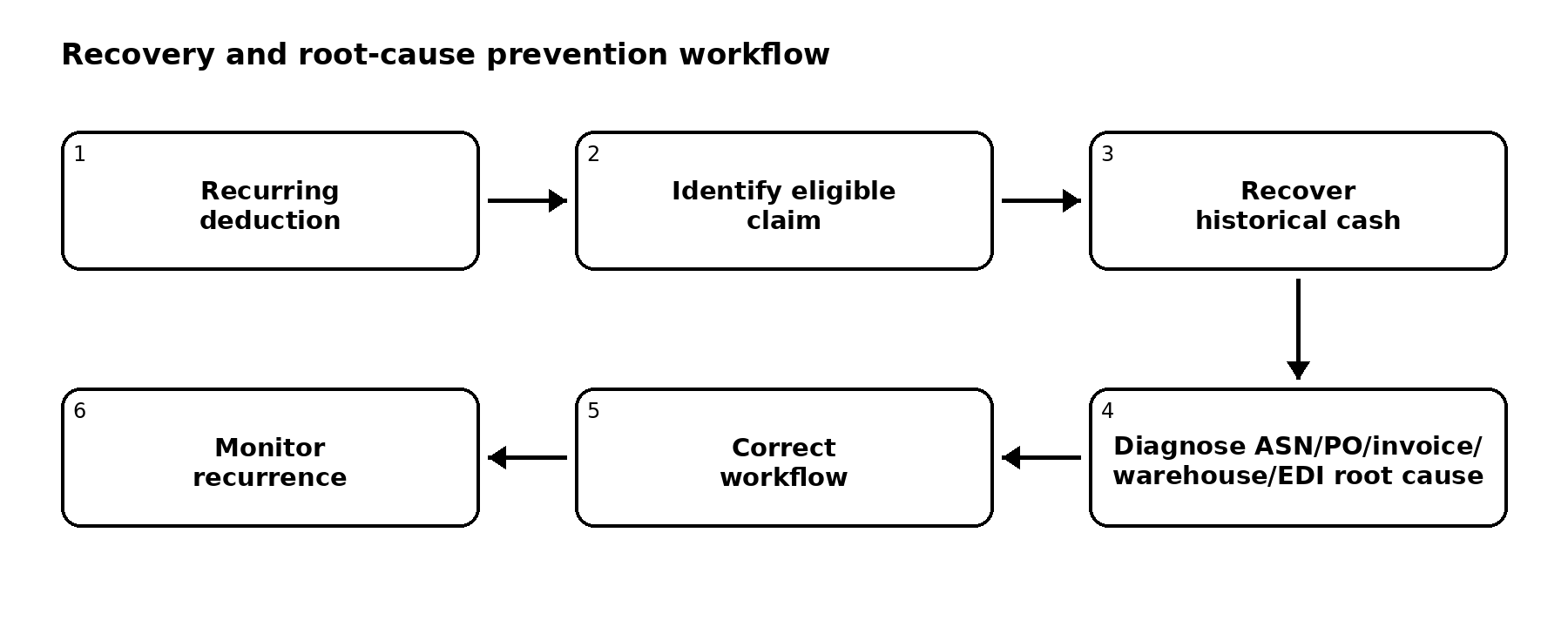
Note: This workflow shows the broader market relationship between recovery and root-cause remediation. SalesDuo’s current role is focused on operational diagnosis and remediation rather than standalone chargeback recovery.
That is why EDI belongs in provider evaluation even though this page should not become an EDI guide. For implementation details, use Amazon EDI for Vendor Central.
Brands needing broader Amazon 1P management rather than specialist recovery should compare Vendor Central management services instead.
If recurring deductions are connected to broader Vendor Central operations, review SalesDuo’s support for shortage claims, EDI, PO processing, ASN accuracy, invoicing, and operational remediation.
What to verify before signing
A provider comparison should end with harder questions than “What percentage do you recover?”
Scope and exclusions
Ask which deductions are included and which are not. Distinguish chargebacks, shortages, co-op deductions, accruals, pricing disputes, and any other recoveries instead of lumping everything under “Vendor recovery”.
Lookback and dispute eligibility
Don't copy a single public lookback number across every Vendor Central deduction type.
Ask the provider to document:
- how far its audit will review;
- which deduction categories remain eligible;
- which deadlines come from Amazon;
- which historical recoveries rely on exceptions or escalation.
Verify current rules against Vendor Central documentation before acting.
Pricing
Know what the percentage or fee is calculated on.
A 15% success fee on cash actually recovered is different from a fee on identified opportunity. Ask about minimums, platform fees, retainers, contracts, and fees for Amazon-initiated reimbursements.
Evidence and duplicate controls
Establish who is responsible for gathering PODs, BOLs, invoices, carton details, ASN information, and similar documentation.
If filing is automated, ask what prevents:
- duplicate claims;
- already-resolved claims;
- ineligible submissions;
- weak evidence from being filed at scale.
Access and security
Ask which permissions the provider needs and why before granting Vendor Central or financial-data access.
Ask:
- Can access be role-limited?
- Who can view financial data?
- How is access revoked?
- What data is retained after termination?
Reporting, SLA, and offboarding
A useful report would break down amounts detected, submitted, rejected, approved, expired, and recovered. Also confirm what responses you can expect, how often you report, who owns escalations and contract termination, and whether you can take historical claim data with you when you leave.
Prevention
Lastly, ask who owns the problem post-recovery.
If ASN, PO, warehouse, labeling, invoice, or EDI errors are causing repeated deductions, does the provider correct those processes, or does it report the trend?
Amazon Vendor Chargeback Recovery Provider RFP Checklist
Before choosing a provider, ask the same questions of every company on your shortlist:
- Which Amazon Vendor Central chargebacks, deductions, shortages, accruals, or co-op claims are included in your service?
- Which deduction categories or claim types are excluded?
- How far back will you audit, and how do you determine whether older deductions are still eligible?
- How do you define the eligible claim universe used to calculate any recovery-rate percentage?
- Is your fee based on amounts identified, amounts disputed, or cash actually recovered?
- Are there setup fees, minimum commitments, retainers, subscription charges, or other costs beyond the recovery fee?
- Who collects and owns supporting evidence such as invoices, BOLs, PODs, ASN data, carton information, and shipment records?
- How do you prevent duplicate, previously resolved, expired, or ineligible claims from being submitted?
- What Vendor Central, financial, ERP, warehouse, EDI, or shipment-data permissions do you require?
- Can you limit access by role, and how is account access revoked when the engagement ends?
- What does your reporting show for identified, submitted, approved, denied, expired, and recovered claims?
- What reporting cadence, response time, and escalation process should we expect?
- Can we export our complete claim history, evidence, and reporting data if we terminate the service?
- Do you only recover historical deductions, or do you also identify and correct root causes such as ASN, PO, invoice, labeling, warehouse, or EDI errors?
- What case evidence can you provide showing the recovery amount, timeframe, eligible claim scope, denominator, and fee basis behind your reported results?
A provider that cannot answer these questions clearly may still be capable. Still, you will have less evidence for comparing its net recovery value, operational fit, and data-control risk with other options.
How to calculate net recovery value
Headline recovery percentages can hide the economics that actually matter.
Use:
Estimated net recovered value = (Eligible disputed amount × Realized recovery rate) − Provider fees − Incremental internal implementation cost
For illustration, assume:
- $100,000 eligible disputed amount;
- 60% realized recovery;
- 15% success fee.
Gross recovery would be $60,000.
A 15% fee on that recovery would be $9,000.
Estimated net recovery would therefore be $51,000 before internal implementation costs.
These figures are assumptions for illustrative purposes, not SalesDuo results or an industry standard.
The denominator matters just as much as the recovery percentage. A provider with an 80% recovery rate on highly pre-screened claims might bring in less total revenue than one with a 55% recovery rate across a wider valid claim universe.
Prevention can also have a big impact on the economics. The economic value of preventing a recurring leakage from an ASN or reconciliation process can be greater than the cash generated from historical claims.
Which option should you choose?
Choose based on the problem you need solved.
A recovery specialist makes sense when historical cash recovery is the priority.
Software works when a capable internal team needs better visibility and reconciliation.
A full-service Vendor Central operations partner becomes more relevant when recurring deductions are connected to ongoing shortage, PO, EDI, ASN, invoicing, or other operational problems.
The goal is not to find the provider advertising the highest recovery percentage. It is to identify the model that creates the strongest net recovery, evidence quality, operational control, and prevention value for your business.
If recurring deductions appear to be connected to EDI, PO processing, ASN accuracy, invoicing, shortages, or other Vendor Central operational issues, you can book a 1:1 Growth Call with SalesDuo to review the underlying process and identify where operational improvements may be needed.
When evaluating chargeback support, ask how an Amazon agency handles the operational issues behind deductions, not just the disputes that follow.
Frequently Asked Questions about Amazon Vendor Cargeback Recovery Services
What does an Amazon Vendor chargeback recovery service actually do?
It identifies potentially recoverable Vendor Central deductions, scrutinizes the supporting data, drafts or submits disputes, monitors Amazon’s decisions, and reports on recovered funds. Certain providers also audit shortages or co-op deductions. Full-service vendors can also deal with the operational reasons for repeat charges.
What is the difference between an agency, recovery specialist, and software platform?
A recovery specialist mainly focuses on identifying and recovering eligible deductions. A full-service Vendor Central operations partner focuses more broadly on the processes that can contribute to recurring deductions, such as EDI, PO, ASN, invoicing, and operational workflows. Software provides reconciliation and monitoring while leaving more investigation and execution with your internal team.
How much do Amazon Vendor chargeback recovery services cost?
Prices vary from one provider to another. RefundPros currently charges a standard 15% commission on recovered reimbursements, while TrueOps charges 10% on successful 1P claims under their launch pricing. Other providers use custom, subscription, retainer, or percentage-based models.
How far back can Amazon Vendor chargebacks be disputed?
It may vary depending on the type of deduction, Amazon’s current policies, the documentation, and the provider’s stated service scope. Don’t assume one-size-fits-all lookbacks. For example, RefundPros says its audits are generally 6–12 months long, but some claim types can exceed that period. Verify real eligibility with the most up-to-date version of Vendor Central documentation before relying on a marketing window from a provider.
What proof should I ask a recovery provider for?
Ask about the recovered amount, the eligible claim universe, timeframe, claim types, denominator behind any recovery percentage, contracted fee basis, and whether results are gross or net of provider fees. A high recovery percentage without those details is hard to compare.
Can a provider prevent future chargebacks?
Prevention depends on the provider’s scope of service. A recovery specialist may identify a recurring pattern without owning the operational fix. A broader Vendor Central operations partner may instead help address PO, EDI, ASN, invoicing, warehouse, or reconciliation issues that contribute to repeat deductions.
How are shortage claims different from chargebacks?
They relate to vendor deductions but stem from different issues. Shortage claims generally concern Amazon recording fewer units than the vendor says were shipped. Chargebacks more often relate to operational or compliance requirements. For deeper coverage, see Vendor Central shortage claims or compare Amazon shortage claim agencies.
Are Amazon Seller chargebacks the same thing?
No. Amazon’s public Seller documentation describes chargebacks as cardholder disputes initiated through the customer’s bank. For that separate process, see Seller Central credit-card chargebacks.
When should recovery stay in-house?
Keeping recovery internal can work when deduction volume is manageable, evidence is organized, deadlines are consistently monitored, and your team understands both dispute rules and root causes. Outsourcing becomes more attractive when claim volume, fragmented data, manual reconciliation, or recurring operational failures consume significant internal time.
About the Author
Meet Paulami Karmakar, an Amazon Content Expert, who specializes in strategizing and crafting powerful SEO content that enhances product visibility, enriching customer experience, and boosting sales on Amazon and Walmart across continents. With a passion for innovation and a commitment to excellence, Paulami consistently creates customized strategies that achieve measurable success. Outside of her work, she finds joy in painting, handcrafts, yoga, and music.
If you would rather hand the whole channel over, our Amazon agency team runs strategy, ads and operations end to end. Brands that want every lever in one place use our full-service Amazon agency.