
Amazon Buy Box Percentage: What It Means and How to Improve It in 2026

Amazon Featured Offer rate, still widely known as the Buy Box rate, represents the share of product page visits where your offer was displayed as the Featured Offer.
No single “good” percentage fits every seller. Read the number in context by looking at the ASIN, competition, traffic, delivery speed, stock, and margin.
If your percentage drops, do not lower your price right away. First, check what is actually causing the popular products may account for the majority decline. The issue may be price, delivery, inventory, account performance, or another offer-level problem.
This guide explains how to improve Amazon Buy Box percentage as a useful business metric without turning it into a race to the lowest price.
For a broader explanation of how Amazon selects the Featured Offer, see SalesDuo’s guide to how Amazon selects the Featured Offer. This page focuses on the percentage itself, how to diagnose changes, and what to do next.
Quick Answer: How to Read Your Featured Offer Percentage
| Reader question | Practical answer |
|---|---|
| What does the percentage measure? | The share of page views for active products where your offer was the Featured Offer. |
| Is there one good benchmark? | No. Compare by ASIN, competition, traffic mix, margin, and your own past performance. |
| What should I check first after a drop? | Affected ASINs → total price/reference price → delivery promise → stock → order/customer performance → suppression or recovery path. |
| Should I lower price immediately? | No. Check the price gap and your contribution floor first. A non-price issue may be causing the drop. |
What Featured Offer Percentage Measures
Featured Offer percentage is based on traffic.
It does not measure the exact amount of time you “held the Buy Box.” It also does not show the percentage of ASINs with an eligibility checkmark.
High-traffic products have a bigger effect on the account-wide number than low-traffic products because the calculation is based on page views.
The Current Amazon Formula
Featured Offer percentage = (page views where your offer was the Featured Offer / total page views received by active products you list) x 100
Amazon staff guidance says it includes only active products.
That matters because one high-traffic ASIN can move the account-wide percentage much more than several low-traffic ASINs.
Amazon’s Featured Offer percentage explanation confirms that the metric is based on page views.
Where to Find It in Seller Central
Utilize the Featured Offer percentage that is available in Seller Central reporting.
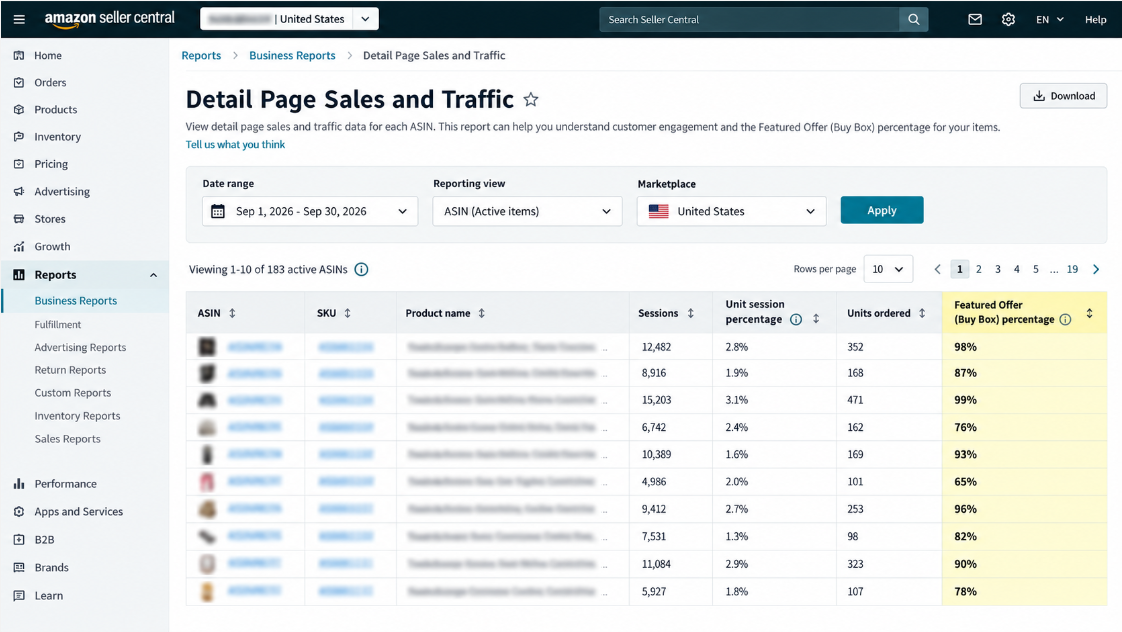
Remember to check it against your chosen date range and the traffic behind each of your ASINs. The names of reports and menu items may change in Amazon's interface, so verify the current US interface before building a locked-down set of steps for your team.
For more context on Amazon performance metrics, see the Amazon Seller Performance Metrics guide.
What Is a Good Amazon Buy Box Percentage?
A good Buy Box percentage depends on your catalog and business goals.
Amazon does not publish a single percentage every seller should target.
The right level depends on factors such as:
- how many sellers compete on the ASIN;
- where the traffic is going;
- your pricing approach;
- your delivery promise;
- your stock position;
- the margin you need to protect.
Why There Is No Universal Healthy Percentage
Two sellers can have the same Featured Offer percentage and still be in very different situations.
A reseller on a heavily contested ASIN may have a lower percentage but still earn healthy profit.
A private-label brand with no competing seller may still have less than 100% Featured Offer share if Amazon does not select the offer on every page view because of price, delivery, stock, or other offer-level conditions.
Avoid treating 80%, 90%, or any other number as a universal target.
That can push teams to cut price when the real problem is elsewhere.
How to Set an ASIN-Specific Baseline
- Compare the ASIN’s current percentage with its own 30-day and previous-period results.
- Look at page views. A 20-point drop on a high-traffic ASIN matters more than the same drop on a low-traffic product.
- Check whether other sellers are competing on the listing.
- Review conversion and contribution per unit with the percentage.
- Watch for major changes such as a new competitor, price issue, slower delivery, or low inventory.
Why Your Buy Box Percentage Changes
Most meaningful changes can be checked through four main areas:
- total price;
- delivery;
- stock;
- order performance.
Amazon’s guidance for the April 2026 Featured Offer focuses on these factors, which directly impact customers, not on providing exact algorithm weights.
Amazon’s current Featured Offer guidance emphasizes customer-facing factors such as competitive pricing, delivery speed, and performance rather than publishing exact algorithm weights.
Price and Reference-Price Competitiveness
Start with total price, including shipping.
Amazon points sellers to competitive external prices, reference prices, and Pricing Health when an offer is not being featured.
Price can matter, but matching the lowest offer alone isn't a complete strategy.
You still need a clear margin floor and a reason to believe that gaining more Featured Offer share is worth the profit you may give up.
Delivery Promise and Shipping
Fast, free shipping and predictable delivery dates can also increase your odds of being featured.
Don’t assume FBA is always better than FBM. Amazon’s April 2026 guidance states that seller-fulfilled offers can continue to compete if they can deliver and provide good service.
For a deeper comparison, see the FBA vs FBM guide.
Stock and Buyability
An out-of-stock offer cannot be featured.
Low inventory can also create other problems, such as slower delivery or the need to protect remaining units.
If stock is the issue, fix forecasting and replenishment before using price as the first solution.
SalesDuo’s Amazon inventory management guide covers this in more detail.
Customer and Order Performance
Amazon also looks at the customer experience around orders.
Accurate fulfillment, correct item condition, and strong service performance can all matter.
If Featured Offer percentage drops at the same time as account-health issues, check those problems before assuming price is the cause.
If the Featured Offer disappears completely instead of slowly dropping, use the lost Featured Offer diagnosis rather than treating it as a normal percentage change.
How to Improve Buy Box Percentage Without Hurting Margin
The safest approach is simple:
- Identify the ASINs responsible for the drop.
- Pinpoint the real issue.
- Fix the non-price problems first.
- Only adjust the price within an approved contribution floor.
This keeps Featured Offer percentage useful as a business signal and prevents it from becoming a vanity metric.
Start With the Affected ASINs and Page-View Context
Don't start with the account-wide percentage alone.
Start with the ASINs that have the most page views and the biggest drop in Featured Offer share.
A few high-traffic ASINs may account for a large share of the page views behind the account-level percentage.
Fix Non-Price Problems Before Lowering Price
Check whether the real issue is:
- stock;
- delivery promise;
- account or order performance;
- missing Featured Offer placement.
A price cut will not fix an out-of-stock ASIN or a slower delivery promise.
If you can see a clear operating problem, fix that first.
Use Pricing Automation With a Floor, Not a Race to the Bottom
Here is a straightforward example.
A product is sold for $30. Variable cost per unit is $22. The seller wants a contribution of at least $4.
That results in a simple floor price of $26.
If a competitor is selling at $25.50, automatically undercutting that offer would push the seller below the planned floor.
Don’t slash the price straight away; just check delivery, stock, and account performance first.
| Illustrative input | Amount | Decision use |
|---|---|---|
| Current selling price | $30.00 | Starting point |
| Variable per-unit costs | $22.00 | Product, referral, fulfillment/shipping, and other variable costs in this simple example |
| Required contribution | $4.00 | Seller-defined minimum contribution |
| Simplified floor | $26.00 | Do not price below this floor without reviewing the economics |
| Competing offer | $25.50 | A lower competitor price alone does not justify an unprofitable response |
If pricing automation makes sense for your account, set it around your own limits.
See Amazon Automate Pricing for setup guidance, or compare Amazon repricer tools if you are considering outside software.
How to Track Percentage Over Time
Track Featured Offer percentage as a trend, not as a one-day score.
The most useful view combines it with:
- page views;
- conversion;
- contribution;
- delivery;
- stock.
This helps you understand whether a percentage change really matters and whether your response improved the business result.
Read Percentage With Traffic, Conversion, and Contribution
| Signal | What it tells you | What to do |
|---|---|---|
| Featured Offer % | How often your offer appeared across relevant page views | Use it to spot changes, not to judge profit by itself |
| Page views | How much traffic sits behind the percentage | Focus on high-traffic ASINs first |
| Conversion | Whether the page turns traffic into orders | Separate Featured Offer access from conversion problems |
| Contribution per unit | Whether gaining more share is financially useful | Avoid price moves that hurt margin too much |
| Delivery/stock / performance | Whether a non-price issue may be limiting placement | Fix the operating problem before repricing |
When Monitoring Software Is Worth Adding
Software becomes more useful when:
- the catalog is too large to review manually;
- Featured Offer ownership changes often;
- several team members need alerts and reporting.
For portfolio-level reporting, see SalesDuo’s Buy Box analytics and reporting strategy.
For software comparisons, see the Buy Box tracking tools comparison.
What Changed in 2026 About Featured Offer Eligibility
Amazon announced that it began removing seller-level Featured Offer eligibility requirements in July 2026.
The rollout is planned across Amazon stores worldwide through the end of 2026.
This removes the first seller-level eligibility step, but it does not mean every offer will automatically appear as the Featured Offer.
Amazon says offer selection still depends on customer-focused factors such as:
- competitive pricing;
- delivery speed;
- performance.
During the 2026 rollout, sellers should avoid treating older seller-level eligibility rules as a permanent requirement.
Instead, focus on whether each offer is actually being selected.
30-Minute Featured Offer Percentage Diagnostic
Use this process when your percentage drops.
The goal is to find the most likely cause before making a major price or margin change.
- Find the ASINs causing the movement. Start with the products that have the most page views and the biggest percentage drop.
- Compare total price and reference-price signals. Note the gap, but do not lower the price yet.
- Check delivery promise and reliability. Look at what the customer actually sees.
- Check stock and buyability. Fix out-of-stock or limited inventory before testing price.
- Review account-health and order-performance signals.
- If the Featured Offer has disappeared, use the recovery process instead of normal percentage tuning.
- Choose one first action. Measure the result and protect your contribution floor before making another change.
| ASIN diagnostic field | Record this | Why it matters |
|---|---|---|
| 30-day page views | Current and previous period | Shows how much traffic sits behind the percentage |
| Featured Offer % | Current and previous period | Measures the size of the change |
| Total price / reference-price gap | Observed difference | Helps test whether price may be the issue |
| Promised delivery | Current customer-visible promise | Helps test delivery competitiveness |
| Stock / buyability | In stock, limited, or unavailable | Separates stock problems from price problems |
| Performance signal | Relevant account/order issue, if any | Shows possible customer-experience problems |
| Contribution floor | Approved minimum price | Helps prevent margin-damaging repricing |
| First action + owner | One controlled change | Makes the next result easier to understand |
If the cause involves pricing, inventory, fulfillment, and account health at the same time, a broader Amazon account management process may be more useful than focusing on one metric alone.
Use Featured Offer Percentage as a Decision Signal, Not a Target
Featured Offer percentage is most useful when it tells you where to look.
Start with the ASINs that bring in the most traffic. Then check whether price, delivery, stock, or performance is limiting placement.
Protect your contribution before changing price.
This approach can help improve Featured Offer share without turning the metric into an expensive target.
For broader support, review SalesDuo’s Amazon Account Management service.
Tracking Buy Box percentage alongside inventory, pricing, and advertising gives a full-service Amazon agency the context to manage account priorities together.
Book Your 1:1 Growth Call and bring the affected ASINs, percentage trend, price and margin limits, delivery promise, and stock position.
Frequently Asked Questions about Improve Amazon Buy Box Percentage
What Is Amazon Buy Box Percentage?
Amazon Buy Box percentage, now called Featured Offer percentage, measures the share of page views for active products where your offer appeared as the Featured Offer.
It is based on page views. It is not the percentage of time you held the Buy Box.
What are Good Buy Box Percentages on Amazon?
There is no universal good percentage.
Compare each ASIN with its own history, competition, page views, delivery, stock, and margin.
A lower percentage can still make business sense if protecting profit is the better decision.
How Is Featured Offer Percentage Calculated?
Featured Offer percentage equals the number of page views where your offer was the Featured Offer divided by the total page views obtained by active products you list, multiplied by 100.
Why Is My Buy Box Percentage Low If I Am the Only Seller?
Being the only seller does not guarantee Featured Offer placement on every page view.
Price or reference-price issues, delivery speed, stock, and other offer-level conditions can still reduce or remove placement.
How Do I Improve My Amazon Buy Box Percentage Without Lowering Price?
Start with non-price issues.
Check delivery, inventory, order performance, and whether the Featured Offer is present.
If price is the real issue, only change it within an approved contribution floor.
Where Can I Find Featured Offer Percentage in Seller Central?
Utilize Seller Central reporting to monitor Featured Offer percentage.
Analyze the data for the selected date range and ASIN traffic. Note that Amazon may change report names and menu options, so verify the current US interface before building a permanent navigation guide.
Did Amazon Remove Buy Box Eligibility Requirements in 2026?
Amazon began removing seller-level Featured Offer eligibility requirements in July 2026, with a global rollout planned through the end of 2026.
Offer-level selection still applies, and being considered does not guarantee placement.
Does FBA Automatically Improve Buy Box Percentage?
No.
Amazon says seller fulfillment can also compete when the offer is strong on delivery and service.
Customer-visible delivery speed, free shipping, reliability, price, and performance matter more than assuming one fulfillment method always wins.
About the Author
Meet Nandita Nair, an Associate Content Writer at SalesDuo, passionate about creating impactful content that helps Amazon businesses grow and thrive. When she’s not writing, she finds joy in listening to music, exploring art, and getting lost in the world of novels.