All-Online Engagement Model for Faster Amazon Execution

On Amazon, delays can cost money. If an issue takes hours or days to notice, approve, and fix, a brand may lose sales, waste ad spend, lose visibility, or create more operational work.
SalesDuo’s all-online engagement model is built to reduce these delays. The goal is to speed up the full process: detect, triage, approve, fix, verify.
The model brings together three main parts:
- Slack-first collaboration for communication, approvals, and managing daily work.
- Ethan, an AI reporting and alerting system that sends clear performance updates, unusual activity alerts, and operational notifications into the same place where decisions are made.
- Cohesity, a content integrity workflow that finds and tracks differences between catalog information and live detail pages. It focuses on important fields such as titles, bullets, and key attributes so teams can fix problems in a planned way instead of reacting at the last minute.
This case study explains why speed matters on Amazon, how this workflow works, and how a faster execution model can reduce avoidable business risk. It does not include account names or account-specific performance numbers.
The Economic Cost of Delay on Amazon
Slow action can cost money in three main ways: products may become unavailable, ad money may be wasted, and content changes may reduce product visibility.
Inventory problems are a big issue in retail. IHL’s 2023 inventory distortion research estimates that inventory problems cost about $1.77T worldwide. Out-of-stock products account for about $1.2T of that amount, while too much stock accounts for around $562B. This shows how costly inventory problems can be.
On Amazon, the Buy Box is one of the main ways customers buy a product when several sellers offer the same item. Industry sources often say that more than 80% of sales happen through the Buy Box. So, if a product loses the Buy Box or becomes less competitive, sales can drop.
Advertising can also become less effective when account conditions change. Amazon Advertising says Sponsored Products ads only appear when the product is in stock. But brands may still waste money on other ad types, or suffer from slow action, if they don't notice stockouts or Buy Box changes quickly. Ad spend can also be wasted when inventory is running low, and campaigns aren't adjusted in time.
One simple way to understand the cost of a delay is to look at the contribution margin at risk.
Contribution margin at risk per hour = (average revenue per day x contribution margin %) / 24
Margin leakage from delay = contribution margin at risk per hour x hours unresolved
This calculation is intentionally simple. It helps teams treat resolution time as something that affects money, not just a service metric.
The Challenge: Amazon Issues Do Not Wait for Weekly Reporting
Many Amazon programs depend on weekly or monthly reports. These reports are useful for reviewing performance, but Amazon problems can happen at any time.
- Content changes can reduce relevance and visibility before problems show up in regular reports.
- Buyability, pricing competitiveness, and policy problems can appear suddenly. The longer they stay unresolved, the more sales they may affect.
- Advertising problems can grow every day when bids and budgets aren't adjusted quickly enough based on performance or account conditions.
In most cases, slow execution comes from three areas: slow communication and approvals, late problem discovery, and slow fixes because ownership or follow-up is unclear.
SalesDuo All-Online Engagement Model
SalesDuo’s model is designed to keep work moving without waiting for meetings or scheduled reports. It combines a human execution team with an AI reporting and monitoring system inside one collaboration workflow.
Slack-first collaboration
Slack is used as the main place where requests are shared, discussed, approved, completed, and closed as part of the broader Amazon account management workflow.
The main benefits include:
- Requests can quickly reach the correct owner, such as the ads, catalog, or operations team.
- Approvals can happen in the same conversation, reducing delays and making decisions easier to track.
- Teams have a searchable record of decisions, updates, and next steps.
- There is less waiting between finding a problem and taking action compared with email-based communication.
This is about more than choosing one messaging tool over another. Slack reduces the time between finding a problem and deciding what to do next.
Ethan AI reporting and alerting
Ethan is designed to reduce the gap between what is happening in an Amazon account and what teams see in regular reports.
It shares clear updates where the team works, so everyone can quickly understand what changed and what needs to happen next.
Ethan can provide:
- Regular performance summaries, such as weekly reports.
- Alerts when important metrics change or unusual activity needs attention.
- Operational notifications that show which tasks need follow-up.
- Recommended next steps that help turn reporting into action.
Sending reports and alerts directly into Slack reduces the need to chase people for updates. It can also make approvals faster because the information and the action happen in the same place.
Cohesity content integrity monitoring
Cohesity is a content integrity workflow that checks whether catalog information matches the live product detail page.
It focuses on important fields such as titles, bullets, and key attributes.
Content changes are not always easy to notice. A listing may not show a clear error, but changes to important content can slowly reduce visibility or conversion.
Amazon’s seller guidance explains that customers can find products by searching keywords that match information such as the product title and description. This makes accurate and relevant content important for organic visibility.
Cohesity puts these content issues into one clear list. It shows the problem, which SKU or ASIN is affected, and whether the issue has been fixed. This makes it easier for the team to track and manage problems instead of checking everything manually.
The execution loop: detect, triage, approve, fix, verify
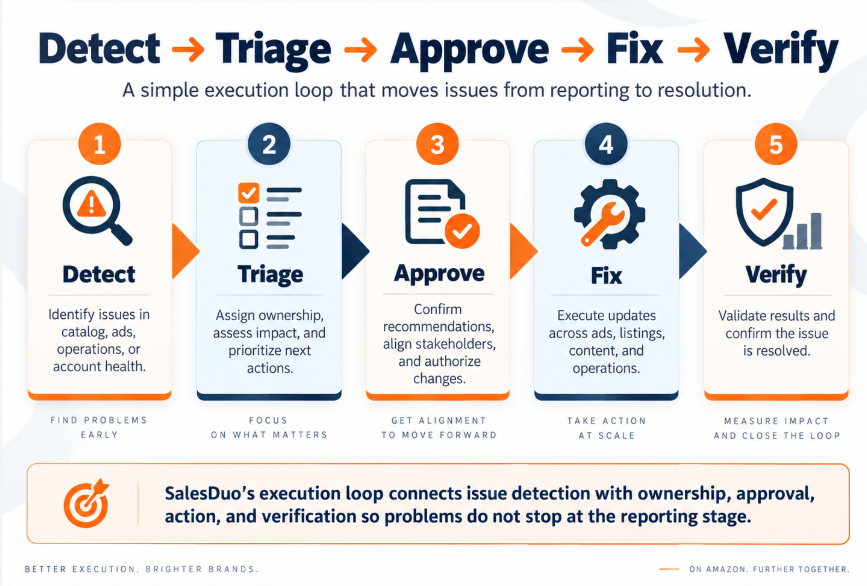
The engagement model follows a clear process that is designed to reduce the time between finding a problem and solving it.
- Detect: Issues are found through Ethan reports and alerts, Cohesity checks, or direct client requests.
- Triage: The issue is sent to the correct team member with the right information and priority.
- Approve: Collect required approvals in the same conversation to reduce wait time and confusion.
- Fix: The right team member makes the needed change, such as fixing catalog content, updating ad settings, or solving an operational problem.
- Verify: The team checks that the change worked, records what was done, and marks the issue as complete.
How delays typically create financial leakage
Slow execution can affect a business in several ways at once.
- Revenue exposure: Buyability problems, competitive changes, or stockouts can reduce sales. Because the Buy Box is such an important buying path, these issues can have a larger impact.
- Efficiency exposure: When account conditions change, such as low inventory, advertising may become less efficient if the team does not respond quickly. Industry guidance also warns that some ad types may continue spending during low-stock or out-of-stock situations.
- Discoverability exposure: Changes to titles and descriptions may weaken keyword matching and reduce organic visibility over time.
Why communication latency is a root cause
Sometimes teams think they have a strategy problem when the real problem is slow communication.
Email-based workflows can create long gaps between messages. SuperOffice benchmark research reports an average customer service response time of 12 hours and 10 minutes. It also reports that many companies do not respond at all.
In Amazon operations, a delay of several hours can easily become several days once approvals, questions, and team handoffs are added.
A Slack-first workflow is designed to reduce this waiting time by making it faster to acknowledge issues, ask questions, get approvals, and move work forward.
Operational outcomes the model is designed to deliver
An execution-focused operating model is designed to improve measurable Amazon workflow metrics.
These include:
- Time-to-first-response: How quickly a request or alert is acknowledged and sent to the correct person.
- Time-to-approval: How quickly required approvals are received before making a change.
- Time-to-resolution: How quickly an issue moves from detection to confirmed resolution.
- SLA compliance: The percentage of important issues that are reviewed and moved forward within agreed time limits.
- Content integrity backlog health: The number of open Cohesity issues, their type and status, and how quickly they are being closed.
- Reporting-to-action conversion: The percentage of reported issues or opportunities that result in actual action.
Teams can measure these metrics without relying only on customer satisfaction scores. As more incident and portfolio data becomes available, teams can get a clearer picture of what is working and where improvements are needed.
Closing perspective
Amazon performance does not depend only on having the right strategy. It also depends on how quickly and reliably teams can act when real problems happen.
These problems can include content changes, operational constraints, competitive pressure, or daily performance shifts.
SalesDuo’s all-online engagement model is designed to reduce the time between finding a problem and taking action.
Slack-first collaboration helps reduce communication delays. Ethan provides regular reporting, alerts, and recommended actions. Cohesity helps turn catalog monitoring from an occasional check into an organized process.
On Amazon, delays can have a real financial cost. That makes execution speed an important part of overall performance.
An all-online engagement model still needs clear ownership, with a full-service Amazon agency managing advertising, content, search visibility, and operational tasks under one team.
Want similar results for your brand? Book your 1:1 growth call today!
Frequently Asked Questions
How does an all-online engagement model improve Amazon execution speed?
A modern Amazon execution model helps teams work faster by using remote Amazon management, Slack-first Amazon collaboration, and Amazon workflow automation.
This makes it easier to communicate, approve changes, and complete work quickly. It can also improve the overall Amazon account management workflow. SalesDuo brings these processes together in one system.
Why are real-time reporting and AI dashboards critical for Amazon operations?
AI reporting for Amazon sellers and Amazon performance dashboards help teams see important account changes faster.
Real-time Amazon reporting supports data-driven operations and lets teams respond before small problems become bigger ones. It also improves Amazon account transparency by giving teams a clearer view of what is happening.
SalesDuo uses these insights to support faster execution.
How does content and process monitoring reduce operational risks on Amazon?
Amazon content monitoring and Amazon workflow automation help teams find listing problems, support compliance, and fix issues faster.
These systems also improve Amazon account transparency because teams can clearly see what needs attention and what has already been fixed.
SalesDuo uses structured monitoring systems to make this process easier to manage.
About the Author
Rahul is an Associate Customer Success Manager driven by a strong interest in business management and leadership. He focuses on solving complex, analytical eCommerce challenges for clients. Beyond work, he actively pursues learning through reading, public speaking, global affairs, and professional development.